








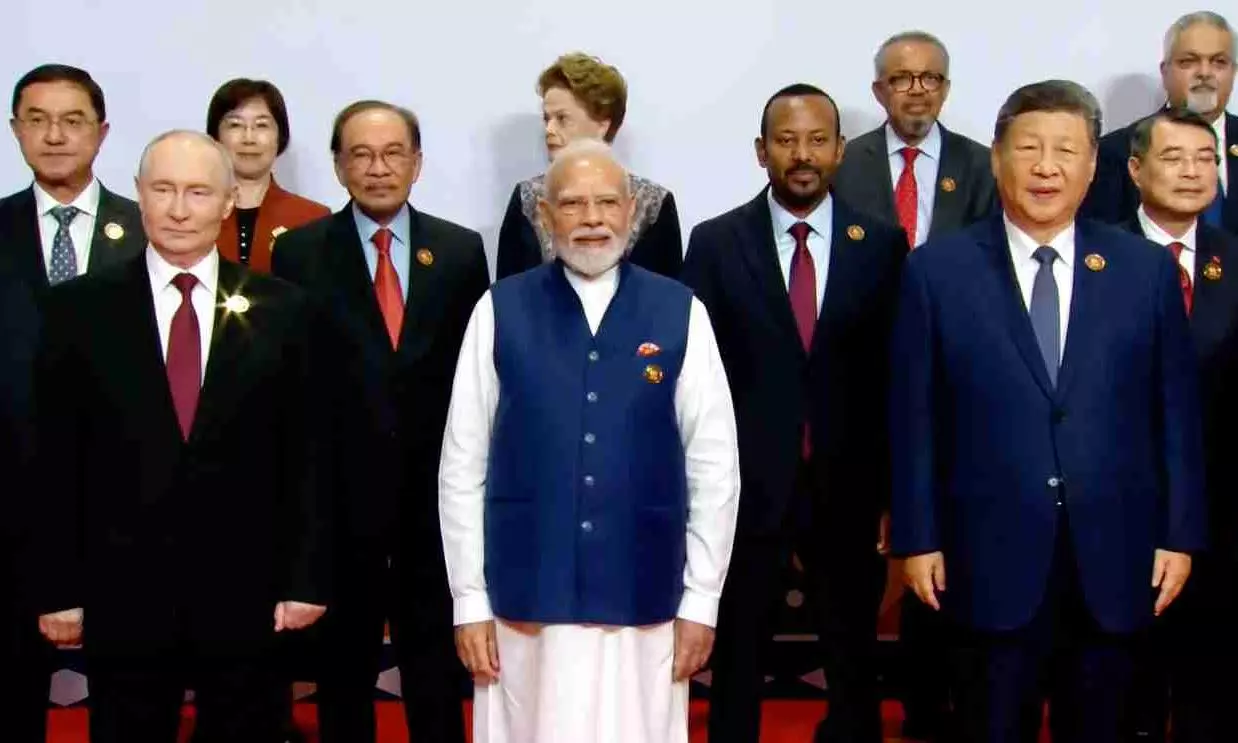
BRICS Summit Day 2 LIVE: Modi urges BRICS unity amid rising global tensions
Two-day 18th BRICS Summit to conclude today after first day marked by joint declaration and a bilateral meeting between PM Modi and China's Xi Jinping

The two-day 18th BRICS Summit 2026 will conclude today (September 13) after the first day was marked by a joint declaration overcoming sharp divisions between Iran and the UAE over the West Asia conflict, and a bilateral meeting between Prime Minister Narendra Modi and Chinese President Xi Jinping.
The world leaders attending the summit are scheduled to hold an open session on 'Resilience, Innovation, Cooperation and Sustainability' during the day.
New Delhi Declaration
On Saturday (September 12), the BRICS grouping adopted a joint declaration that was severely critical of Israel for continuing violence in Gaza and called for fulfilling aspirations of Palestinian people even though it was mum on Russia’s war on Ukraine.
BRICS, without naming the US, also voiced serious concerns over proliferation of “trade-restrictive actions” such as “indiscriminate” tariffs and non-tariff measures as well as protectionism, saying they threatened to further reduce global trade, disrupt global supply chains, potentially exacerbating existing economic disparities.
The grouping came out against “unilateral sanctions” and “coercive measures” that are contrary to international law, in what is seen as a veiled criticism of Western economic sanctions on Russia.
Modi holds talks with Xi
In their talks on the sidelines of the BRICS summit, PM Modi and Chinese President Xi reaffirmed that both the countries should take a strategic and long-term perspective of their ties and differences should not become disputes, according to the Ministry of External Affairs.
PM Modi conveyed to President Xi that peace and tranquillity along the frontier remains “essential” for development of India-China relations, even as the two leaders welcomed “steady progress” in the bilateral ties.
A Chinese readout said Xi made four specific points on promoting the steady and sustained development of China-India relations that included calibrating the direction of the ties with a clear objective to move forward and considering each other as partners rather than rivals.
Modi’s opening address
The two-day BRICS Summit started in New Delhi on Saturday with the theme “Building for Resilience, Innovation, Cooperation and Sustainability”. In his opening address, Modi proposed a 10-point roadmap for global governance reform under the BRICS framework and advocated for a “Seafarers’ Emergency Support Network” to safeguard sailors facing heightened risks from ongoing global and regional crises.
India assumed its fourth BRICS chairship on January 1. The year 2026 also marks a milestone as BRICS completes 20 years since its establishment.
Follow LIVE updates below:
Live Updates
- 13 Sept 2026 4:25 PM IST
Iran Prez urges BRICS to expand trade in national currencies, resist sanctions
BRICS must expand trade in national currencies and work towards an inclusive global economic framework as excessive dependence on existing financial and trade systems has made emerging economies vulnerable to political shocks, Iranian President Masoud Pezeshkian said on Sunday.
In an address at the BRICS summit, Pezeshkian, taking a swipe at Western powers, was also critical of "unilateral sanctions", saying they are directly impacting global food security and people's welfare.
The Iranian leader's remarks came weeks after the US imposed new economic sanctions on Iran, tightening the squeeze on Tehran's finances amid ongoing military hostilities between the two sides.
The BRICS must play a greater role in building a more balanced, inclusive and just international order, the Iranian president said, stressing that resilience, cooperation and sustainability should be translated into practical action.
The Iranian president said economic resilience could not be sustained without security, referring to what he described as the military aggression by the United States and Israel against Iran. The attacks on Iran's economic, energy and development infrastructure could have consequences beyond national borders, creating regional and global repercussions, he said.
Pezeshkian said the Iranian people had paid a heavy price, with civilians killed and infrastructure built over decades damaged. The Iranian president said the international community has a responsibility to protect civilians and prevent the "normalisation of attacks on civilian targets".
- 13 Sept 2026 3:12 PM IST
‘80% Indians are non-vegetarian’: Rahul’s swipe at all-veg BRICS gala dinner menu
Congress leader Rahul Gandhi took a swipe at the menu for the BRICS gala dinner hosted in New Delhi, pointing out that the spread for visiting world leaders appeared to have no non-vegetarian dishes.
Eighty per cent of Indians are non-vegetarian and Indian non-vegetarian food is delicious, Rahul said on Sunday, a day after an all-vegetarian spread was served at a BRICS Summit gala dinner.
Prime Minister Narendra Modi hosted the dinner for the leaders and delegates of the BRICS Summit at the Bharat Mandapam on Saturday.
In a post on social media platforms X, Facebook and Instagram, Gandhi wrote, "For the record: 80% of Indians are non-vegetarian. Indian non-vegetarian food is delicious. As are my sister's chole bhature." He also posted a picture of chole bhature on a dining table.
'Khandvi mille', a feuille steamed gram-flour roll, and 'khumb galouti', pan-grilled mushroom kebabs with mint pearls, were served as starters The main course offered 'paneer lababdar', 'gucchi marmik' -- Himalayan morel mushrooms and tender asparagus -- and 'carrot bean poriyal'.
The other items on the menu included 'thakkali belle saaru' -- light lentil broth, millet pulao, beetroot raita, and assorted Indian breads.
For the desserts, 'Old Delhi fruit cream with jalebi' and 'shahtoot phirni' wrapped up the menu for the VVIP guests.
- 13 Sept 2026 2:28 PM IST
Xi says Global South must defend rule of law, reject ‘might makes right’ at BRICS
Chinese President Xi Jinping on Sunday called on Global South countries to jointly defend the rule of law in international affairs, saying global rules must be written by all countries and applied without double standards. Speaking at Session II of the 18th BRICS Summit, Xi said a world without rules was like “a crossroads without traffic lights”, where chaos and disorder were inevitable, and stressed the need to uphold sovereign equality, non-interference in internal affairs and the peaceful settlement of disputes. He said the logic of “might makes right” had no place in international affairs and should have been discarded long ago.
- 13 Sept 2026 1:48 PM IST
Calibrated capitulation: Congress slams PM Modi after his meeting with Xi
The Congress on Sunday posed four questions to Prime Minister Narendra Modi over his approach to India-China relations, and accused him of "calibrated capitulation" to that country.
Congress general secretary in-charge communications Jairam Ramesh asked whether the PM's "infamous clean chit" to China on June 19, 2020 weaken India and why has he "allowed China's territorial advances in Ladakh and now Arunachal Pradesh".
There was no immediate response from the government or the BJP over the Congress' claims. Ramesh's remarks came a day after Prime Minister Narendra Modi conveyed to Chinese President Xi Jinping that peace and tranquillity along the frontier remains an "essential" basis for development of India-China relations, even as the two leaders welcomed "steady progress" in the bilateral ties.
In a statement posted on X, Ramesh said, "Now that his bilateral summit with President Xi Jinping is over, here are four questions for Prime Minister Narendra Modi to which the nation continues to seek answers. Did not your infamous clean chit to China on June 19, 2020 weaken India?" On the night of June 15-16, 2020, twenty of our soldiers made the supreme sacrifice in hand-to-hand combat with Chinese troops in the Galwan valley, the first such loss of life on the border in 45 years, the Congress leader recalled.
"Just four days later, on June 19, 2020, you inexplicably told an all-party meeting 'Na koi humari seema mein ghus aaya hai, na hi koi ghusa hua hai.' That statement has never been retracted. Has this not greatly weakened our subsequent negotiating position?" Ramesh said.
Ramesh further asked why has the PM "allowed China's territorial advances in Ladakh and now Arunachal Pradesh". Our traditional patrolling and grazing rights across large stretches of Eastern Ladakh have been quietly but definitely "surrendered", he alleged.
- 13 Sept 2026 11:55 AM IST
PM Modi outlines 4 BRICS pillars for inclusive growth
Prime Minister Narendra Modi, in an address on the second day of the BRICS summit on Sunday, said increasing geopolitical tensions are adversely impacting ordinary lives globally, emphasising that BRICS must unite to address these challenges and drive inclusive growth, particularly across the Global South.
The prime minister also flagged serious concerns over the “weaponisation of technology and critical minerals”, saying it could hinder shared progress and prosperity.
Prime Minister Modi outlined a broad agenda to strengthen resilience, innovation, and inclusivity. He framed his vision around four key pillars: Resilient supply chains, innovation and startups, digital agriculture, and sustainability and clean energy.
Key points from his speech:
Supply chain resilience: Announced the BRICS Logistic Supply Chain Cooperation Framework to make global supply chains more reliable.
Startup innovation: Proposed a BRICS Startup Innovation Fund and Incubator Network to connect entrepreneurs and scale solutions.
Digital agriculture: Launched a network aligning AI, geospatial tech, and digital infrastructure with farmers’ needs.
Early warning systems: Consensus on a BRICS Integrated Early Warning System for infectious diseases and disaster data integration.
Skills and MSMEs: Through BRICS Connect, promoted employability, women’s workforce participation, and launched an MSME portal.
Urban mobility: Established a hub to share best practices among cities.
Sustainability: Advanced clean energy via a Digital Centre of Excellence, agro-ecology centres, and climate adaptation principles.
Global South focus: Stressed that BRICS solutions must serve the Global South, turning nations from rule‑takers into rule‑shapers.
Shared future: Concluded that BRICS’ strength lies in diversity and cooperation, ensuring progress benefits all humanity.
Listen to his full speech here:
- 13 Sept 2026 10:57 AM IST
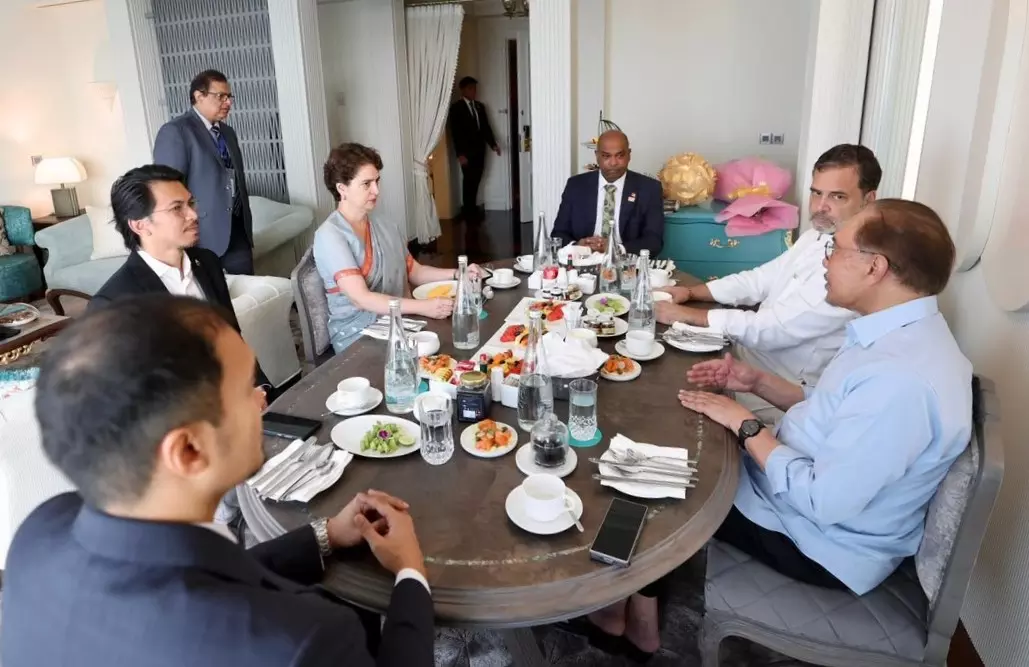
Rahul, Priyanka meet Malaysian PM Anwar Ibrahim over breakfast
Leader of Opposition in the Lok Sabha Rahul Gandhi on Sunday called on Malaysian Prime Minister Anwar Ibrahim for a breakfast meeting and discussed India-Malaysia ties.
Congress general secretary Priyanka Gandhi Vadra was also present.
The meeting comes a day after Prime Minister Narendra Modi and Ibrahim held talks focusing on cooperation in the areas of trade, semiconductors, infrastructure and defence.
- 13 Sept 2026 10:00 AM IST
Tibetan Youth Congress members detained for protest near Bharat Mandapam
Police have detained over 30 members of the Tibetan Youth Congress during a protest near Bharat Mandapam.
The protesters were detained while allegedly demonstrating against the Chinese delegation attending the BRICS Summit in the national capital.
- 13 Sept 2026 8:54 AM IST
What UN reforms did BRICS seek in New Delhi Declaration?
The BRICS nations have sought several structural, administrative, and legal reforms from the United Nations (UN) in the New Delhi Declaration 2026. The primary demands outlined in the document include:
1. Comprehensive reform of the UN Security Council (UNSC)
Increased representation: Expanding the UNSC membership to include more developing countries from Africa, Asia, and Latin America to adequately respond to modern global challenges.
Amplifying the Global South: Ensuring the reform leads to a stronger, amplified voice for the Global South, acknowledging the Ezulwini Consensus and Sirte Declaration regarding African representation.
Support for Brazil and India: China and Russia explicitly reiterated their backing for Brazil and India's aspirations to play a greater role in the UN and its Security Council.
2. Overhauling the UN Secretariat and senior leadership
Ending post monopolies: Implementing a strict rule that no single state or group of states should hold a monopoly over senior administrative and executive posts within the UN system.
Geographical representation: Addressing the persistent underrepresentation of developing nations, particularly at senior and decision-making levels.
Gender inclusivity: Increasing the role and share of women—especially from Emerging Markets and Developing Countries (EMDCs)—at all levels of leadership.
Selection transparency: Demanding that the selection and appointment of the UN Secretary-General and other executive heads be transparent, inclusive, and fully aligned with Article 101 of the UN Charter.
3. Revitalising major UN organs
General Assembly: Pushing for continuous efforts to revitalize the UN General Assembly (UNGA) to boost its authority.
Economic and Social Council: Strengthening the Economic and Social Council (ECOSOC) to make global socio-economic governance more robust.
Peacebuilding architecture: Advancing the full implementation of the 2025 Review of the Peacebuilding architecture.
4. Enforcing UN Charter exclusivity on sanctions
Rejecting non-UN sanctions: Condemning and calling for the elimination of unilateral coercive measures and secondary sanctions.
Upholding international law: Reaffirming strict opposition to any economic sanctions that are not explicitly authorized by the UN Security Council, stating they undermine the UN Charter.
5. Standardizing legal frameworks under the UN
Counter-terrorism: Calling for the expeditious finalization and adoption of the Comprehensive Convention on International Terrorism (CCIT).
Cybercrime and ICT: Underscoring the central role of the UN in forging a universal legal framework for security in Information and Communications Technologies (ICTs) and urging rapid ratification of the UN Convention against Cybercrime.
- 13 Sept 2026 7:50 AM IST
Why Bangladesh PM Tarique Rahman skipped BRICS Summit
Will he? Won’t he? After much speculation over his presence at the 18th BRICS summit in New Delhi, Bangladesh Prime Minister Tarique Rahman decided to give it a miss. What drove his decision? According to senior journalist Subir Bhaumik, it stemmed from a fear of upsetting the United States and its president Donald Trump, alongside a domestic strategy to appease anti-India elements and mask his government’s severe economic failures as Bangladesh faces escalating power shortages, fuel crises, and internal political volatility. Watch the full interview here:
- 13 Sept 2026 7:44 AM IST
Iran, UAE leaders hold talks amid strained ties
Iranian President Masoud Pezeshkian met Abu Dhabi Crown Prince Sheikh Khaled bin Mohamed bin Zayed Al Nahyan in New Delhi on Saturday on the sidelines of the BRICS summit, a significant engagement given recent tensions after Iran targeted US bases in the UAE in retaliation for American strikes.
The meeting comes as Iran prepares to meet Gulf Cooperation Council members and Iraq in Oman on September 14 to discuss a transit agreement through the Strait of Hormuz—the first such dialogue since the outbreak of the West Asia conflict.


