'Wherever Indians go, caste travels with them' | Off The Beaten Track
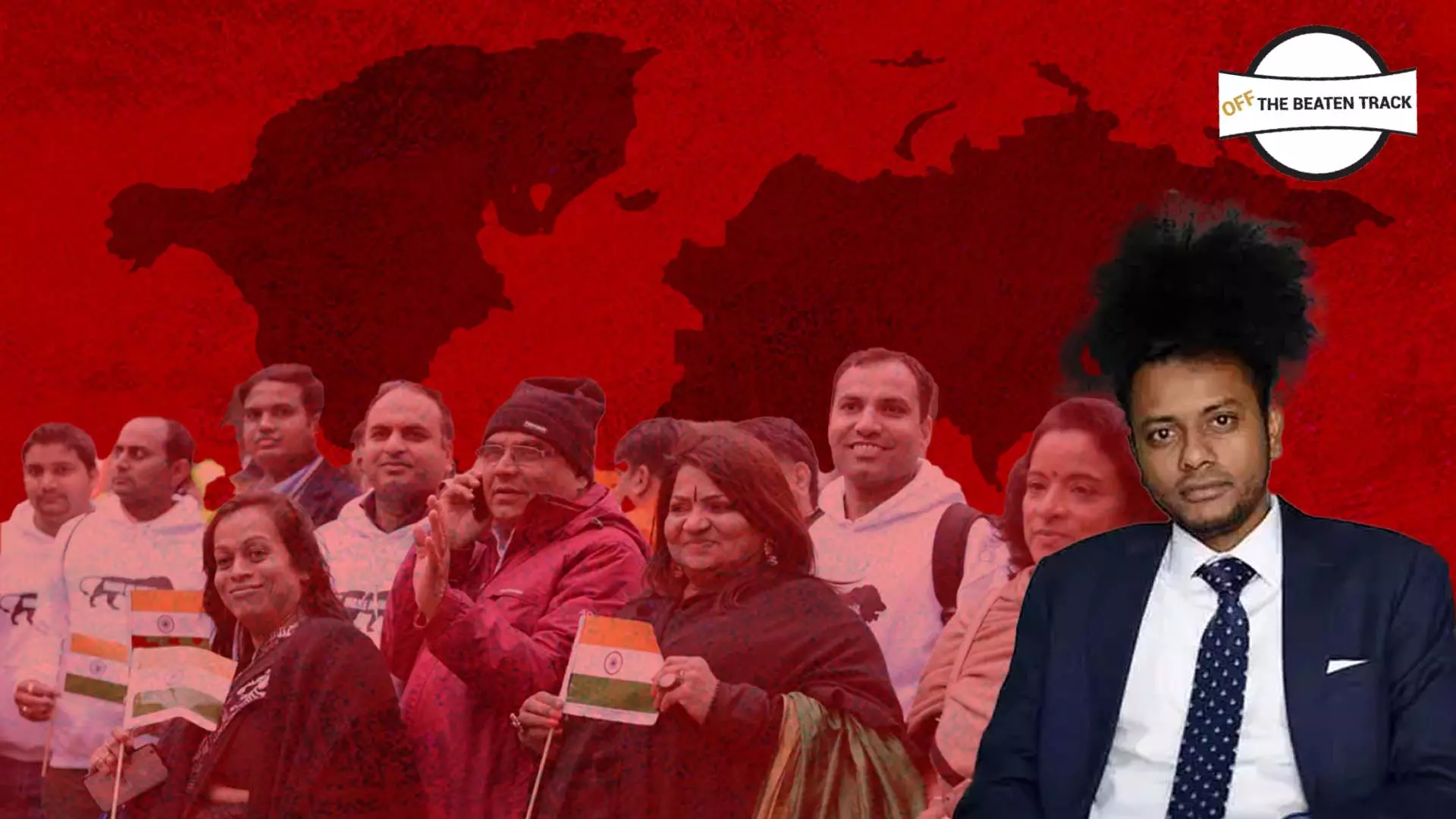
Scholar-author Suraj Yengde explains how caste persists across global Indian diaspora, influencing identity, discrimination and politics beyond India’s borders

“Caste is not something Indians consciously carry abroad—but it travels with them as part of their cultural instinct,” said Suraj Milind Yengde in an interaction, underlining the central argument of his book Caste: A Global Story.
As debates around caste intensify within India—from court rulings to political mobilisation—his work expands the conversation beyond national borders, showing how caste persists and evolves across diasporas.
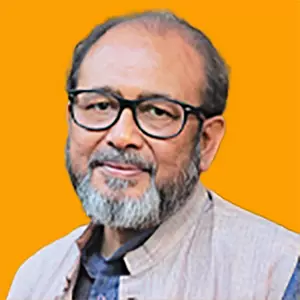
In this episode of Off The Beaten Track, The Federal spoke to Yengde, an Indian scholar, author and activist known for his work on caste and race. He is also an assistant professor of history and African Studies and a Ford Foundation Presidential Fellow at the University of Pennsylvania.
Does caste follow Indians abroad like a birthmark—something inescapable regardless of geography or profession?
I think the migratory aspects of caste were actually documented early on by SV Ketkar, an anthropologist from Cornell. He wrote a succinct text on caste in the early 20th century. Dr BR Ambedkar also picked up on this theory—that caste remains attached to the Indian body politic.
In my research, I’ve covered nearly 15 countries. I’ve interviewed descendants of indentured labourers from Bihar, Uttar Pradesh, Bengal, and Odisha, as well as Gulf migrants and contemporary IT professionals. Across all these groups, caste persists.
Also read: Does caste disappear after conversion? Supreme Court ruling sparks debate
When people leave India, they don’t consciously think they are carrying caste. They carry it as part of their cultural identity, a kind of ‘lightweight carry-on’. But it shapes interactions, relationships, and hierarchies abroad as well.
Caste also evolves in conversation with global structures—colonial histories, white societies, and economic systems. The global caste dynamic is not isolated; it is constantly interacting with other power structures.
How does caste discrimination—especially against Dalits—play out abroad? And what about Dalits who converted to Christianity or Islam?
If you look at history, caste has remained persistent across time and geography. That’s why you can talk about 19th-century Caribbean societies like Trinidad and connect them to contemporary India.
In Trinidad, for example, Dalits and other lower castes were assimilated into a broader national religious identity. Religion there often reflected culture more than rigid hierarchy.
Also Read: Rahul Gandhi slams absence of Bahujans in top institutional positions
But conversion does not erase caste. Along India’s coastal belt—from Odisha to Andhra Pradesh to Tamil Nadu—many Dalits converted to Christianity over 150 years ago. Yet caste identity continues.
Even within Sikh communities abroad, we see caste divisions. In Canada, on remote islands, you find separate congregations formed due to caste discrimination.
Over generations, identity evolves. Diaspora communities become ‘hyphenated’—Indian-American, Indian-Canadian—but caste consciousness doesn’t disappear. In fact, in recent decades, caste awareness has intensified, partly influenced by developments in India.
How are upper-caste diaspora communities responding to growing Dalit assertion globally?
From what I’ve observed, many professionals in the diaspora—especially those from technical fields—come from environments shaped by anti-reservation sentiment.
Some dominant caste individuals resist acknowledging caste discrimination. Their common argument is that they were treated unfairly themselves.
At the same time, second- or third-generation diaspora communities often treated caste as an ‘innocent identity marker’ because Dalit assertion was less visible earlier.
Now, as Dalit communities assert themselves—demanding dignity and equality—this creates discomfort. But assertion is not about pushing anyone back. It is simply about claiming equal space.
The challenge is that many diaspora communities still operate with a frozen image of India—often shaped by post-1947 narratives. When they encounter the realities of caste and inequality, it can be jarring.
Have Dalit movements abroad influenced institutional or legal changes, such as anti-caste policies in universities and cities like Seattle?
Yes, there has been significant movement. I witnessed early discussions at universities like Brandeis, where students shared experiences of caste discrimination.
These efforts led to institutional responses—task forces, policies, and broader recognition of caste as a form of discrimination.
While Dalit voices triggered these discussions, the movement expanded into a broader human rights concern among South Asian academics.
You now see Ambedkarite student groups across the world. Even in places like Kyrgyzstan, students celebrate Ambedkar Jayanti.
This is not just resistance—it’s assertion. Students are saying: ‘This is our culture, our history, our identity. We deserve space too.’
Did your own experience as a Dalit shape how you encountered caste abroad?
Yes, very much. Stigma is not something you can easily shed—it requires deep psychological unlearning.
I grew up in a Dalit colony with open sewage and extreme marginalisation. That environment shapes your consciousness.
For years, I hid my identity—telling people I was from Pune or Mumbai instead of Nanded. It took time to reclaim that identity.
Also Read: Why rush to appropriate late Kanshi Ram in UP reflects broader lack of unifying Dalit face
My work reflects this journey. I call it a kind of ‘cosmopolitan Dalit universalism’—a worldview shaped by marginality but connected globally.
My upbringing also exposed me to global Black movements. My father admired figures like Kofi Annan. That influenced how I understood solidarity between Dalit and Black struggles.
You draw parallels between Dalit struggles and Black movements. How has this played out globally?
The Dalit movement has long relied on literature, poetry, and cultural expression as tools of resistance.
Dalit literary conferences are major events—spaces where communities gather, share, and assert identity.
This mirrors Black cultural movements globally. These spaces are not just artistic—they are political and deeply rooted in dignity and resistance.
For me, growing up in that environment naturally led to comparative thinking. It wasn’t forced—it was part of lived experience.
You describe an ‘irony’ during the global protests after the George Floyd protests. What did you observe?
It was striking. Many Indian elites in the US participated in protests after George Floyd’s killing.
But I asked: What have you done to address caste inequality in your own society?
There is an irony here. By aligning with Black struggles, some elites seek recognition as ‘oppressed minorities’ in the West—while ignoring caste privilege.
Caste creates a worldview where one centres oneself and ignores others’ struggles. That contradiction was very visible during those protests.
How does the Indian diaspora respond to caste violence and politics in India today?
It varies by region and community. Punjabi diaspora communities, for instance, still engage with caste dynamics—Jat assertion and Dalit pushback.
Tamil diaspora groups, including political cadres, also remain connected to caste-based movements back home.
However, the mainstream ‘cultivated diaspora’ narrative—especially under recent governments—often excludes Dalit voices.
There has been no meaningful effort to include Dalits in this global Indian identity.
At the same time, Dalit diaspora communities continue to assert themselves through academic spaces and constitutional values inspired by Ambedkar.
One concerning trend is the emergence of diaspora networks aligned with ideological groups, sometimes monitoring and targeting activists abroad. This raises serious questions about democratic space and freedom.
What is your view on the debate over reservation rights for Dalits who convert to Christianity or Islam?
This is a complex issue. The original policy framework involved multiple leaders, including B. R. Ambedkar, Jawaharlal Nehru, and Vallabhbhai Patel.
The question is not just legal—it’s social and economic. We must ask: How do caste-based inequalities persist within different religious communities?
Dalit Christians and Dalit Muslims often face ‘double marginalisation’—excluded both within broader society and within their own religious communities.
This issue requires national dialogue. It cannot be reduced to a simple yes-or-no policy question.
We also need to recognise regional variations. In coastal regions, caste boundaries between communities have historically been blurred.
Ultimately, the goal should be to address inequality in all its forms, regardless of religion.
The content above has been transcribed from video using a fine-tuned AI model. To ensure accuracy, quality, and editorial integrity, we employ a Human-In-The-Loop (HITL) process. While AI assists in creating the initial draft, our experienced editorial team carefully reviews, edits, and refines the content before publication. At The Federal, we combine the efficiency of AI with the expertise of human editors to deliver reliable and insightful journalism.