








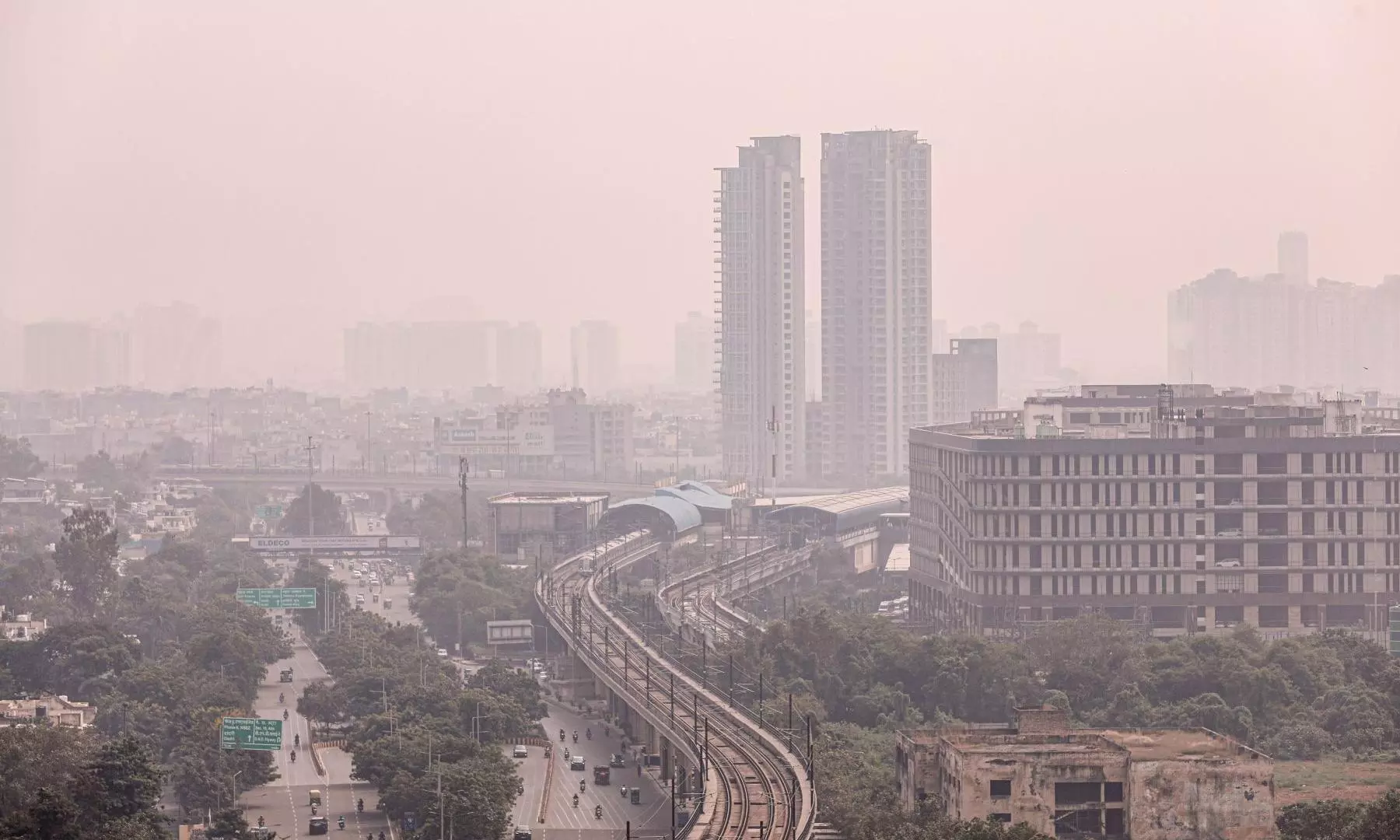
Chronic air pollution | Uttar Pradesh, Rajasthan top list of states: CREA study
The research found that nearly 44 per cent of Indian cities face chronic air pollution, indicating a structural problem driven by persistent emission sources rather than short-term episodes

Uttar Pradesh tops the list of States that face chronic air pollution, according to an analysis by the Centre for Research on Energy and Clean Air (CREA). Using satellite data, CREA assessed PM2.5 levels in 4,041 cities in India.
The report noted that Uttar Pradesh tops the list with 416 non-attainment cities, followed by Rajasthan (158), Gujarat (152), Madhya Pradesh (143), Punjab and Bihar (136 each) and West Bengal (124).
Also read: All major Indian cities recorded unsafe AQI, Bengaluru least affected: Study
The research found that nearly 44 per cent of Indian cities face chronic air pollution, indicating a structural problem driven by persistent emission sources rather than short-term episodes.
PM2.5 standard assessment
"Out of 4,041, at least 1,787 cities exceeded the national annual PM2.5 standard every year from 2019-2024, excluding the COVID-affected year of 2020. This means nearly 44 per cent of Indian cities face chronic air pollution, indicating a structural problem driven by persistent emission sources rather than short-term episodes," the report said.
The PM2.5 assessment for 2025 ranks Byrnihat (Assam), Delhi, and Ghaziabad (Uttar Pradesh) as India's top three most polluted cities with annual concentrations of 100 µg/m³ (Micrograms per cubic meter), 96 µg/m³, and 93 µg/m³, respectively.
Also read: India sets own norms, says global air quality rankings carry no official sanction
Noida is the fourth on the list, followed by Gurugram, Greater Noida, Bhiwadi, Hajipur, Muzaffarnagar, and Hapur.
Cities under NCAP
"Yet, India's flagship National Clean Air Programme (NCAP) covers only a fraction of this burden. Just 130 cities were included under NCAP, and only 67 overlap with the 1,787 persistently non-attainment cities. As a result, NCAP currently addresses only 4 per cent of India's chronically polluted cities, leaving the vast majority outside targeted clean air action," it added.
Non-attainment cities are urban areas identified by the Central Pollution Control Board (CPCB) that consistently fail to meet the National Ambient Air Quality Standards (NAAQS) over several years.
PM level targets
Out of 130 NCAP cities, 28 still lack continuous ambient air quality monitoring stations (CAAQMS), and among the 102 cities with stations, 100 cities reported 80 per cent or higher PM10 levels.
"Progress on PM10 control remains mixed. Twenty-three cities have achieved the revised 40 per cent PM10 reduction target, 28 cities have recorded 21-40 per cent reduction, 26 cities show modest improvements of 1-20 per cent, while 23 cities have in fact experienced an increase in PM10 levels since the programme's inception," the report said.
"For PM10, Delhi tops the list with an annual average of 197 µg/m³, three times the national standard. Ghaziabad and Greater Noida follow with averages of 190 µg/m³ and 188 µg/m³, respectively.
"Rajasthan has the highest number of cities in the Top 50 in terms of PM10 concentration, 18 in total, followed by Uttar Pradesh (10), Madhya Pradesh (5), and Bihar and Odisha (four each)," the report said.
Corrective plans
According to Manoj Kumar, India Analyst, CREA, strengthening the country's air quality governance through targeted, science-based reforms may be the only way forward.
"This means prioritising PM2.5 and its precursor gases (sulphur dioxide and nitrogen dioxide) over PM10, revising the list of non-attainment cities under NCAP, setting stricter emission standards for industries and power plants, allocating funding based on source apportionment studies, and adopting an airshed-based approach to address air pollution at a regional scale," he said.
Also read: Pollution rises in Bengaluru as Metro ridership dips after fare hike, shows data
Since the programme's inception, Rs 13,415 crore has been released under the NCAP and 15th Finance Commission grants, of which Rs 9,929 crore (74 per cent) has been utilised.
Road dust management accounts for 68 per cent of spending, followed by transport (14 per cent) and waste and biomass burning (12 per cent), while industries, domestic fuel use, public outreach (each less than 1 per cent), and capacity building and monitoring (3 per cent) received limited allocations.
(With agency inputs)