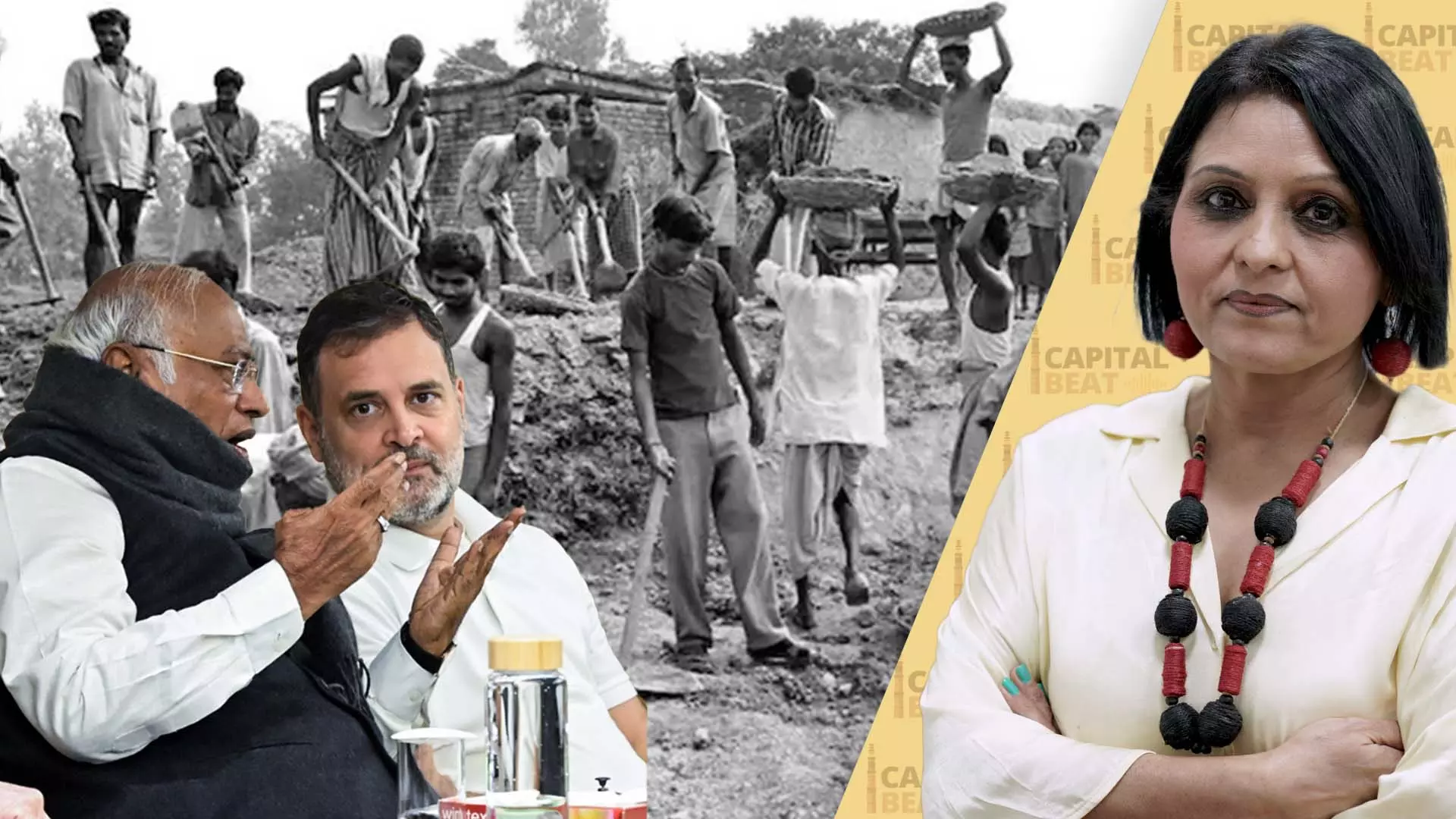
Congress to launch MGNREGA Bachao Abhiyan from Jan 5; will it resonate nationally?
Capital Beat discussion assesses the political and federal implications of scrapping the rural employment guarantee and replacing it with a new framework

In the latest Capital Beat episode, senior editor TK Rajlakshmi and author Pushparaj Deshpande discussed the Congress’s decision to launch a nationwide MGNREGA Bachao Abhiyan from January 5, 2026. The panel examined the Centre’s move to repeal the rural employment guarantee scheme and replace it with a restructured rural jobs framework, and assessed its political and administrative implications.
Congress announces nationwide campaign
The Congress Working Committee (CWC) announced a nationwide campaign, MGNREGA Bachao Abhiyan, to protest against the repeal of the rural job guarantee law. The timeline was disclosed following the committee meeting, with directions issued to state units and party workers to mobilise across the country.
The campaign was presented as a response to what the party described as the scrapping of a long-standing rural employment guarantee and the erosion of employment rights. Public outreach, rallies, and other forms of protest were outlined as part of the campaign to build momentum ahead of the January 5 launch.
The announcement raised questions about whether the new campaign would replace earlier Opposition efforts centred on electoral issues such as Special Intensive Revision, particularly after those debates gained traction during the Bihar elections.
Federal implications highlighted
Deshpande described the repeal as more than an election issue, stating that it represented “an attack on the rights-based paradigm that the UPA government had created between 2004 and 2014.” He identified the issue as federal in nature, pointing to changes in financial responsibility.
“The financial burden of the scheme has been transferred to the states,” he said, adding that a cap on workdays during peak agricultural seasons would place pressure on state governments. He linked this to broader concerns about underfunding of centrally sponsored schemes and limits on tax devolution.
The panel discussion also referenced upcoming Finance Commission considerations and their potential impact on state finances. Deshpande noted that states would have “very limited financial room to actually implement their welfare agendas.”
From demand-based to supply-based model
A central concern raised was the transformation of the employment scheme’s structure. Deshpande pointed out that under the original Act, workers were guaranteed 100 days of employment and an unemployment allowance if work was not provided within 15 days.
“What you have effectively done is turn a demand-based programme into a supply-based programme,” he said. He linked this shift to pressures on rural landless labourers and families dependent on the scheme.
The panel referenced data points discussed during the episode, including claims that 45 to 50 per cent of the population relied on the scheme and that employment and wage growth had stagnated in recent years.
Popularity and reach of the scheme
Rajlakshmi described the rural employment programme as popular because it offered “a fighting chance” to people at the margins. She said it provided “a chance of survival to millions of families who are landless or have very small landholdings.”
She noted that small farmers and even educated youth had relied on the programme due to a lack of alternative employment avenues. The discussion linked rural distress with urban employment pressures, stating that the scheme addressed part of this imbalance.
Rajlakshmi acknowledged delays in payments and said the Centre was responsible for many of them, but argued that delays were not grounds to alter the scheme’s fundamental nature.
Concerns over discretion and allocation
The panel discussed concerns about discretion in the new framework. Rajlakshmi said the revised structure would make work allocation contingent on central decisions, stating, “It will be entirely contingent on the whims of the Centre.”
She warned of possible favouritism at local levels, noting that panchayat heads could gain greater control over work allocation. The discussion also highlighted apprehensions about how capped workdays would be distributed geographically.
Federal tensions were again underlined, with the panel pointing to the requirement for states to shoulder a larger share of costs.
Mobilisation challenges for Congress
Rajlakshmi described the Congress campaign as a necessary political move but stressed the challenges of mobilisation. She said converting the issue into a national movement would require substantial ground-level organisation.
“It will require a lot for the Congress and others in the INDIA bloc to make this into a national issue,” she said. She contrasted the situation with the farm laws agitation, where farmers across categories had mobilised collectively.
The panel noted that agricultural workers and marginal farmers, who were most affected by the changes, were less organised nationally, making mobilisation more complex.
Electoral context and parallel issues
The discussion returned to whether MGNREGA Bachao Abhiyan would overshadow other Opposition issues such as Special Intensive Revision (SIR) and alleged vote theft raised during the Bihar elections.
Deshpande said these issues would continue in parallel, describing SIR as “a thinly veiled CAA-NRC”. He said the framing of SIR had already taken communal overtones in certain regions and would remain relevant in states heading to elections.
He distinguished the two issues by stating that one targeted electoral rights, while the employment issue represented “an economic attack” affecting livelihoods.
Rural distress and consumption concerns
Deshpande cited survey figures discussed on the panel indicating that a large majority of Indian farmers owned less than five hectares of land, with at least one family member dependent on rural employment schemes.
He linked the repeal to broader economic trends, including stagnant wages, rising rural indebtedness, and declining consumption. “MGNREGA was a critical lifeline,” he said.
The discussion described the challenge of organising landless labourers and marginal farmers, noting the absence of a nationwide body capable of rapid mobilisation.
Long-term implications raised
Toward the later part of the episode, Deshpande spoke about longer-term effects beyond immediate elections. He said dismantling the scheme would weaken the idea that the state has duties toward citizens.
He raised concerns about rural-to-urban migration if employment support declined, stating that urban infrastructure was not equipped to absorb a sudden influx of labour. He described potential pressure on cities and services if rural safety nets were removed.
Rajlakshmi echoed that the issue extended beyond electoral calculations. She described it as “a matter of life and death for millions of agricultural workers,” adding that framing it only as an election issue would weaken the seriousness of the response.
Organisational test for opposition parties
The panel concluded by discussing the organisational test the campaign posed for Congress and its allies. Rajlakshmi said the campaign's success depended on energising workers at district and grassroots levels and moving beyond press statements.
She said the southern states might be better positioned due to stronger party structures, while the Hindi belt would require coordination with alliance partners.
The Capital Beat discussion underscored that the MGNREGA Bachao Abhiyan was presented as both a political mobilisation and a response to structural changes in rural employment policy.
The content above has been transcribed from video using a fine-tuned AI model. To ensure accuracy, quality, and editorial integrity, we employ a Human-In-The-Loop (HITL) process. While AI assists in creating the initial draft, our experienced editorial team carefully reviews, edits, and refines the content before publication. At The Federal, we combine the efficiency of AI with the expertise of human editors to deliver reliable and insightful journalism.