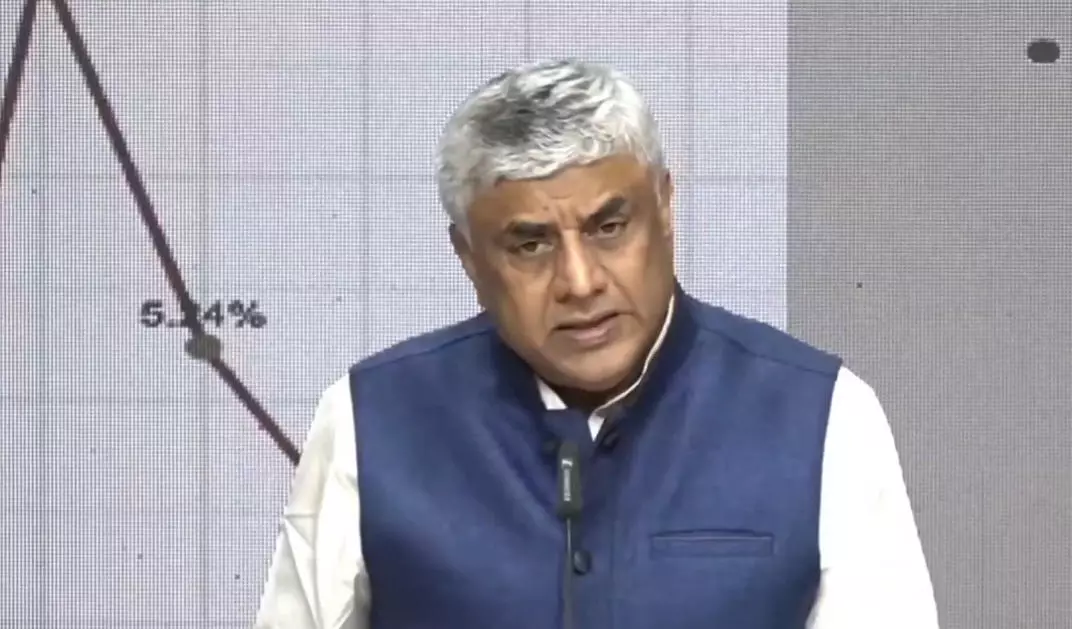
Prof Rajeev Gowda, ex-MP and chairman of the Congress party’s Research Department, presenting the report on Tuesday (Jan 27). Photo: X screengrab | @INCIndia
Congress slams Centre: 'Real state of economy exposes Modi govt's priorities'
The party's report 'Inequality on the rise, Welfare in retreat - Real State of the Economy 2026' highlights rising inequality, joblessness, and questions the government's data credibility, citing an IMF 'C' grade

Ahead of the upcoming Budget session, the Congress on Tuesday (January 27) released a report titled “Inequality on the rise, Welfare in Retreat - Real State of the Economy 2026” that attacked the Modi government for portraying a picture of the economy very different from reality.
The principal Opposition party pointed out that the International Monetary Fund (IMF) has given New Delhi’s statistics a “C” grade due to questions over the credibility of the government’s data, and claimed that thousands of high-net-worth millionaires are fleeing India every year.
The report criticised the government for its “failure” to address basic needs, including health, education, and jobs. The party stated that there has been a “K-recovery” post the Covid-19 pandemic, whereby the top layer of the country is benefitting while the others are languishing.
Increase in inequality
The report claimed there’s an increase in inequality in the country. Prof Rajeev Gowda, ex-MP and chairman of the party’s Research Department, told reporters that “the real state of the economy exposes the Modi government’s priorities”.
“At a time when inequality is worsening, corporate profits are rising, while job creation is not happening. The Modi government is fixated on slashing welfare,” he said.
Also Read: Why IMF says India must fix its data, industry strategy and human capital
In a scathing attack on Prime Minister Narendra Modi, the Congress leader said his government’s policies are dismantling the “social safety net” for the poor, youth, farmers, and women.
Questions credibility of govt data
Gowda raised questions about the credibility of the government’s claims about the economy, and referred to the IMF’s recent decision to award a “C” grade to India’s statistics.
“0.5 per cent inflation rate is not the reality of people's lives in the country. If the economy is doing well, why is the rupee collapsing? The rupee has become the worst-performing currency in Asia against the dollar. Is this the sign of a strong economy? Foreign Direct Investment is negative, and even Indians are preferring to take their money abroad,” said Gowda.
Also Read: IMF raises India's GDP growth forecast to 6.6 pc for FY26
The Congress leader said even the former Chief Economic Adviser Arvind Subramanian has publicly argued that India’s GDP growth may be overstated by 2.5 percentage points.
“Flawed deflators have created a 47 per cent gap between GDP measured by the production method versus the expenditure method in 2024. If inflation is officially at 0.5 per cent, why is the cost of living rising for every household? Why have household savings collapsed and household debt increased substantially?” he questioned.
Absence of job creation in manufacturing
The report shows a clear reversal of structural transformation between 2017-18 and 2023-24, stating that manufacturing employment fell from 12.1 per cent to 11.4 per cent; services fell from 31.1 per cent to 29.7 per cent, and agriculture rose from 44.1 per cent to 46.1 per cent.
“This is a signal of return to low-productivity work in the absence of job creation in manufacturing,” explained Gowda. He said the job growth is concentrated in informal and gig work.
The report also claims that youth unemployment in the country reached 15 per cent in September 2025, and 18.4 per cent in urban areas. “1 in 4 urban young women who want to work cannot find a job,” the report stated.
'Top one per cent owns 40 per cent of wealth'
The report documents a sharp rise in inequality, stating that the top 10 per cent of the population earns 58 per cent of the national income while the bottom 50 per cent gets only 15 per cent. It also adds that the top 1 per cent owns 40 per cent of the wealth and the bottom 50 per cent owns just 6.4 per cent.
“The country’s tax burden has shifted from corporates to ordinary citizens: people’s share in total direct taxes rose from 38.1 per cent in FY14 to 53.4 per cent in FY24,” said the report.
Also Read: Gita Gopinath expects India's GDP growth to hit 7pc in FY26
The Congress has taken the government to task over the replacement of MNREGA by the VB-G RAM G scheme.
“The budgets had been already systematically weakened before this crucial social safety was dismantled and the right to employment replaced by the restrictive VB-G RAM G scheme,” the report stated.
Undernourishment, pollution, education
The report states that 12 per cent of Indians remain undernourished and 31 per cent of children under 5 are stunted, while 59.1 per cent of adolescent girls and 52.2 per cent of pregnant women are anaemic.
The party said pollution has been “silently and slowly killing” large numbers of Indians, and accused the government of ignoring the problem.
Also Read: NITI Aayog 'knows' what no one else does: Farmers’ income doubled in 7 years
On the state of education in the country, the report stated that school enrollment fell from 25.18 crore to 24.69 crore in two years. It stated that 68 lakh students exited the school system in 2024–25, out of which 32 lakh were girls, that over 3.5 lakh teacher posts are vacant, and that funding for higher education has fallen by 55 per cent over a decade. The report also mentioned that student suicides have risen by 65 per cent in 10 years.
Neglecting 'most vulnerable'