








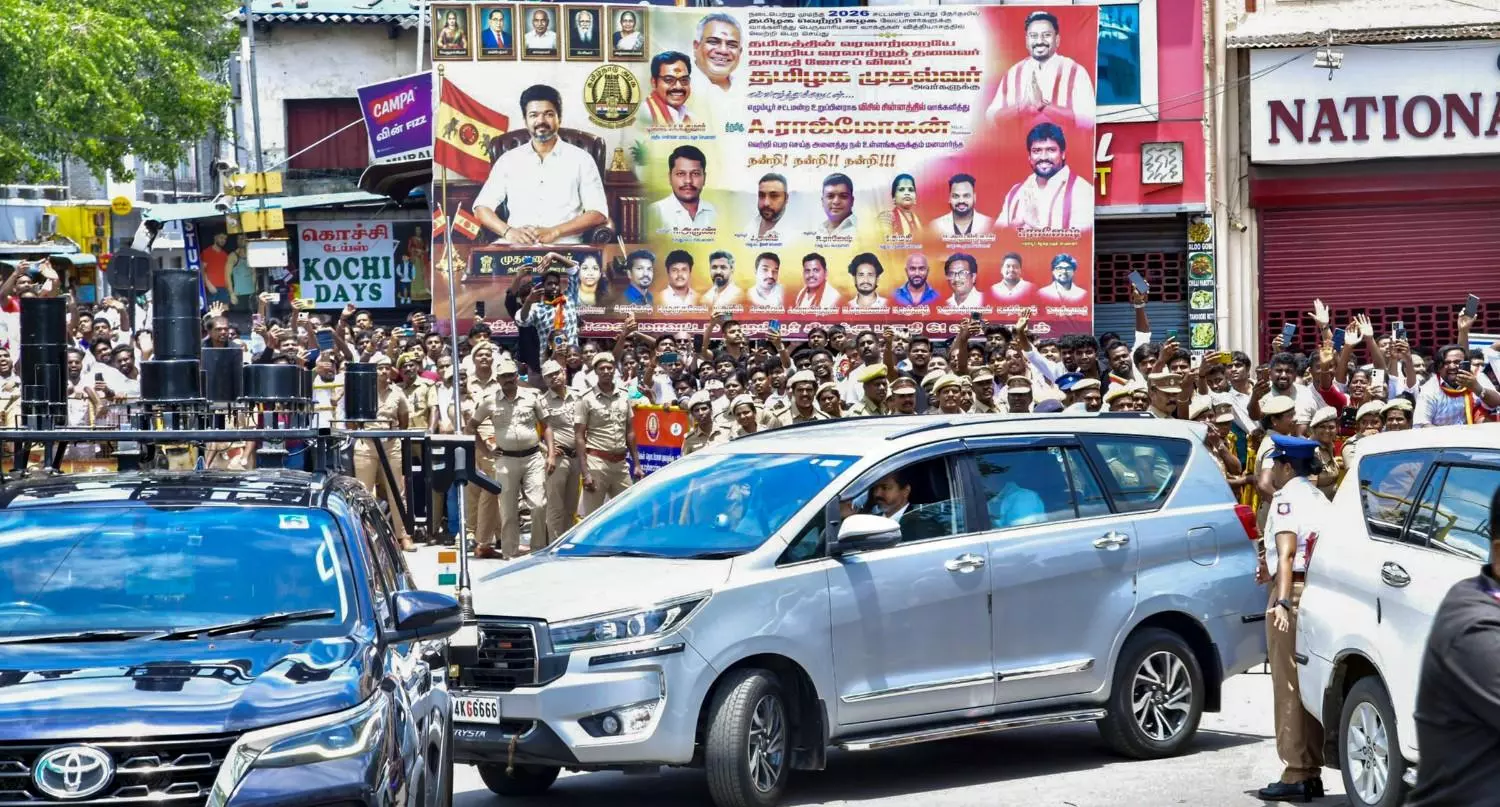
TVK supporters cheer as Tamil Nadu Chief Minister Joseph Vijay's convoy arrives at the state secretariat in Chennai after his swearing-in on May 10, 2026. Photo: @CMOTamilnadu/X via PTI
The great convoy cutdown: How India’s chief ministers are reining in VIP culture
Prompted by public ire and a PM-led austerity drive, leaders from Kerala to Bengal are slashing their motorcades to ease traffic and save energy

One of the first decisions that V D Satheesan, the chief minister-designate of Kerala, has taken even before being sworn in is to restrict his official convoy to a minimum number of vehicles. The step marks a sharp contrast with larger motorcades that were seen during the times of Satheesan’s predecessor, Pinarayi Vijayan, which had drawn criticism from many quarters.
Also read: Can TN's new actor-CM Vijay turn euphoria into governance? | AI With Sanket
One has not forgotten the chain-reaction rear collision involving multiple cars of Vijayan’s convoy that took place in Thiruvananthapuram in October 2024 when the pilot vehicle tried to save a civilian riding a two-wheeler. Vijayan was unhurt.
Satheesan urges for less cars in his convoy
The incoming chief minister has said that while he would be entitled to Z-Plus category security, he asked the police to ensure that his movement doesn’t cause inconvenience to the public and to keep a convoy with the least number of cars possible. According to leaders of his Congress party, Satheesan has indicated that only a pilot car and escort vehicle should accompany his car and road traffic should not be blocked while he travels.
Kerala Police, however, said that the chief minister’s security arrangements are governed by guidelines from the Union Home Ministry, commonly called the Yellow Book. As per them, the standard convoy under normal circumstances includes the CM’s vehicle, besides five to six escort vehicles and an ambulance. Sources said the size and composition of the CM’s convoy can increase depending on threat perception and the nature of the visit.
In TN, CM Vijay is aware of public inconvenience
In neighbouring Tamil Nadu, where a new chief minister also took over after the 2026 elections, similar efforts are being made to ensure that the public is not inconvenienced. Joseph Vijay, who has taken charge as the new CM, has sought a parallel traffic arrangement while he travels so that traffic flow is not affected.
On the instructions of Tamil Nadu Chief Minister Vijay, parallel traffic arrangements were put in place during the convoy movement to facilitate uninterrupted traffic flow and ensure public convenience.
Also read: Why Vijay's TVK win doesn't mark the end of Dravidian politics in TN
There are also reports that to ensure better management of the traffic and CM’s security, Vijay may move to a new address closer to the state secretariat in Chennai from his current house in Neelankarai, located 17 kilometres from his workplace.
Heavy deployment of police and stopping the traffic for a long time, as it has been seen during the times of some past chief ministers, has made it more challenging for the authorities to ensure that the CM’s security and movement are not compromised while other people are also able to commute without hurdles. However, Vijay was yet to reveal whether he was bringing down the car number in his convoy TANGO, which is between 12 and 14.
Some non-BJP states follow austerity measures, some don't
In some other states that are not ruled by the Bharatiya Janata Party (BJP), which is currently dominating India’s political landscape, including Himachal Pradesh and Telangana (both ruled by the Congress), the chief ministers also did the same, particularly after Prime Minister Narendra Modi recently appealed for responsible consumption of energy amid the ongoing crisis in West Asia.
However, there are also Opposition-ruled states where the chief ministers refused to attach much importance to the PM’s appeal. Karnataka Chief Minister Siddaramaiah is one of them. He felt the appeal for austerity was only a temporary measure and not the correct step to tackle the fuel crisis.
Saffron states respond to PM's appeal
In the BJP-ruled states, the same was seen happening widely. After the prime minister and many key central ministers reduced the number of vehicles in their respective convoys, state-level leaders of the lotus party were also seen doing the same.
Also read: TN CM Vijay drops 'VIP' white chair towel after youngster's urge: 'Change is coming'
They were also seen promoting carpooling and encouraging greater use of public transport and electric vehicles. Governors of several states also reduced the size of their cavalcades. Many MLAs were also seen using bicycles for official commuting.
Another new chief minister, Suvendu Adhikari, who recently assumed responsibility for West Bengal, also responded to PM Modi’s appeal to decide that only those vehicles that are necessary would be kept in his convoy. “I have asked the security staff to remove the unnecessary vehicles,” he said after taking oath in the state Assembly earlier this week.
In neighbouring Assam, where Himanta Biswa Sarma returned to power, the BJP government took a slew of austerity measures, including the reduction of vehicles in the convoys of the governor, the chief minister, ministers and senior officials.
Similar scenes have been witnessed in other BJP/National Democratic Alliance-ruled states such as Uttar Pradesh, Delhi, Rajasthan, Maharashtra, Bihar, Andhra Pradesh and others.
Maharashtra Chief Minister Devendra Fadnavis made the headlines by riding a motorcycle to the Assembly, while his Bihar counterpart Samrat Choudhary walked to the secretariat from his official residence in Patna.
N Chandrababu Naidu, whose convoy has faced several serious attacks in the past, including a near-fatal one in 2003, also decided to reduce the number of vehicles in his official convoy during district visits by 50 per cent.