



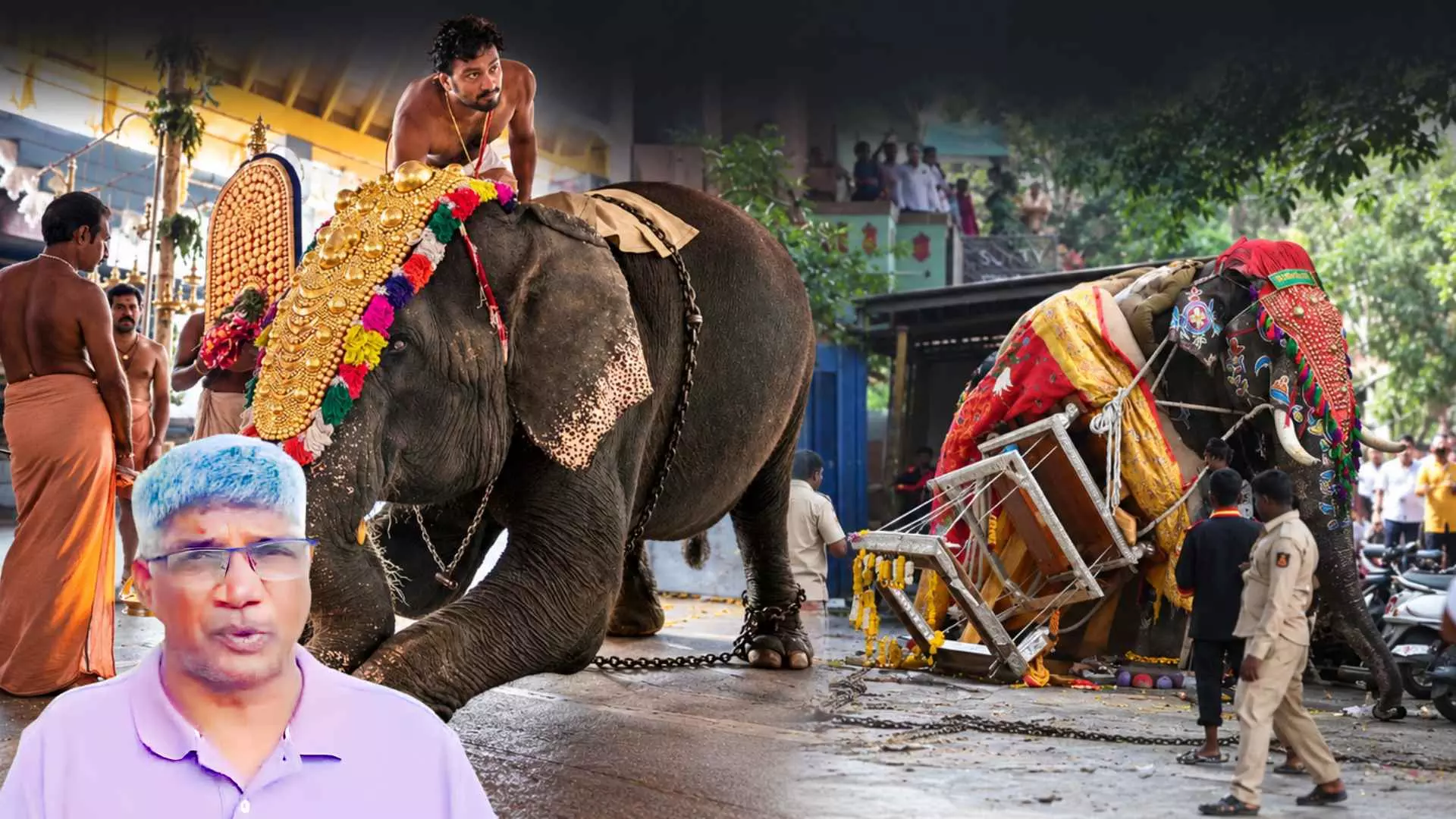
Mysuru was prepared, Shivamogga was not, says Joseph Hoover on the Somanna rampage
Shivamogga elephant mishap: District Dasara processions must stop, says wildlife activist
Contrast between Mysuru and Shivamogga reveals systemic failures, says Joseph Hoover, renewing calls for mechanical elephants and safety reforms

While Mysuru’s iconic Jambu Savari proceeded smoothly after weeks of preparation, an elephant named Somanna ran amok during Shivamogga’s Dasara procession, reviving fierce debates over captive animal safety.
In an interview with The Federal, Karnataka wildlife activist Joseph Hoover, president of the United Conservation Movement and a former member of the Karnataka State Wildlife Board, argues that preparation alone isn't enough, calling for an end to district-level processions and a transition to mechanical elephants.
Excerpts from the interview:-
Mysuru’s Jambu Savari went smoothly, unlike the Shivamogga procession, where an elephant ran amok and caused damage. How do you interpret these two contrasting incidents, and what do they imply for animal welfare and public safety?
There are two contrasting approaches here. In Mysuru, the 400-year-old procession follows a structured methodology. Elephants arrive 50–55 days in advance for proper nutrition, medical care, route rehearsals, and desensitization to cannon fire and crowds. Crowd management is similarly well-streamlined.
Shivamogga was completely disorganised. Somanna — an elephant known to be erratic with a history of fleeing during capture operations — was selected just days prior after another elephant suffered a leg injury. Somanna had no preparation to carry 650 kg or navigate dense crowds. Accustomed to the quiet Sakrebailu camp, Somanna was suddenly overwhelmed by DJ music, firecrackers, and thousands of people, triggering the rampage.
This is part of a systemic pattern at Sakrebailu. In 2023, forest officials failed to notice elephant Netravati was pregnant until she gave birth a day before the procession. In 2025, elephant Balanna was forced to participate despite injuries, ultimately requiring an ear amputation due to improper treatment.
District processions in Shivamogga, Tumakuru, Srirangapatna, and Anekal are essentially vote-bank politics driven by local politicians. Despite existing court restrictions on sending elephants to processions, officials approve these events out of negligence and arrogance. These district processions must be stopped.
You have raised concerns about tradition being used to justify these processions. How do you think cultural practices should evolve while respecting tradition?
Society has evolved through industrial, technological, and AI revolutions. We no longer travel in bullock carts or horse chariots, so our traditions should adapt as well.
For instance, we could reduce the weight of the golden ambari (ceremonial howdah) from 750 kg to 200 kg to lessen the physical strain on the elephant. Beyond that, we need to begin replacing live elephants with mechanical alternatives.
Could technology provide a middle ground through the use of mechanical elephants, allowing festivals to retain their traditional appearance without subjecting live animals to suffering?
Yes. Kerala has already begun adopting mechanical elephants at temple festivals to prevent stampedes and animal rampages. Karnataka should follow suit.
We do not need to replace all 13 elephants immediately. We could retain three or four live elephants at the front for tradition and replace the rest with robotic alternatives.
There is also a stark hypocrisy in how these animals are treated: they receive proper food and care leading up to Dasara, but once the festivities end, they return to neglected camps lacking basic medical care and adequate feeding.
If a rampage like Shivamogga's occurs in Mysuru amid lakhs of people, the resulting stampede could cause catastrophic loss of life. We must act before that happens.
What happens to an elephant physiologically and psychologically when it is exposed to an unfamiliar environment filled with loud music, firecrackers and thousands of people? How does it react to such conditions?
Elephants are highly emotional and sensitive animals with exceptional hearing, sensitive to frequencies that make loud noise deeply distressing. Exposing them to blasting DJ music and firecrackers causes extreme psychological stress. We cannot justify animal suffering by pointing to historical practices. Traditions must evolve in the interest of animal welfare and public safety.