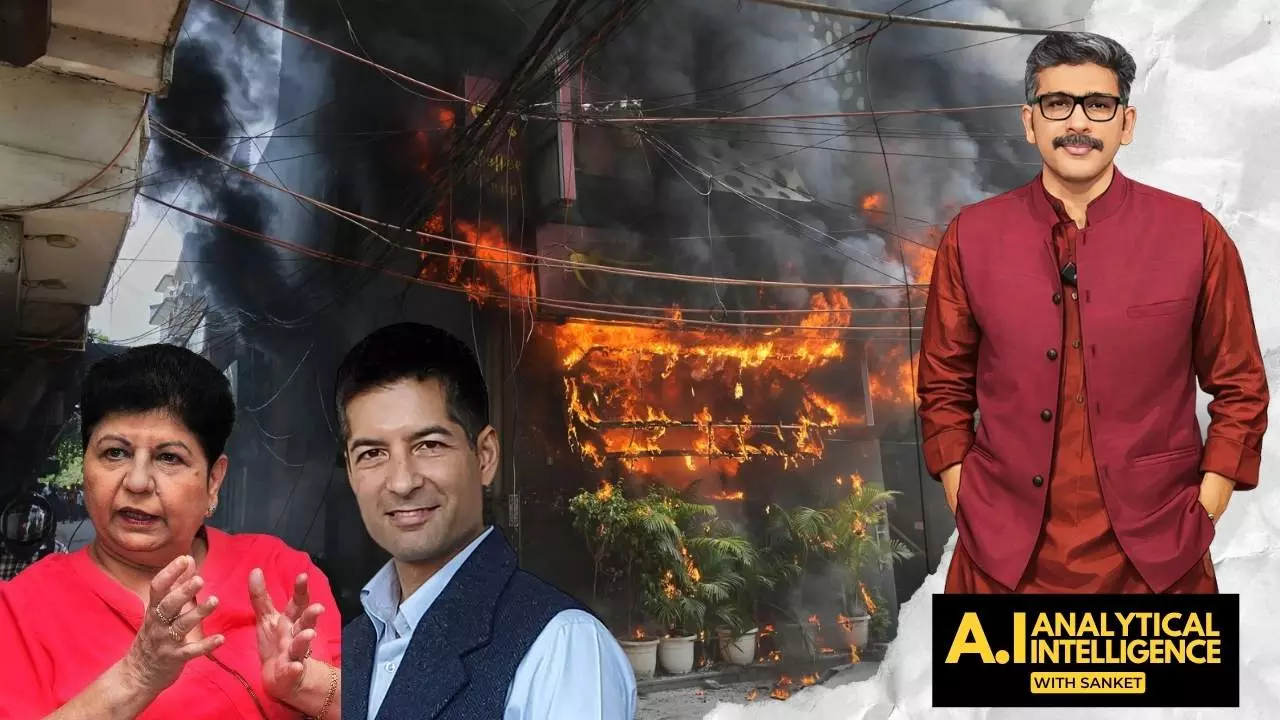
Activists slam Delhi hotel fire: 'System created to profit from tragedies' | AI With Sanket
Neelam Krishnamoorthy and Gaurav Bakshi say India's fire tragedies are the product of a criminal syndicate of corrupt officials, not unfortunate accidents

"This is murder by negligence, not an accident," said one of the two activists about the devastating fire at a hotel in Maviya Nagar in Delhi on Wednesday (June 3) that killed at least 21 people, most of whom were foreign nationals.
In this episode of AI With Sanket, The Federal spoke with Neelam Krishnamoorthy, activist, author, and president of the Association of Victims of Uphaar Tragedy (AVUT), and Gaurav Bakshi, citizens' rights activist and founder of HelpdesQ, in the wake of the disaster, one of the worst such incidents the national capital has seen in recent memory.
Also read: Delhi fire: How locals risked lives to smash windows, saved leaping people with mattresses
According to the unsparing verdict of the two voices who have fought the system from within for decades, India's fire tragedies are not accidents — they are the outcome of a deliberately engineered system of corruption that profits from preventable deaths.
Nearly 3 decades, still no change
For Krishnamoorthy, who lost her two children in the Uphaar Cinema fire of June 13, 1997, the images from Malviya Nagar were all too familiar. "We've lived this, and we're still living it — 29 years down the line and nothing has changed," she said.
She described the predictable cycle that follows every such tragedy: politicians make promises, buildings are sealed for a few weeks, inspections are conducted and then, quietly, officials extract a higher hafta (extortion money) and operations resume once public attention has moved on.
"Each time we hear a politician say doshiyon ko chhoda nahi jayega (the culprits will not be spared), and then when you go back to them, they say dekhiye madam, ab to matter court mein hai (see, the case is now with the court)," she said. The ritual of outrage, she argued, is itself part of the cover-up.
The price of an NOC
At the heart of the problem, Krishnamoorthy said, is the commercialisation of regulatory compliance. Building owners who comply fully with fire-safety norms do not need to bribe officials. Those who don't comply find it cheaper to pay officials than to invest in safety infrastructure.
Also read: How did a Delhi fire bring NEET, CBSE rows back under lens? | Capital Beat
"You spend crores of rupees building a multi-storey hotel. All you have to spend is another three to four per cent of the total cost to ensure fire safety measures are in place. But they don't want to do that," she said. "Every NOC (no-objection certificate) has a price. It is well known in Delhi and all over the country."
Officials, she said, are not passive recipients of bribes — they actively guide building owners on "deviations" and issue certificates for a price. The result is a system where compliance is penalised, and corruption is incentivised.
Rewarding the guilty
The Uphaar case, she said, illustrates how the justice system can inadvertently reward the very institutions that were complicit in a tragedy. The Supreme Court, in its landmark 2015 judgment in the Uphaar criminal case, released the Ansal brothers — citing their advanced age — on the condition that they each pay Rs 30 crore to the Delhi government for the construction of a dedicated trauma centre in Dwarka.
The Delhi government, she pointed out, had been complicit in the original tragedy through its agencies — the Municipal Corporation of Delhi, Delhi Fire Service, and the Delhi Vidyut Board. "Instead of punishing those people, you have actually rewarded the Delhi government," she said.
In 2025, she moved the Supreme Court to seek compliance — and found that Rs 60 crore had simply been absorbed into the Delhi government's general budget. No trauma centre was built.
A fire official's calculus
The insufficiency of the penalty structure extends beyond the Ansals. A fire official who was on casual leave when he issued the NOC to Uphaar Cinema Hall was convicted and asked to pay a fine of Rs 10 lakh to the Delhi government.
Krishnamoorthy's point was stark: "He will say — If at all I am convicted, I'll pay this Rs 10 lakh fine." With no credible deterrence in place, the incentive structure for corruption remains intact.
She also cited the case of former IPS officer Amod Kanth, who was summoned in the Uphaar case. The Central Bureau of Investigation, which functions as a prosecuting agency and does not have the authority to decide on sanctions for prosecution, went to court in January this year and said it had decided not to pursue sanctions. "They protect their own, they protect each other," she said.
A criminal syndicate
Bakshi, who has worked with government departments across multiple states on compliance and citizens' rights, was equally blunt. He described the system not as a series of individual failures but as a functioning criminal enterprise.
"Our bureaucracy and our politicians at the top have deliberately orchestrated a very corrupt system which is intended to create tragedies and profit from tragedies," he said. "When a tragedy like this happens, their eyes open wide — because instead of Rs 6 lakh for a license, now they can take out Rs 6 crore from this fellow. They are hoping for tragedies to happen."
Also read: Delhi fire: How iron window grills, a locked terrace trapped residents, including a toddler
He described the motivational logic that drives the entire chain: the aspiring MLA, the minister, the chief minister — all require money to climb the political hierarchy, and that money flows from a network of compliance-based extortion targeting India's 63 million MSME businesses.
Millions of time bombs
The practical consequence of this system, Bakshi warned, is catastrophic in scale. "Because of this criminal syndicate and this chain, millions of buildings are not compliant with building laws. Millions of businesses inside those buildings are not compliant with fire safety. We are a sitting time bomb."
He distinguished between the high-profile fires that make news and the countless smaller incidents that go unreported, arguing that India wakes up only when the death toll is large enough to break through the media cycle — only for the same political theatre to play out and the same system to resume.
"The same individuals who lack integrity continue to lead the country, the state, and the municipality. The chain is still there," he said.
What needs to change
Krishnamoorthy laid out three concrete demands. First, a crackdown on corrupt officials with exemplary punishments from courts. Second, a new law specifically to deal with man-made disasters — one with non-bailable offences and a mandatory trial completion within two years. Third, a minimum sentence of 10 years of imprisonment.
"You do it for two or three cases and just wait and see — there will be a change," she said, pointing to Romania, where an entire government resigned following a single fire tragedy. "In our country, we have seen so many fires, and nobody is ever bothered."
She also cited the precedent she herself helped create: the JP Narayan Trauma Centre in Delhi exists because AVUT filed a writ in the High Court in 2002. Without that legal intervention, there would have been no trauma centre to receive the Malviya Nagar victims.
The hafta goes to the top
Both guests agreed that the Malviya Nagar building — registered for six rooms but operating 25 — could not have functioned without the knowledge of every level of the local administration, from beat-level police to the area MLA. "You can make out from the parking alone that this is not just six rooms," Krishnamoorthy said. "You can't turn a blind eye."
Also read: Odisha hospital fire death toll rises to 12 after ICU blaze
The hotels in the vicinity that locked up overnight and fled, she predicted, would all be back in business within four to six weeks. The police, as Bakshi put it, would simply revise their hafta rate upward and look the other way again.
"They are making a damn fool out of all of us — making merry at our cost and expense," Bakshi said. "It's time we realise how we are being fooled, completely and blatantly, on our faces."
The content above has been transcribed from video using a fine-tuned AI model. To ensure accuracy, quality, and editorial integrity, we employ a Human-In-The-Loop (HITL) process. While AI assists in creating the initial draft, our experienced editorial team carefully reviews, edits, and refines the content before publication. At The Federal, we combine the efficiency of AI with the expertise of human editors to deliver reliable and insightful journalism.