








From JP to CJP: How Delhi remains the epicentre of India’s power-shifting protests
Following the resignation of Union Education Minister Dharmendra Pradhan over the NEET scandal, a look back at some historic movements that shook the Capital

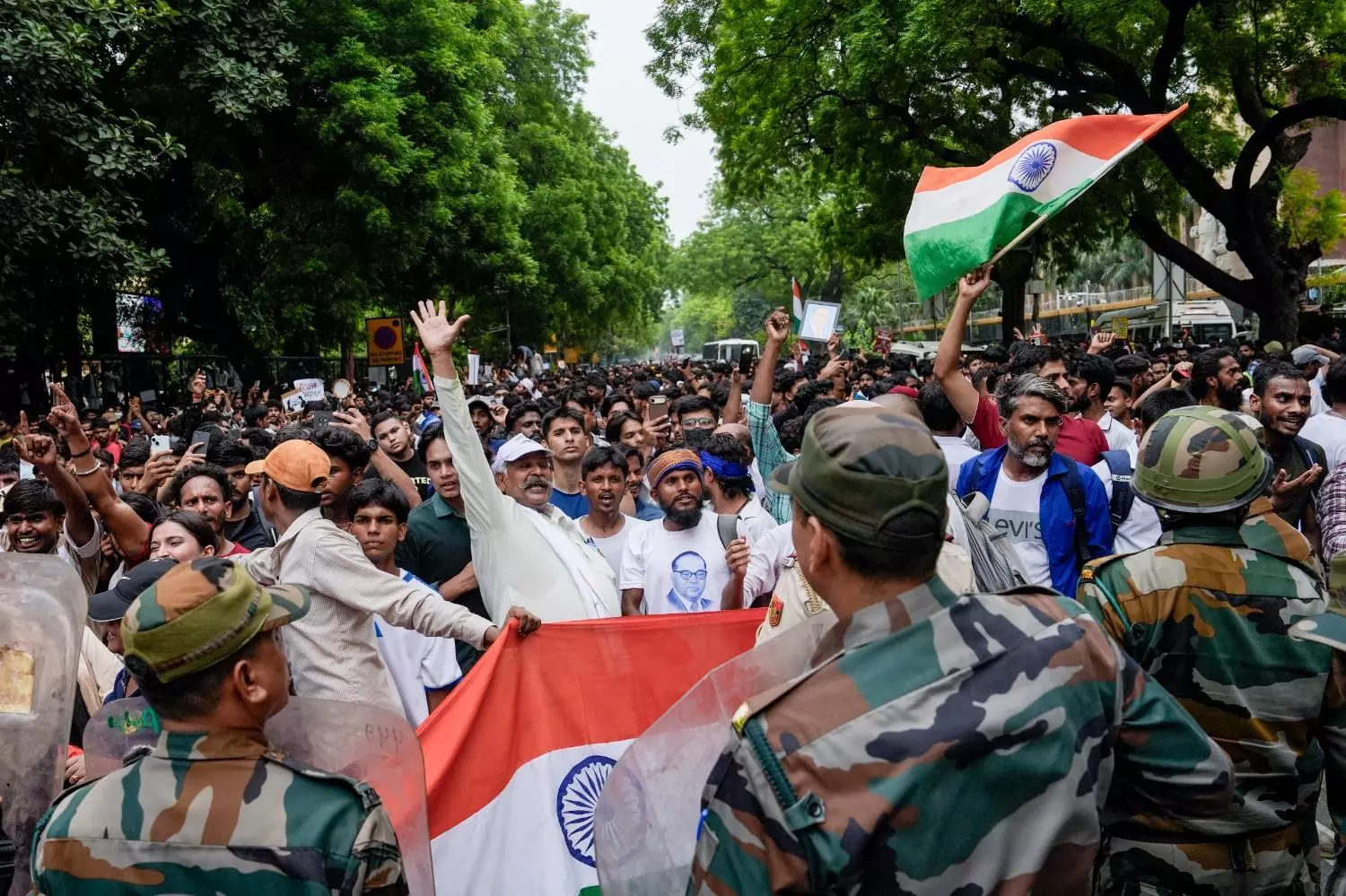
The protest by the newly formed Cockroach Janta Party (CJP), founded by a US-returned youth to demand education reforms, yielded significant results on Saturday (July 25) when Union Education Minister Dharmendra Pradhan quit over the NEET examination irregularities.
Also read: CJP withdraws protest with 'immediate effect'
It was a rare occasion when a sitting MP of the Narendra Modi government, a heavyweight one, stepped down in the face of relentless protest. What the protest next achieves is something for time to tell, but the episode showed once again that New Delhi, the country’s political capital, continues to be the epicentre of protests, some with a major impact while others proved to be less effective.
While the city remained witness to many pre-colonial era conflicts and rebellions during British rule, its tradition of protests and conflicts continued even in the post-Independence days. Particularly, over the last many years, Delhi’s landmarks — Jantar Mantar, India Gate, Ramlila Maidan and its borders became sites for protests, ranging from anti-corruption marches to farmer sit-ins. Many of them went beyond just headline-making movements to affect laws, careers, and public consciousness. Many of these protests took place in the Modi era and even spread to other major cities of the country.
Here are some notable protests held in Delhi:
JP Narayan’s historic rally (1975)
Delhi was also witness to a historic rally led by the legendary Jayaprakash Narayan against the Indira Gandhi government in Ramlila Maidan, demanding the PM’s resignation. The protest was triggered by the Allahabad High Court’s verdict convicting Indira of electoral malpractice and barring her from holding public office for six years. Hours after the jam-packed rally, which was attended by major opposition leaders and future prime ministers such as Morarji Desai and Atal Bihari Vajpayee, the Indira government announced Emergency.
The anti-corruption movement (2011)
Activist Anna Hazare's hunger strike at Jantar Mantar and later Ramlila Maidan in 2011 galvanised a nation frustrated with corruption scandals during the second United Progressive Alliance government (2009-14). Thousands gathered demanding a strong anti-corruption ombudsman, the Lokpal. The impact of the movement, called India Against Corruption, was profound and lasting: it eventually gave birth to the Aam Aadmi Party a year later, which would go on to govern Delhi for over a decade, fundamentally reshaping the city's political landscape and proving that civil society movements could translate directly into electoral power.
Also read: Minister's resignation, PM's midnight reels: Why CJP protest is a rare political spectacle
Nirbhaya protests (2012)
The brutal gang rape and murder of a young paramedical student on a moving Delhi bus on the night of December 16, 2012, triggered an outpouring of grief and anger unlike anything the Capital had seen. Protesters gathered at India Gate, Raisina Hill, Parliament and Rashtrapati Bhavan and other places, demanding justice and systemic change, leading to a heavy police crackdown. The impact was concrete: the then UPA II government constituted the Justice Verma Committee, leading to the Criminal Law (Amendment) Act 2013, which introduced stricter rape laws, and the creation of the Nirbhaya Fund for women's safety initiatives — a rare case where street anger directly rewrote India's criminal code.
Both the above protests had directly resulted in the defeat of former Delhi chief minister Sheila Dikshit in the 2013 state polls after a 15-year rule.
JNU sedition row (2016)
When students at Delhi’s Jawaharlal Nehru University were charged with sedition over alleged anti-national sloganeering, protests spread across Delhi's university campuses. While the movement didn't result in immediate legal or policy reversal and the matter remains in a legal stalemate even after a decade, its impact was ideological — it reignited a national debate on free speech, campus politics, and the boundaries of dissent, issues that continue to surface in Indian public discourse today. Names such as Umar Khalid and Kanhaiya Kumar became familiar in the country’s political and legal circles.
CAA-NRC Protests and Shaheen Bagh (2019-20)
The Citizenship Amendment Act sparked months of sustained protest, most iconically the women-led sit-in at Shaheen Bagh over 100 days, which became a global symbol of peaceful civil resistance. Though the Act, passed in December 2019, was not repealed, its implementation rules remained stalled for years, and the protest reshaped how grassroots, women-led movements are perceived in Indian politics. The period also saw the riots in the Capital that resulted in many deaths, underscoring how protest and communal tension can dangerously intersect in the capital.
Also read: ‘Don’t make me a hero, country ruined by making one person a hero’: Dipke after Pradhan quits
Khalid's name also surfaced in connection with the 2020 riots. In January this year, the Supreme Court turned down pleas of both Khalid and Sharjeel Imam, another student activist, who were arrested after the riots.
They were accused by the police of conspiracy to incite clashes that killed mostly Muslims. The duo was held under strict anti-terror laws such as Unlawful Activities (Prevention) Act and applied for bail in courts over the years without any success.
Farmers’ protests (2020-21)
One of the most consequential protests in the times of Modi happened when farmers, primarily from Punjab and Haryana, camped for over a year at Delhi's Singhu, Tikri, and Ghazipur borders, opposing three contentious farm laws brought by the Centre. The impact here was clear: the Centre repealed all three laws in November 2021, with Modi himself conceding that his government failed to convey the message. This incident, which happened months before the Punjab elections 2022, marked one of the few instances in recent Indian history where sustained protest forced a complete policy reversal at the national level.
Wrestlers' protests (2023)
Indian wrestlers, including Olympic and World Championship medallists, protested at Jantar Mantar alleging sexual harassment by the then Wrestling Federation of India chief and former BJP MP, Brij Bhushan Saran Singh, who stepped aside later under pressure. The protest turned ugly when police detained the protesting wrestlers tried to march towards the new Parliament building. The protest's impact extended beyond sport — it forced a national reckoning on athlete safety, power structures in sports federations, and the treatment of women athletes, eventually contributing to leadership changes in the federation, which also drew ire of the sport’s world-governing body.
Arvind Kejriwal arrest protests (2024)
Workers and supporters of the AAP protested across Delhi, including outside BJP headquarters, in March 2024 after the arrest of Arvind Kejriwal, the then chief minister of Delhi, in the excise policy case. While the protests didn't secure his immediate release, they sharpened public debate around the use of central agencies like the Enforcement Directorate and Central Bureau of Investigation against opposition leaders, a theme that has since remained central to India’s political discourse.
Also read: NEET dreams break families, while GST revenues shoot up
The trigger for each of these protests is different, but there is a common ground – Delhi protests have historically served as a stress test for Indian democracy, which sometimes brought the desired results while not at other times.