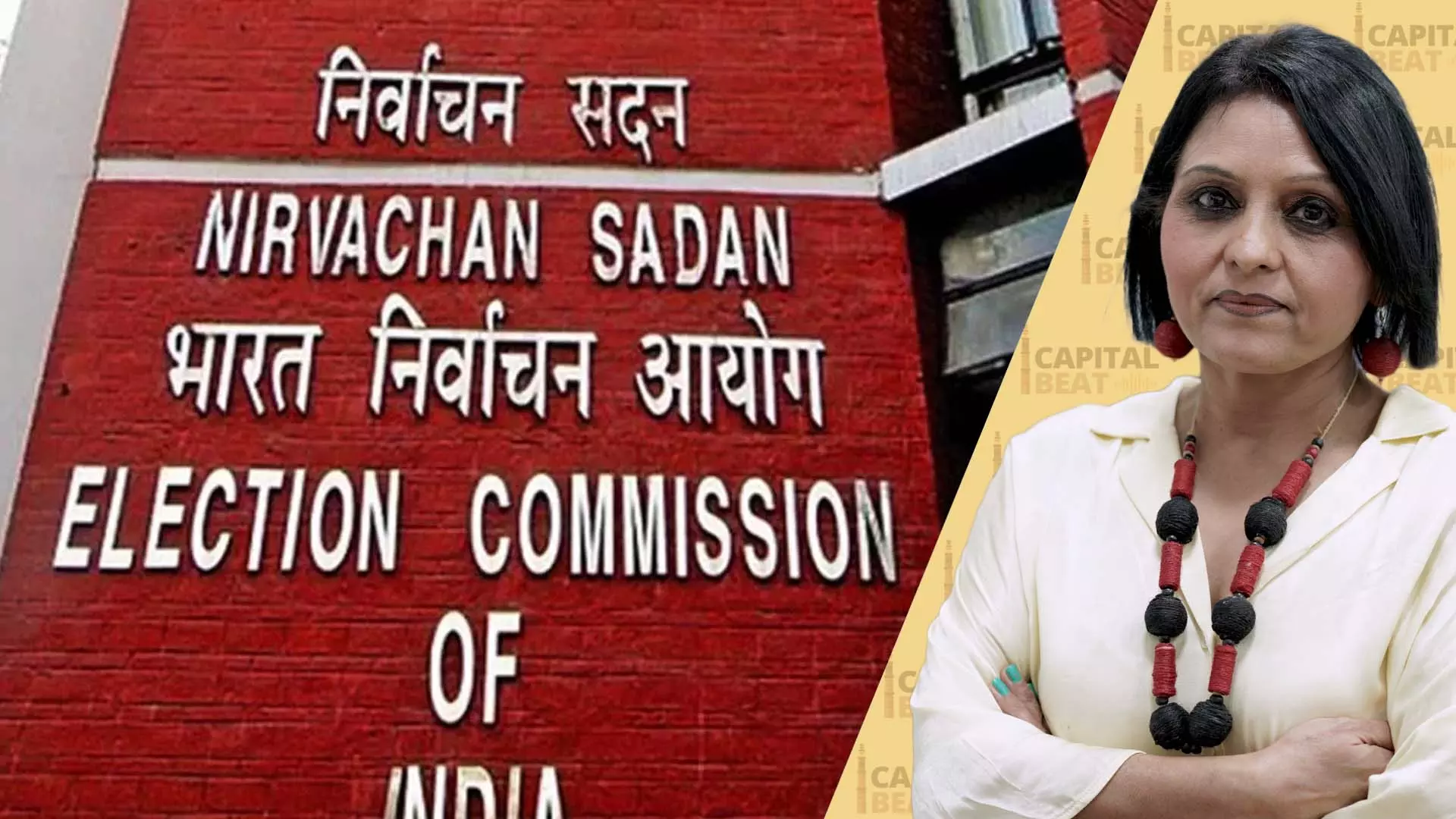
EC tells SC its deduplication software was ineffective; what does it mean for SIR?
ECI disowns its own deduplication software in Supreme Court after deploying it nationwide before 2024 polls

The Election Commission, in a counter-affidavit filed on November 24, told the Supreme Court that its deduplication software produced “variable” results and that “large numbers of suspected DSEs [demographically similar entries] were not found to be duplicates”.
The affidavit stated that “the said technology was last used in 2023” and that the Commission had discarded it on grounds of alleged inaccuracy. This position, the programme noted, contrasts with the strong endorsement the same software received in 2023, when the EC asked officials to deploy it in “campaign mode” across 100 per cent of electoral rolls to identify suspect duplicates ahead of the 2024 Lok Sabha elections.
In this episode of The Federal's Capital Beat programme, Nitin Sethi of The Reporters’ Collective and retired IAS officer EAS Sarma discussed the implications of the admission. The discussion underlined that the EC had not publicly disclosed that the software had been discontinued and that this fact emerged only after The Reporters’ Collective’s investigation was cited in court proceedings, prompting the EC’s affidavit.
Reporters’ Collective investigation into Bihar SIR
Nitin Sethi explained that his colleague Ayushi and their team had been following the Bihar SIR for about three months and investigating different facets of the exercise. They obtained the final Bihar voter roll and, with the help of data scientists, ran a software tool that replicated the EC’s own deduplication methodology.
Also read: Biggest anti-national act you can do is vote chori: Rahul in Lok Sabha
Using this process, the team identified around 14.51 lakh “suspect duplicates” where “names of relatives and ages matched” and people appeared to hold “two or more voter ID cards”. Sethi said they were able to narrow down “several lakh cases where a single voter had demographic information exactly the same in multiple cards”, including name, address, age and relative’s name.
He noted that this work was done despite the voter roll being made harder to process through optical character recognition and that the data scientists “were able to crack it over months and prove this”.
How the software was supposed to work
During the investigation, sources within the EC pointed Sethi’s team to an internal manual that described how the deduplication software had been in use since around 2018–2019. Once new EPIC data was uploaded, the system would automatically match entries and throw up “possible duplicates”, which then required ground verification.
The EC’s own documentation, Sethi said, showed that officials were expected to investigate these suspect entries, determine whether they were genuine duplicates or fraudulent, and only then remove them after due process. The machine’s role was limited to flagging suspects; deletion was dependent on human verification.
Also read: Lok Sabha debate: Congress's Tewari calls SIR ‘illegal’, demands return to ballots
Sethi stated that as they examined Bihar SIR, “a suspicion was it isn’t” being used, because the exercise appeared “hurried and ill organised”. Speaking to sources across the system, the team received confirmations that the draft roll for Bihar had not been put through the software and that the deduplication module had been removed from the ECI’s software stack, leaving officials to rely on manual checks.
Manual checks across 60 crore voters called ‘impossible’
Sethi described what “manual checks” mean in practice under the current approach. Booth-level officers (BLOs) and electoral registration officers (EROs) are now expected to verify whether a voter has more than one card in the same booth, constituency, state or another state.
However, a BLO only has access to booth-level records, an ERO only to records within a particular constituency, and state officials to their own state’s data. Yet, by the current logic, they are expected to check manually across a database of about 60 crore voters to locate duplicates.
Sethi stated, “I don’t think it takes any understanding of a computer to imagine that this is impossible manually.” He emphasised that “the only way to detect duplicates across constituencies, booths, states and the country is by a process of digitised inquiry”.
2024 presentations and TCS upgrade documents
The programme noted that the EC’s affidavit claimed the technology was discontinued in 2023. Sethi countered this with internal material accessed by his team. He said that in August 2024, the EC was still making presentations describing how it had “upgraded this software” into an enhanced version.
Also read: Bengal SIR under Maoist shadow in Jangalmahal as tribals reject EC exercise
He stated that these presentations, which may not now be publicly available on the Commission’s website, are in The Reporters’ Collective’s possession. Additionally, Sethi referred to a Tata Consultancy Services report documenting that in the financial year 2024–25, the firm had revised the “ERONet” software for the EC.
Sethi said his team’s evidence shows that while EC told the Supreme Court it had stopped using the software in 2023, it was simultaneously presenting it publicly as improved and enhanced in 2024.
Electoral roll integrity flagged
Former IAS officer EAS Sarma said he had been reading “every word” of The Reporters’ Collective’s investigative reports over months and had written two letters to the EC asking it to verify the facts. He also studied the 2023 Manual on Electoral Rolls and found that reference to the deduplication software appears in six paragraphs.
Sarma noted that the manual remains valid and “has not been modified”, indicating that the Commission had formally retained a serious commitment to deduplication even while, in practice, the module was reportedly switched off.
He pointed out that after March 2023, several assembly polls, by-elections and the 2024 Lok Sabha elections took place. In his assessment, switching off the software while being aware that duplicates existed meant “they were using fraudulent electoral rolls” and that “they knew that these electoral rolls had duplicate voters’ names, but they willingly became a party to it”.
Citizenship verification and deletions in Bihar
Sarma also referred to concerns around citizenship verification during Bihar SIR. He argued that under the relevant law, the EC “had no authority” to verify citizenship and delete names on that basis, yet it “tried to do it in Bihar”.
Also read: BLO deaths during SIR duty: SC asks states, UTs to provide more staff to EC
He pointed to reports that a large number of minority voters’ names were deleted. Citing figures reported by The Reporters’ Collective, he mentioned “1.46 lakh” cases and “tens of thousands” of instances where individuals reportedly held three EPICs.
Sarma linked this to earlier instances, including objections raised in Delhi, Karnataka and Haryana, where political figures and civil society groups had flagged alleged irregularities in voter lists, and where, he said, those names continued to appear in final lists.
Questions for Supreme Court and pause on SIR
Discussing the implications of ECI’s affidavit, Sarma outlined the questions he believed the Supreme Court should be asking. He argued that the EC had refused to provide machine-readable electoral roll formats and had not been transparent about discontinuing the software.
Sarma stated that if the court were to examine the sequence of disclosures, it could find that SIR in Bihar and subsequent exercises were conducted “without” the deduplication tool in operation. In such a scenario, he said the court should “stop the SIR in other states” and direct the EC to re-run the process using both the software and door-to-door verification.
He remarked that “when other citizens and The Reporters’ Collective are able to do it, why can’t you do it”, calling the situation “absolutely ridiculous” for a constitutional body.
Call for presidential reference under Article 143(1)
Sarma disclosed that he was in the process of writing to the President of India seeking a reference to the Supreme Court under Article 143(1) of the Constitution. He said he had earlier raised concerns about the law governing appointments to the Election Commission and now intended to consolidate new issues, including the software, refusal to share machine-readable rolls and SIR practices.
Also read: SIR in TN: More than 5.89 million voter names struck off so far
He argued that these developments “suggest that there is some kind of connivance between the Election Commission of India and the political executive” and that a presidential reference could ask the court what steps should be taken, including whether SIR should be stopped and the appointment law revisited.
Sarma described the moment as “a golden opportunity for the Supreme Court to restore the confidence of the public in the whole electoral process”, adding that “trust in the Election Commission is no longer there” among political parties and the public.
Ground verification of duplicate voters
Returning to the Bihar SIR investigation, Sethi said The Reporters’ Collective had not limited itself to running algorithms. The team sent reporters to the field to verify suspected duplicate entries physically. In one constituency, they found “hundreds of people having the same photographs on two different EPIC cards”.
He pointed out that some of this evidence has been placed before the Supreme Court by petitioners such as advocate Prashant Bhushan and the Association for Democratic Reforms (ADR), including copies of duplicate entries.
Sethi stated that their deduplication work shows duplicates existed earlier as well, but in Bihar “they increased”, which, at the least, suggests that “the ECI is incompetent”.
Future investigations into SIR
Sethi said The Reporters’ Collective would “keep at it” and that “more work is in the pipeline” on SIR and related issues. He indicated that the team was close to assembling further evidence pointing to a “degree of incompetence” in the way the SIR exercise has been executed.
He noted that the Constitution grants the Election Commission a “large mandate” to conduct voter roll revisions using a laid-down process, but in the Bihar SIR case “the only rule Election Commission has followed is its own discretion”.
Also read: EC extends SIR schedule by one week after workload criticism
Sethi argued that the Commission’s approach risks turning what he called a “liquid mess” in the rolls into a “solidified mess”, since the SIR is projected as a one-time, final clean-up of voter lists on which future elections will be conducted.
‘Not possible without technology’
Drawing on his experience, Sarma recounted that while in service he had invited an officer from Bihar who had led an intensive survey in 2003 to help conduct door-to-door verification in Visakhapatnam. He concluded that leaving duplication detection to voter self-declaration or to BLO-level manual checks “will never happen” effectively.
He pointed out that it is “very difficult” even to detect duplicate EPICs across constituencies within the same state using manual methods, let alone across states. He referred to evidence of adjacent constituencies in Uttar Pradesh where the same individuals appeared to hold EPICs.
Sarma stated that “election management is not rocket science” and that India has the expertise to build effective tools, but that “the software threw up some very inconvenient information which they didn’t want to use”. He described this as “unfair to the public”.
(The content above has been transcribed from video using a fine-tuned AI model. To ensure accuracy, quality, and editorial integrity, we employ a Human-In-The-Loop (HITL) process. While AI assists in creating the initial draft, our experienced editorial team carefully reviews, edits, and refines the content before publication. At The Federal, we combine the efficiency of AI with the expertise of human editors to deliver reliable and insightful journalism.)