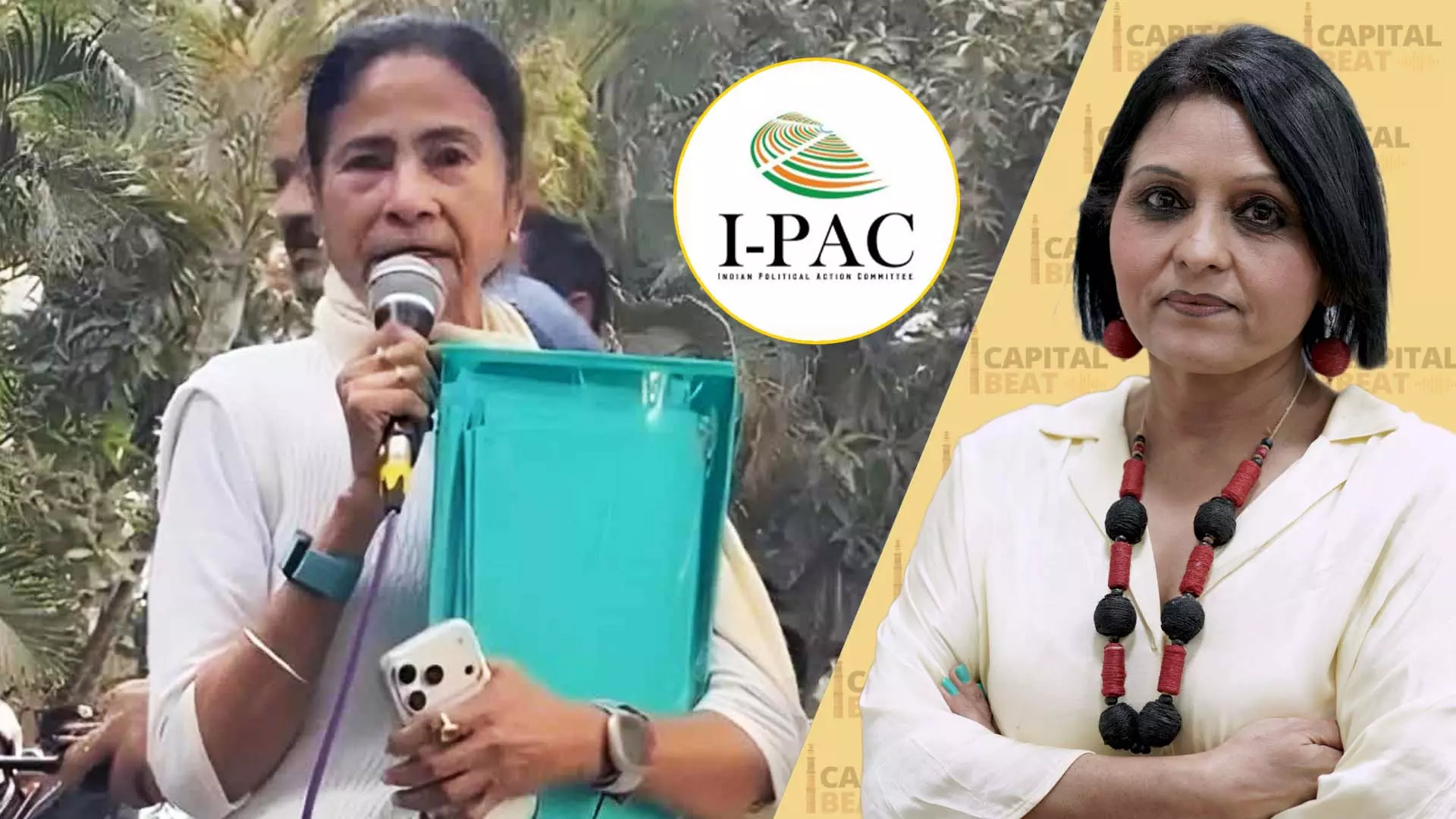
ED raids spark showdown
ED raids at I-PAC spark political confrontation in West Bengal | Capital Beat
High-stakes confrontation unfolds in poll-bound Bengal as the Chief Minister directly intervenes during ED action

A Capital Beat episode examined the political fallout of the Enforcement Directorate’s searches linked to political consultancy firm I-PAC in Kolkata, with panellists Manojit Mondol of the Trinamool Congress, Congress spokesperson Chandan Ghosh, and senior journalist Shikha Mukherjee debating allegations of political targeting, the timing of the raids, and their implications ahead of the West Bengal Assembly elections.
The episode focused on the dramatic scenes that unfolded as West Bengal Chief Minister Mamata Banerjee confronted ED officials during searches at locations associated with I-PAC, alleging attempts to access Trinamool Congress’s internal party material, including candidate lists and election strategy documents.
The discussion revolved around competing claims — the ED’s stated position that the searches were part of a money laundering probe linked to alleged coal smuggling, and the Trinamool Congress’s assertion that the action was politically motivated and timed to coincide with a sensitive electoral phase in the state.
Details of the ED searches and Mamata Banerjee’s response
The Enforcement Directorate conducted searches at two locations in Kolkata — the residence of Pratik Jain, described as a senior I-PAC functionary, and the firm’s office at the Godrej Waterfront building in Salt Lake’s Sector V. As news of the searches spread, Trinamool Congress leaders gathered outside the office, and the Bidhannagar Police Commissioner reached the spot amid rising tension.
Also Read: 'I-PAC disruption could affect TMC's election campaign'
Mamata Banerjee, who was initially present at one of the locations, later arrived at the Sector V office and addressed the media. She alleged that the ED action was aimed at accessing Trinamool Congress’s internal political material.
“It’s most unfortunate that the ED came to our office to collect candidate lists, party strategy, plans, and confidential documents,” Banerjee said, while displaying a green file she claimed contained sensitive party documents.
The Chief Minister’s intervention, including her public display of files taken from the premises, became a central point of political and media attention throughout the day.
ED’s stated case and the coal smuggling probe
During the episode, reference was made to reports stating that the ED action was linked to an ongoing investigation into alleged illegal coal mining and money laundering. The probe reportedly stemmed from a Central Bureau of Investigation case concerning alleged coal theft in leasehold areas of West Bengal.
The alleged case involved illegal excavation and sale of coal across multiple districts, with claims of organised syndicates, bribery of public servants, and transfer of proceeds of crime through hawala channels, including overseas transfers.
The ED maintained that the searches were not aimed at accessing Trinamool Congress party material, but were part of a continuing investigation under the Prevention of Money Laundering Act.
Perception, timing, and political context
Senior journalist Shikha Mukherjee placed the episode within a broader political context, describing the long-standing perception among opposition parties that central agencies are used selectively during politically sensitive periods.
Also Read: What is I-PAC and how is it connected with Mamata’s TMC?
“This has been a constant stream as part of the political confrontation between the BJP and the opposition,” Mukherjee said, referring to repeated claims of agency misuse over several years.
She noted that the timing of the searches coincided with critical political developments in West Bengal, including the Special Intensive Revision (SIR) of electoral rolls and preparations for the upcoming Assembly elections.
Mukherjee highlighted that I-PAC plays a significant organisational role for the Trinamool Congress, particularly in coordinating booth-level operations during electoral processes.
SIR exercise and organisational stakes
The panel discussion repeatedly returned to the issue of the SIR process, which involves verification and deletion of voter names from electoral rolls. Mukherjee noted that the Trinamool Congress possesses an extensive booth-level network required to manage such exercises.
“The Trinamool Congress is about the only party in West Bengal which has the necessary network of people to provide the booth-level representatives needed for the SIR process,” she said.
She added that the BJP, Congress, and CPI(M) lack comparable organisational depth in this context, making the issue particularly sensitive for the ruling party.
According to Mukherjee, the documents allegedly held at I-PAC would be “critical and sensitive” to the Trinamool Congress’s electoral strategy, especially amid disputes over voter deletions and discrepancies. Manojeet Mondol, representing the Trinamool Congress perspective, strongly rejected the ED’s rationale for the searches and questioned the logic of conducting such an operation at a public office shortly before elections.
“Three months before the election, do they really believe confidential documents will be kept in a public office?” Mondol said.
He described the action as “nothing but a vendetta” and accused central agencies of attempting to intimidate the party and its workers.
Mondol also referred to the presence of young professionals and students working at the I-PAC office, stating that the Chief Minister intervened to protect them from distress caused by the searches.
“She is standing tall and like a rock solid to protect them,” he said.
Congress response: optics and political theatre
Congress spokesperson Chandan Ghosh offered a different reading of the episode, framing it as part of a broader pattern of political optics in West Bengal.
He referred to previous cases investigated by central agencies, including Saradha and Narada, and noted that multiple parties in the state have experienced agency scrutiny over the years.
If it is a fixed match, does the BJP actually want to lose
Ghosh questioned the optics of Mamata Banerjee emerging with files from the raided premises, suggesting that the episode itself had become a political spectacle.
“Just look at the optic — the Chief Minister coming out with files in front of the ED,” he said, questioning what the raid ultimately achieved.
He argued that both the BJP and the Trinamool Congress benefit from polarised political narratives, while issues of development, industrialisation, and economic policy receive limited attention.
Allegations of fixed matches and political narratives
The panel also addressed claims circulating in political discourse about alleged tacit understandings or “fixed matches” between major parties in West Bengal.
Mukherjee rejected such conspiracy theories, stating that there was no evidence to support them.
“If it is a fixed match, does the BJP actually want to lose?” she asked, dismissing the claim as unsubstantiated.
Mondol similarly rejected the notion, pointing to electoral outcomes where the BJP lost ground and asserting that such theories recur before every election.
Impact on election narrative
The discussion acknowledged that the ED raids and Mamata Banerjee’s response are likely to become part of the broader election campaign narrative.
Mukherjee described the episode as a moment where both sides delivered strong political blows, characterising it as neither a clear win nor loss for either party.
“It’s a hard punch and a counter-punch,” she said, referring to the raid and the Chief Minister’s response.
Ghosh maintained that repeated reliance on such confrontations risks confusing voters and diverting attention from governance-related debates.
Ongoing confrontation ahead of polls
The episode concluded without definitive resolution, reflecting the unresolved political contest surrounding the ED action. Panellists agreed that similar confrontations could recur as elections draw closer, given the heightened political stakes in West Bengal.
The discussion underscored how agency actions, public responses by political leaders, and competing narratives intersect in shaping electoral discourse, particularly during periods of intense political mobilisation.
The content above has been transcribed from video using a fine-tuned AI model. To ensure accuracy, quality, and editorial integrity, we employ a Human-In-The-Loop (HITL) process. While AI assists in creating the initial draft, our experienced editorial team carefully reviews, edits, and refines the content before publication. At The Federal, we combine the efficiency of AI with the expertise of human editors to deliver reliable and insightful journalism.