



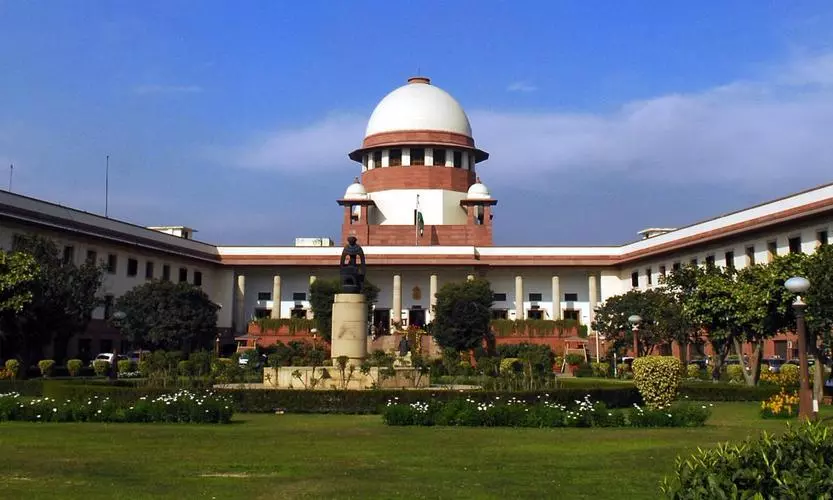
Sircar says we must wait to see what the Supreme Court does next.
'RTI letters are primary evidence of EC breakdown,' says Jawahar Sircar
Former Rajya Sabha MP says RTI documents on letters by Election Commissioners raise serious questions about the ECI’s functioning and warrant judicial scrutiny

The disclosure of letters written by Election Commissioners Sukhbir Singh Sandhu and Vivek Joshi to Cabinet Secretary TV Somanathan has raised fresh questions about internal disagreements within the Election Commission of India (ECI) over work allocation and administrative oversight. Obtained through an RTI application by Commodore Lokesh Batra, the letters provide documentary evidence of an issue previously reported by The Indian Express.
In this interview with The Federal on Capital Beat, former Rajya Sabha MP, retired bureaucrat and former West Bengal electoral officer Jawahar Sircar discusses the documents, their implications for ECI decisions, the Supreme Court’s role and the wider political fallout. He also calls for a larger constitutional bench and interim safeguards for electoral rolls.
Edited excerpts:
How significant are the RTI documents, and what do they establish about the reported differences within the Election Commission?
The documents constitute primary evidence, unlike the secondary reports we had relied on so far. A copy of a letter is about as close to primary evidence as one can get, unless a court insists on seeing the original.
Also read | EC rift: How the government handled two commissioners’ complaint
We now have a concrete basis for examining what happened. The documents point to a breach in the Commission’s functioning. The issue is not merely whether decisions are taken unanimously or by majority, but whether the Commission functions as a collective body in its day-to-day work.
Maneesh Garg was appointed through the Appointments Committee of the Cabinet, which, in my view, means the political leadership of Prime Minister Narendra Modi and Home Minister Amit Shah. He began changing things immediately after taking charge. It is difficult to believe this happened without instructions from those who appointed him or people familiar with their intentions.
I cannot speculate about who gave him instructions, but the circumstances suggest he was acting on behalf of those who appointed him. The speed of the changes also suggests he may have been briefed beforehand. This looks like a hatchet job: the closest one can get without actually taking a hatchet and striking someone with it.
These are pieces of evidence that can be examined, not dismissed as speculation.
Did Cabinet Secretary TV Somanathan act appropriately by forwarding the letters to Chief Election Commissioner Gyanesh Kumar? Why did the two Election Commissioners approach the Cabinet Secretary instead of the President?
That is precisely the point. Constitutional authorities are not supposed to refer their responsibilities to a superior whenever they face a difficult decision.
The Supreme Court cannot refer its responsibilities to a higher authority. The same principle applies to the Comptroller and Auditor General and the Election Commission.
These institutions are given substantial authority so their officeholders can exercise independent judgment during their tenure and be held accountable for their decisions. There is no excuse for abandoning that responsibility.
The two Election Commissioners should have exercised their judgment within the institutional framework available to them. They were appointed to independent constitutional positions precisely so they could act according to their assessment of what was right.
The RTI documents do not establish whether Gyanesh Kumar responded to the Cabinet Secretary. Does that missing information matter?
We do not know whether Gyanesh Kumar responded, but I do not think that is the most important issue at this stage. Given how he has responded to Opposition leaders and Chief Ministers, I would expect a similarly discourteous response. I use “discourteous” because it is the mildest way I can put it.
His conduct towards political leaders, in my view, is inconsistent with what is expected of a civil servant. He appears to believe he is answerable to one or two people and need not concern himself with others.
The consequences of this controversy are becoming clearer, and those who appointed him may also have to reckon with them.
The documentary evidence should now be placed before the courts. The argument would be that decisions taken during the institutional discord may be invalid if they lacked the sanction of all three Election Commissioners or the required majority.
That raises another question: what happens to decisions already implemented if they are subsequently found invalid? We have not encountered a situation of this nature before.
You have been critical of the Chief Justice's handling of the controversy. What is your assessment of his response to the allegations and criticism directed at the judiciary?
The Chief Justice has contributed to public tumult through remarks I consider intemperate. His comments were followed by a wider public reaction, including the emergence of what has been called the cockroach movement, a reference to remarks attributed to him that drew criticism.
Serious allegations about the judiciary have also circulated in the media and other public forums. I hope they are untrue, but their seriousness warrants an appropriate response.
If someone alleges corruption against the Chief Justice, he can address the allegations, deny them and pursue legal remedies if they are false. Instead, there appears to be a contrast between forceful responses to some criticism and the response to other allegations.
For instance, there has been a strong reaction to issues involving subordinate officials, including NCERT textbook examiners, and forceful remarks about officials involved in electoral processes. But questions have also arisen about judicial officers handling electoral appeals in West Bengal.
In one constituency discussed in this controversy, I understand that a judicial officer appointed under the relevant court-directed process rejected an overwhelming proportion of appeals. Reports suggest that approximately 95% were rejected and that a substantial majority of the affected voters were Muslims.
Also read | Appointment dispute and internal dissent: EC faces a checks-and-balances question
These are serious matters that require scrutiny, not selective outrage. The Chief Justice should use this opportunity to restore confidence in the judiciary by demonstrating that the Court is prepared to examine the evidence impartially.
What should people watch for next in this controversy?
We must wait to see what the Supreme Court does next. Its response to the RTI documents and the wider questions about the Election Commission will be important.
The upcoming winter session of Parliament will also matter, particularly because the impeachment proceedings remain unresolved.
The INDIA bloc’s planned rally on November 1 could become another significant moment in the political response. The coming weeks will show whether the institutions involved address the questions raised and whether the political debate produces concrete action.