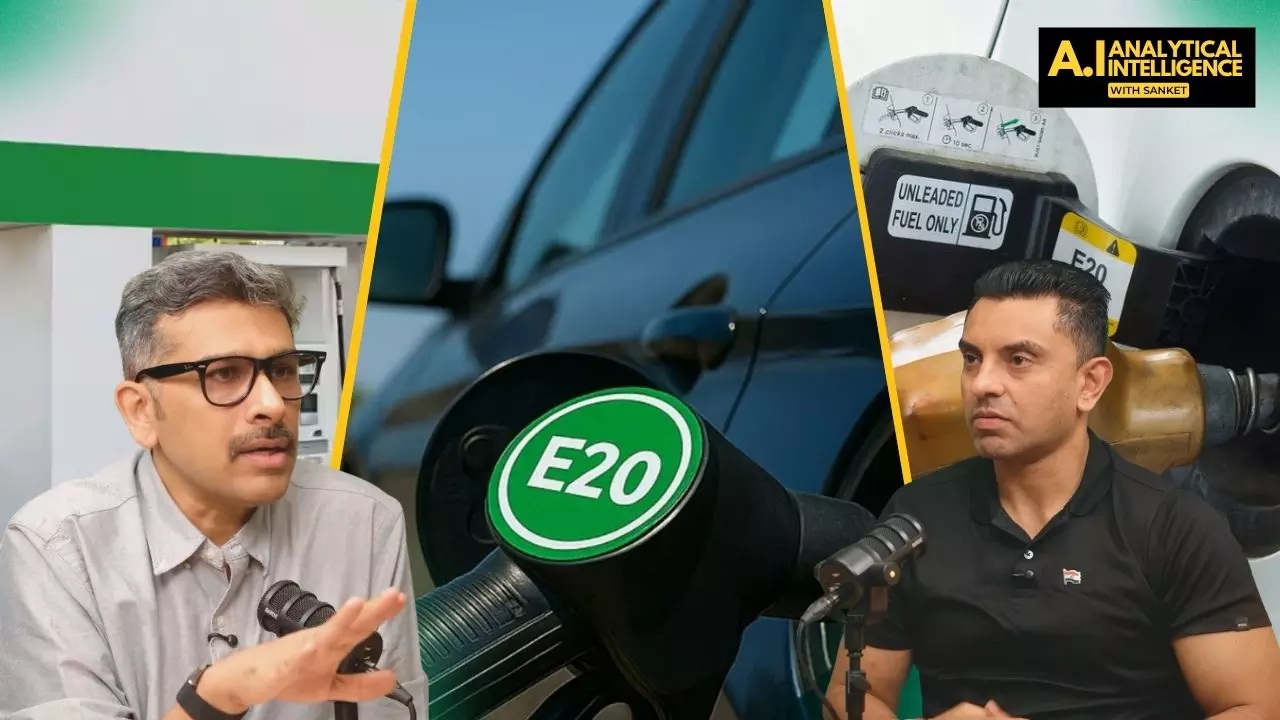
Why is E20 policy report not in public domain if it's beneficial for India?: Tahseen Poonawala
Team Bharat founder weighs in on opacity of Centre’s E20 policy, its toll on Indian consumers, and why Union ministers Nitin Gadkari and Hardeep Singh Puri must answer for its failure

“If the E20 policy is truly in the interest of Indians, why is the government's key report on it not in the public domain?" That's the question political commentator Tahseen Poonawala says lies at the heart of the controversy surrounding India's ethanol-blended fuel policy. He argues that consumers have been denied transparency while bearing higher vehicle maintenance costs and lower fuel efficiency.
Ahead of a protest planned against the E20 fuel rollout on July 31, Poonawala, also the founder of Team Bharat, which is leading the movement, in a discussion with The Federal, talks about the economic rollout of the opaque and “non-consensual” policy on Indians, his campaign and why Union ministers Nitin Gadkari and Hardeep Singh Puri must be held accountable for the policy’s failure.
Why have you chosen to take up the ethanol issue?
Because this is an issue that affects most Indians. For most Indians, a vehicle is the second-most expensive purchase they make. It is usually bought during a happy occasion — Diwali, Christmas or Eid. When that vehicle becomes a source of stress instead of happiness, it affects every aspect of life.
I also believe this was a non-consensual policy. As we've gone deeper into it, we've realised the government has kept citizens completely oblivious of what should have been our right to know.
Also read: From mileage loss to rising repair bills: What a survey on E20 fuel found
If this policy is so beneficial for Indians, why is the E20 policy document not in the public domain? Why can't The Federal examine it? Why can't you read it? Why can't ordinary citizens access it? If it is in my interest, why is it being kept secret?
The government's opacity is what has angered people. At the same time, people are experiencing real financial losses. Fuel efficiency has reduced, vehicle maintenance costs have increased and many are facing technical issues.
What exactly are your demands from the government?
Our demands are very clear.
First, the price of ethanol-free petrol—E0 or pure petrol—which is currently available at a limited number of company-owned petrol pumps for around ₹165-170 per litre, should be brought down to ₹90 per litre. I will explain later why I believe this price is achievable.
Second, we are not against E20 fuel. But 80 to 90 per cent of vehicles currently on Indian roads are E10 compliant. Those vehicles should be supplied with E10 fuel according to their design specifications. E20 should continue as an option. In fact, it should be sold at a discount.
Also read: Are automakers misleading E20 consumers? | AI With Sanket
Third, every document relating to the E20 policy should be placed in the public domain.
Fourth, vehicles that have suffered because of E20 fuel should have a proper resolution mechanism.
And finally, Union ministers Nitin Gadkari and Hardeep Singh Puri must be held accountable for what I consider a complete policy failure.
Why do you believe these documents should be made public?
Because it is a matter of public interest. The reports that are publicly available include studies by IIT Kanpur and ARAI. But the most important report—which reportedly discusses damage to rubber components and vehicle compatibility—is not available to the public.
If the policy is genuinely beneficial, there is no reason to keep those findings hidden.
Many consumers are worried about higher maintenance costs, lower mileage, and now fuel contamination. How do you see these concerns?
The biggest concern for people is maintenance costs. The second is mileage. Before buying a vehicle, one of the first questions every Indian asks is, “Kitna deti hai? (What is the mileage?)" Fuel efficiency matters enormously.
The third concern is contamination. Today, consumers are being told that water has entered ethanol-blended petrol. Car manufacturers say their vehicles are designed for petrol, not water contamination.
So who takes the responsibility?
I have paid taxes to buy my vehicle. I have paid taxes on the vehicle itself. I pay taxes every time I buy fuel. After doing all this, the least I deserve is peace of mind—not anxiety over adulterated fuel.
Also read: The Cockroach Effect: Two new online movements now target E20 fuel, caste quotas
If adulterated fuel is reaching consumers, that is the government's responsibility. I don't manufacture fuel at home. I don't choose adulterated petrol.
Oil companies argue the issue is adulteration, not ethanol itself. What is your response?
I don't know anyone who has ever walked into a petrol pump and asked for adulterated fuel. If adulterated fuel is being sold, the responsibility lies with the government and the petroleum ministry.
But there's another technical issue. According to the hidden ARAI (Automotive Research Association of India) and Committee of Indian Manufacturers reports, the country wasn't originally supposed to move fully to E20 until 2030 because older vehicles needed time to phase out.
The reports also mention that more than one lakh petrol pumps are not adequately equipped to store E20 fuel because ethanol absorbs moisture.
Also read: Gadkari files Rs 11-cr civil lawsuit over E20 deepfakes; here’s what it says
So the question is: how many petrol pumps have actually upgraded their storage infrastructure?
Reports suggest ethanol absorbs moisture during the monsoon. Is that one of your concerns?
Yes. A report in The Hindu quoted petrol pump dealers as saying that during the rainy season ethanol-blended fuel absorbs moisture, leading to water contamination inside storage tanks.
Oil marketing companies have reportedly shifted responsibility to petrol pump owners by asking them to inspect tanks three times a day. Pump owners say that isn't practically possible. This is why separate storage infrastructure should have been created before implementing the policy.
I am not saying ethanol itself is bad. Ethanol has benefits for the country. But national interest cannot come at the cost of consumers.
The government says blending has been increasing gradually over the years. Why object now?
Because consumers believed they were using E10 fuel. Now we are officially told it is E20. That naturally raises another question. How can I be sure I am getting exactly E20 today? What if tomorrow it becomes E22 or E25 and we are informed years later?
Basic consumer rights require transparency. You cannot experiment on citizens without their informed consent.
You're organising a protest on July 31. What exactly is planned?
We plan to take cars, motorcycles and even bicycles from India Gate to the residences and offices of Hardeep Singh Puri and Nitin Gadkari. It will be a peaceful vehicle rally. We're prepared to cooperate fully with the police. If they want us to move in a single lane, we'll do that. We are willing to follow every law. I have personally taken responsibility for this protest.
Also read: BJP-NDA supporters reject E20: 'Government should listen to people's feedback'
Unfortunately, the Delhi Police has not been cooperative. We have been told permission may not be granted and that participants could be arrested. My response is simple: if they arrest me, I'll sit in jail. I am a citizen with a legitimate grievance. The state cannot simply threaten peaceful protesters.
If permission is denied, what will you do?
I can only control my own actions. I am prepared to cooperate with the authorities. If violence occurs, I will accept responsibility for my protest. But I also expect the police to cooperate in preventing infiltration by outsiders. Everyone joining us is being registered. We know who our participants are. I don't want this protest diverted towards any issue other than ethanol, petrol prices and consumers' money.
Why have you singled out Nitin Gadkari for accountability when he is not the petroleum minister?
That's precisely my point. Why is he speaking so much about ethanol if he isn't the petroleum minister? He repeatedly made public statements saying he had signed files for 100 per cent ethanol and that petrol would no longer be required. My question is: in what capacity was he making those claims? If he was speaking as a Union minister, then he must be accountable for the promises he made.
Also read: Policy over choice? Experts flag consumer risks in E20 fuel rollout | AI With Sanket
He publicly said Indians would one day get petrol for ₹15 because of ethanol blending. Today people are paying ₹102 or more per litre. If you make commitments as part of the government, you must stand by them.
My second concern is conflict of interest. His children are in the ethanol business. I believe that creates an ethical conflict. It may not be a criminal issue, but it certainly raises questions of propriety. When you are part of Cabinet discussions and your family has business interests connected to the same sector, people naturally ask questions.
Many people online seem angrier with Nitin Gadkari than Hardeep Singh Puri. Why do you think that is?
Because Gadkari has become the face of the policy. People hear statements about flying buses, 100 per cent ethanol and futuristic promises. But, most Indians simply want their bikes and cars to function properly. They're saying, “Experiment with flying buses if you want. Don't experiment on our vehicles. Our vehicles are E10 compliant. Give us E10 fuel. That's all we're asking."
Do you think advancing the E20 rollout from the original 2030 target was a mistake?
Yes. The original 2030 deadline was more practical. Celebrating the fact that the target was achieved five years early may sound like an achievement, but it has come at the cost of consumers. If this policy is genuinely beneficial, why are the supporting documents still not in the public domain?
Also read: E20 petrol row: India denies Bhutan export claim, documents tell different story
Most vehicles on Indian roads today were manufactured before 2023. Around 80 to 90 per cent of them are designed only for E10. If E20 works perfectly in E10 vehicles, then why did manufacturers redesign their vehicles after 2023? It simply doesn't add up.
Government ministers argue that vehicles haven't suddenly stopped working because of E20. How do you respond?
That's not how engineering works. If someone gradually consumes something harmful every day, the effects don't appear overnight. The same applies to vehicles. A vehicle designed to last 15 years may now last only 10. And then you have a vehicle scrappage policy waiting.
So a middle-class family is pushed into another loan much earlier than expected. I bought my vehicle expecting it to serve me for 15 years. I paid taxes when I earned my income, I paid taxes while purchasing the vehicle, and I paid taxes on fuel. After paying taxes at every stage, I deserve to use my vehicle without unnecessary policy-driven damage.
You've repeatedly spoken about consent. Why is that so important?
Because democracy begins with consent. Give me a choice, take my permission; that's all. If citizens are denied both choice and transparency, then what remains of consumer rights? That's Democracy 101.
Do you believe the government could eventually reconsider the policy?
I am not interested in making the government bow before me. This is my government. I may oppose the ruling party politically, but it is still my government. My priority is policy, not personalities.
Also read: IIT Kanpur claims E20 petrol doesn't harm engine performance
If consensus can be achieved, I welcome it. But choice, transparency and accountability cannot be compromised. I am not fighting for a personal victory. I am fighting for a policy correction.
Some people say this movement is politically motivated because of your known political views. How do you respond?
I am in touch with no politician from the BJP, Congress, Aam Aadmi Party or any other political party regarding this protest. It is entirely a citizens' movement. Yes, I vote for the Congress. I agree with many of its positions. But I also disagree with several of its recent positions. I am openly anti-BJP. I have never hidden that. But does being political make my demands invalid? Absolutely not.
We live in a democracy. Being political is not something to be ashamed of. What matters is that no politician will share my stage. No political speeches will be allowed. No issue other than ethanol, petrol prices and consumer rights will be raised.
You've demanded that pure petrol should cost ₹90 per litre. How did you arrive at that figure?
I asked Members of Parliament to raise questions in Parliament regarding India's actual procurement cost. The government's own figures indicate that petrol currently costs around ₹55 to ₹56 per litre before taxes. I rounded that to ₹60. Add approximately 30 per cent tax and it becomes ₹78. Add another amount for emergency reserves and price stabilisation and you reach roughly ₹90 per litre.
Also read: Most NDA supporters reluctant to adopt E20 petrol: C-Voter survey
So why are consumers paying ₹160 to ₹170 for pure petrol? Where is the additional money going? States and the Centre should work out a mechanism to reduce this burden on citizens.
What should E10 and E20 fuel be priced at?
If pure petrol is ₹90, then E10 should be priced lower. E20 should be cheaper still. That's what consumers were led to believe. But when I asked another parliamentary question, I found that ethanol itself costs the government around ₹70 to ₹72 per litre—more than petrol.
So you're blending a more expensive product into petrol, increasing my costs, while claiming it's being done in the national interest.
That simply doesn't make economic sense."
The government says ethanol benefits sugarcane farmers. What's your response?
I have no objection to helping farmers. But let's look at the facts. Has sugarcane pricing improved significantly? India has restricted sugar exports. So who is benefiting? In my view, sugar mills and ethanol distilleries.
Also read: Are automakers misleading E20 consumers? | AI With Sanket
The leftover ethanol could instead be supplied to industries that currently import ethanol. Why are we importing ethanol while simultaneously forcing expensive domestically produced ethanol into vehicle fuel?
You pointed out that many ethanol distilleries are linked to politicians across parties. Doesn't that weaken your argument against only the BJP?
Exactly. Distilleries are owned by politicians across party lines. Congress leaders benefit, leaders in Maharashtra benefit, politicians in Karnataka benefit, politicians in western Uttar Pradesh benefit. That's precisely why I don't expect political support. If a policy benefits politically connected businesses across parties, then naturally there is little incentive to oppose it.
Some critics have accused you of working for the oil lobby or other vested interests. What do you say?
If I'm leading this protest, then I should be subjected to the strictest scrutiny. I welcome forensic audits of all my accounts. I am willing to place my expenditure in the public domain. So far, my own spending has been modest. I am also willing to undergo any investigation the government wants. If technology permits, I am even willing to take a public lie detector test. I have nothing to hide. But while investigating me, investigate the ministers as well. Hold everyone equally accountable.
Are you connected with the E20 Janata Party?
No. I have nothing to do with that organisation. They used my videos and photographs without my permission. I was as surprised as anyone else.