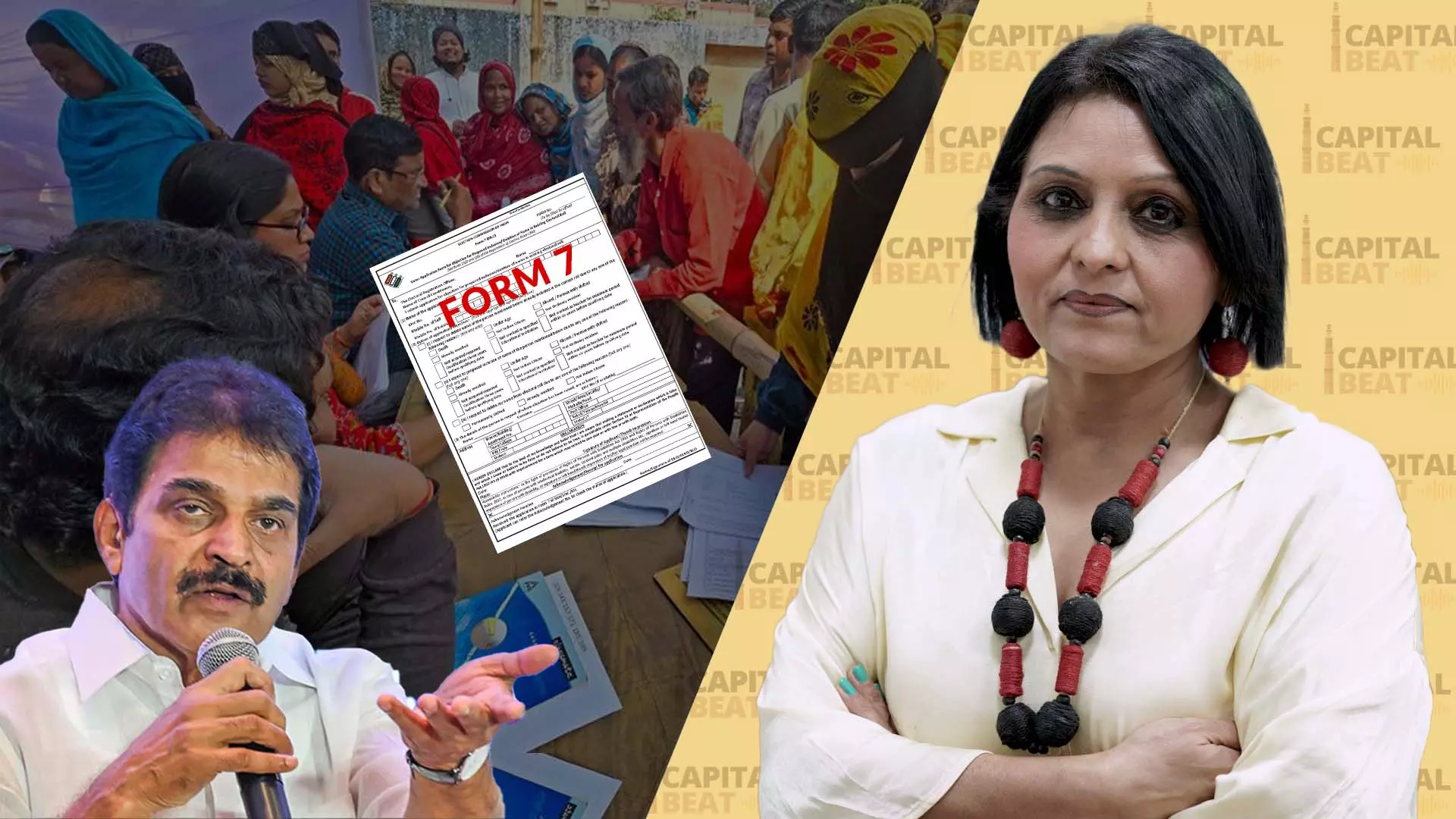
Congress alleges Form 7 misuse during SIR; what experts say | Capital Beat
The issue, first flagged in Rajasthan, was stated to have subsequently emerged in Gujarat, Madhya Pradesh, Chhattisgarh, Uttar Pradesh, West Bengal, Assam, Kerala, and Tamil Nadu, raising concerns about the integrity of the electoral roll revision process

The latest edition of Capital Beat episode brought together election data scientist Dr. Pyarelal Garg, political analyst AS Paneerselvam, and Congress spokesperson Chandhan Ghosh to discuss allegations raised by the Congress over the alleged large-scale misuse of Form 7 during the Special Intensive Revision (SIR) of electoral rolls across multiple states. The discussion focused on claims of mass deletion of voters, procedural violations, and institutional accountability.
The panel examined a letter submitted by Congress general secretary KC Venugopal to the Election Commission (EC), which alleged that Form 7 — a statutory mechanism meant for specific objections such as death or duplication — was being misused to remove eligible voters in bulk.
Also read: Tamil Nadu SIR: Pallakkapatti voters cry foul after 123 living persons marked as dead
The issue, first flagged in Rajasthan, was stated to have subsequently emerged in Gujarat, Madhya Pradesh, Chhattisgarh, Uttar Pradesh, West Bengal, Assam, Kerala, and Tamil Nadu, raising concerns about the integrity of the electoral roll revision process.
What Congress letter alleges
The Congress letter to the EC described what it called a “systematic and coordinated abuse of Form 7”, warning of potential mass disenfranchisement. The letter alleged that bulk pre-printed Form 7 applications, generated through a centralised mechanism, were submitted across multiple assembly constituencies.
According to the letter referenced in the discussion, these objections targeted specific categories of electors, including Scheduled Castes, Scheduled Tribes, minorities, and senior citizens above 60 years of age.
Also read: Assam voter roll revision triggers panic among Muslims; freedom fighters' kin not spared
The party further claimed that the applications lacked mandatory particulars such as verifiable identities of objectors, valid EPIC numbers, and supporting documents, which are required under the Electors Registration Rules, 1960.
Missing particulars, role of booth-level networks
The discussion highlighted that Form 7 requires detailed information about the objector, including name, address, EPIC number, and a declaration of responsibility for the accuracy of the claim.
Dr. Garg stated, “In this form, the details of the objectors have to be given… mother’s name, father’s name, sex, part number, EPIC number, everything has to be given, but it is not being taken.”
The Congress letter, as discussed on the show, alleged that several individuals named as objectors were later traced and either identified as BJP booth-level agents or denied having filed any objection.
Alleged scale of voter deletions highlighted
Dr. Garg cited figures from multiple states to underline the scale of alleged deletions. “In Tamil Nadu, more than 90 lakh voters have been removed,” he said, adding that this amounted to nearly 18 per cent of the electorate in the state.
He also referred to Kerala, stating, “In Kerala, where there are only 2 crore 78 lakh voters, around 24 lakh have been removed by the misuse of these forms.”
Drawing comparisons, Dr. Garg noted that the numbers exceeded deletions seen in Bihar, which had earlier triggered political controversy.
Legal framework and procedural violations raised
Dr. Garg argued that the SIR exercise itself violated statutory provisions under the Representation of the People Act, 1950, and the Electors Registration Rules, 1960.
“The procedures are concerned, the People’s Representation Act 1950 provisions… are all violated,” he said, adding that even judicial scrutiny had not addressed key sections of the law governing voter deletion.
He described the alleged misuse of Form 7 as “nothing but havoc playing with the democratic system of the country.”
Bengal deletions contested and revised
Congress spokesperson Ghosh detailed the situation in West Bengal, stating that large-scale deletions had been challenged repeatedly.
“In West Bengal, the deletion was made 1.67 crore,” he said, adding that after challenges, the number was reduced in stages to 1.37 crore and later to 98 lakh, with objections still ongoing.
Ghosh claimed that the issue had existed even before the SIR began and that complaints submitted after previous elections did not receive resolution.
Psychological impact and voter distress
Ghosh described what he called a climate of fear among voters. “The electorates are completely under psychological fear,” he said, adding that voters felt their identities were being challenged.
He also claimed that over 100 suicide cases were reported in the state during the period, linking them to distress caused during the electoral revision process.
Tamil Nadu: scrutiny by regional parties
Political analyst Paneerselvam stated that political parties in Tamil Nadu were closely examining the draft electoral roll figures.
“Both DMK and AIADMK at some level identified that there is a problem in the draft released by the EC,” he said.
Paneerselvam pointed to the non-use of the national register of births and deaths as a key issue. “Why is the national register of birth and death not been considered for removing the names who are dead?” he asked.
Questions on accountability of objectors
Paneerselvam questioned the accountability mechanism behind Form 7 objections. “The complainant is not answerable. The complainant is not visible,” he said.
He argued that identifying a voter as bogus without clear responsibility undermined due process, particularly when India maintains extensive birth and death records.
Institutional boundaries and executive overreach
Paneerselvam raised concerns about institutional overreach, referencing statements by political executives defending the process.
“Government can never defend autonomous institutions like Election Commission,” he said, adding that such defence blurred constitutional boundaries.
He questioned why multiple institutions were not integrated into the verification process, despite available documentation systems.
Correlation between deletions and electoral margins
Paneerselvam highlighted what he described as a numerical pattern. “The voters numbers which have been put in the draft… is also the difference between the winning coalition and the opposition coalition,” he said, citing Tamil Nadu’s 2024 parliamentary election margins.
He stated that while he could not identify who orchestrated it, the correlation warranted scrutiny.
Calls for public assertion of voting rights
Dr. Garg argued that institutional remedies had failed to address the issue. “When the court is not giving you any respite… the only alternative is that the people start talking about their rights,” he said.
He described the issue as “not a voting right of a political party… the voting right of an Indian citizen.”
Political parties and public mobilisation
Ghosh stated that writing to the Election Commission was part of alerting the public and building awareness. “We are making the sensations. We are alerting the people,” he said.
He described the effort as an attempt to take the issue to what he termed the “people’s court”, emphasising public accountability over institutional silence.
(The content above has been transcribed from video using a fine-tuned AI model. To ensure accuracy, quality, and editorial integrity, we employ a Human-In-The-Loop (HITL) process. While AI assists in creating the initial draft, our experienced editorial team carefully reviews, edits, and refines the content before publication. At The Federal, we combine the efficiency of AI with the expertise of human editors to deliver reliable and insightful journalism.)