








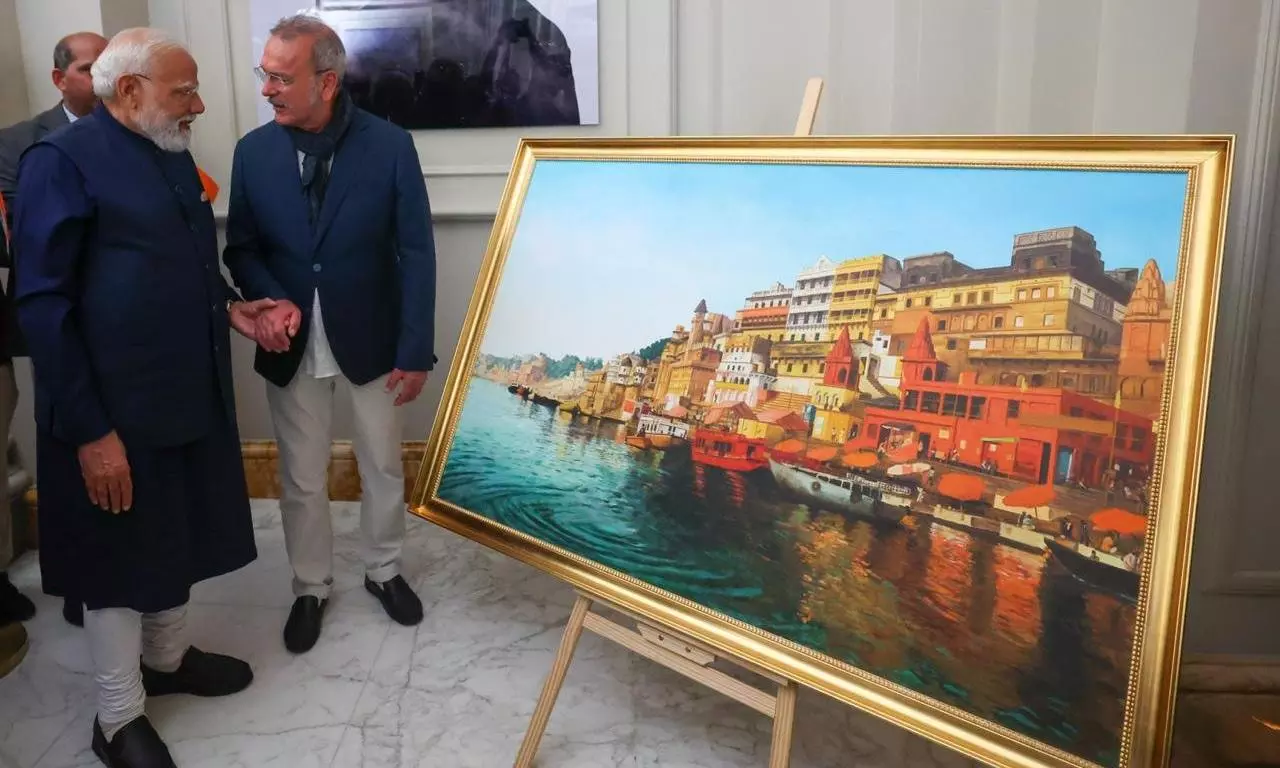
Italian artist Giampaolo Tomassetti presents his painting 'Holy Varanasi' to Prime Minister Narendra Modi during his visit to Italy, on May 20. Photo: X/Narendra Modi
Who is Giampolo Tomasseti, Italian painter who gave Modi ‘a glimpse of Kashi in Rome’?
Italian artist Giampaolo Tomassetti described his Varanasi painting for PM Modi as a cultural bridge between Italy and India

Prime Minister Narendra Modi was presented with a special painting of Varanasi during his visit to Italy, marking a cultural highlight in the final leg of his five-nation tour.
The artwork, titled ‘Holy Varanasi’, was created by Italian artist Giampaolo Tomassetti and depicts the sacred ghats of Varanasi along the banks of the Ganga using mixed artistic techniques, including acrylic colours.
The ‘bridge’ connecting Italy, India
Describing the work, Tomassetti said the painting reflects India’s spiritual vibrancy and cultural richness. “I call it Holy Varanasi. It is very colourful, reflecting the vibrant culture of India,” he told IANS, adding that he viewed the artwork as a “bridge” connecting the vision of an Italian artist with the spirit of India.
Also read: Beyond ‘Melodi’: Modi-Meloni meeting focuses on trade, AI and strategic cooperation
Responding to the gesture, Modi, who is also the MP from Varanasi, praised the artist’s longstanding engagement with Indian culture and noted that his fascination with Indian spirituality and mythology spans more than four decades. The Prime Minister also acknowledged Tomassetti’s work as an illustrator associated with Vedic literature and Mahabharata-inspired art.
Deep connection with India
Though born and raised in Italy, Tomassetti developed a deep interest in Indian philosophy and spirituality at a young age. His fascination reportedly began at the age of 17 after watching British director Peter Brook’s theatrical adaptation of the Mahabharata.
Over the years, he immersed himself in Indian scriptures including the Bhagavad Gita, the Mahabharata and the Ramayana, drawing artistic inspiration from their themes, symbolism and spiritual ideas.
“I found India extremely rich in culture, sculptures and paintings,” the artist said, adding that his repeated visits to India further strengthened his connection with Bhakti Yoga and spiritual living.
Also read: Netherlands hands back Chola copper plates; ties to go up to strategic partnership level
Tomassetti also worked closely with the Bhaktivedanta Book Trust as an illustrator for books on Vedic culture. During that phase of his life, he reportedly lived as a monk for nearly nine years under the name Jnananjana Dasa.
Mahabharata masterpieces
The Italian painter is especially known for his large-scale oil painting series based on the Mahabharata, where he combines European Renaissance artistic techniques with Indian mythological and spiritual themes.
His most celebrated work is a collection of around 25 massive oil-on-canvas paintings portraying scenes from the Mahabharata. Reports suggest he spent nearly five years studying the epic and over a decade creating the series.
Also read: Why Modi is betting on Dutch tech to save Gujarat’s mega-dam Kalpasar project
The paintings are currently displayed at the Museum of Sacred Art at Villa Vrindavana in Florence.
What makes Tomassetti’s work distinctive is the fusion of classical European realism with Indian spiritual storytelling. His paintings are known for their dramatic lighting, detailed anatomy and emotional portrayal of characters such as Krishna, Arjuna and Karna.
Apart from oil paintings, Tomassetti has also worked across mediums including acrylics, frescoes, watercolours, pastels and clay sculptures.