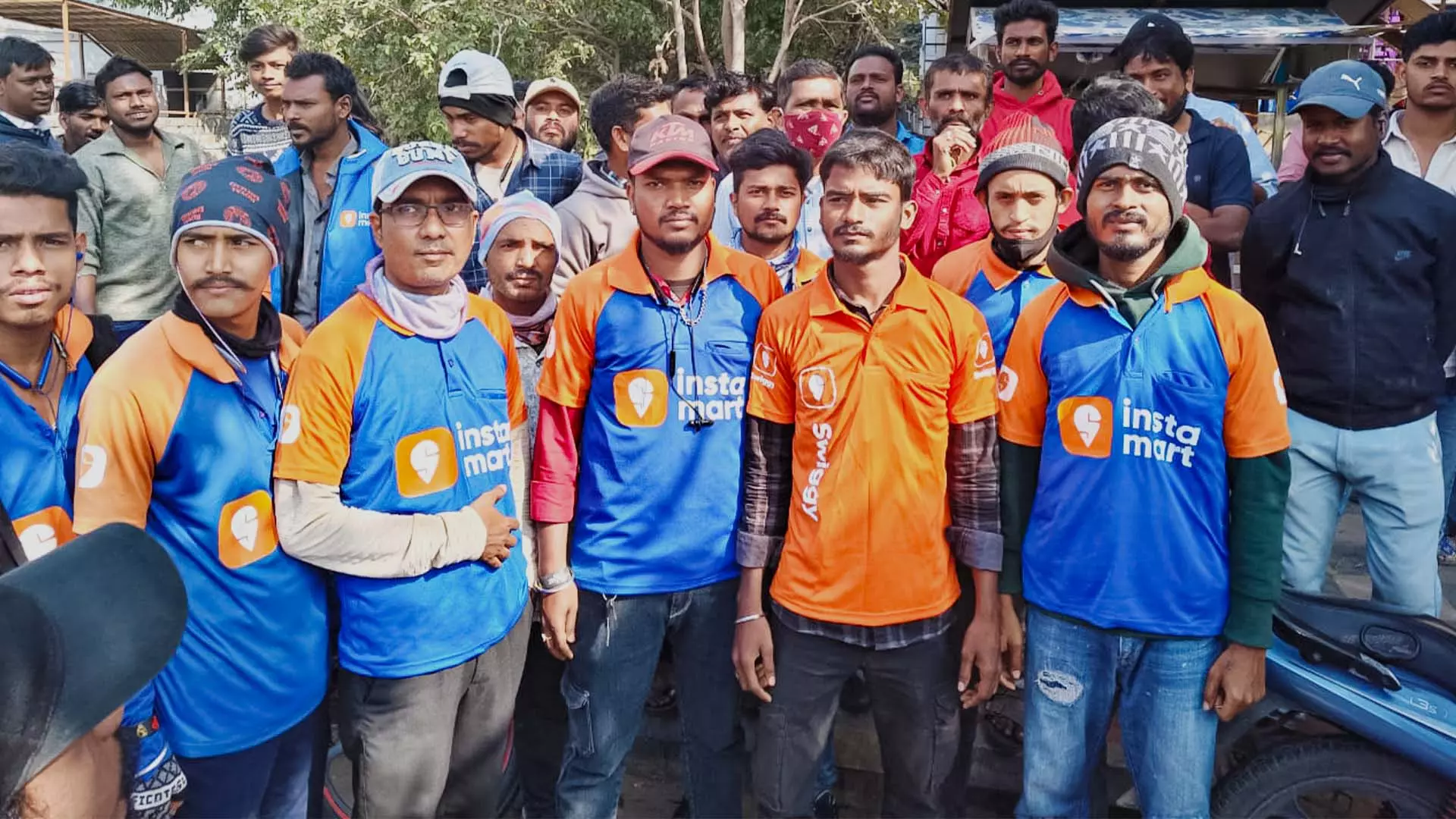
Gig workers strike on New Year’s Eve over worsening work conditions
Delivery partners across platforms like Swiggy and Zomato resent falling wages and 10-minute delivery targets that they say risk lives

India’s booming quick-commerce economy faced a disruption, albeit limited, on Wednesday (December 31) as gig workers across platforms called for an all-India strike. Among the services that were affected on New Year's Eve were food and parcel deliveries. The effect was mainly seen in Bengaluru, Hyderabad and parts of Telangana.
Delivery partners from leading apps such as Swiggy, Zomato, Blinkit, Zepto, Amazon and Flipkart took part in the protest, raising concerns about falling wages, safety risks and the lack of basic protection for workers.
Also read: New labour codes: From gratuity after 1 year to equal pay, all you need to know
The strike, announced by workers' unions, comes at a time when app-based delivery services have become deeply embedded in urban life, promising groceries, food and parcels in minutes.
Who protested
The Telangana Gig and Platform Workers Union and the Indian Federation of App-Based Transport Workers, which have been mobilising delivery workers across multiple states for the protests, said lakhs of workers were set to join the strike.
Union leaders say the strike is meant to draw attention to what they describe as worsening working conditions in the gig economy, even as companies record growing demand and expansion.
This was not an isolated action. A flash strike on December 25 had already disrupted deliveries in several states, including Delhi, Haryana, Maharashtra and Karnataka.
Earlier strike
Referring to the December 25 protest, one union representative said, “And you already saw it (the impact of the strike) the day before yesterday. On the 25th, 40,000 workers took part in a flash strike. 50–60 per cent of deliveries were delayed. This had a big effect.”
Also read: Karnataka govt passes Gig Workers’ Bill
The scale of that disruption, workers say, showed how dependent platforms are on a workforce that has little job security or bargaining power.
It also emboldened the unions to call for a nationwide action on one of the busiest delivery days of the year.
Falling pay
At the heart of the strike is the issue of shrinking payouts per delivery. Workers say their earnings have steadily declined, even though delivery volumes have increased.
One delivery worker explained the drop in wages in blunt terms: “Earlier, we used to get Rs 80 per delivery. Then it became Rs 60, Rs 40, and Rs 20. Now it has come down to Rs 10 and Rs 5. This should not happen. We are demanding the old payout.”
Another worker added that there is no legally guaranteed minimum: “We cannot call it a minimum wage. Rather, a minimum rate per kilometre and per order should be decided. The government should make a decision and fix a rate.”
Unsafe targets
Workers also blame ultra-fast delivery models for putting their lives at risk. They argue that 10-minute delivery targets force riders to speed through traffic, increasing the chances of accidents.
Also read: Karnataka gig workers worried over new problem amid bike taxi ban
One protester said, “A lot of road accidents are happening during these 10 minutes. Many people are losing their lives. In Hyderabad, Telangana, six delivery boys have died. Many people have lost their limbs in such accidents. And many people are still bedridden.”
According to unions, the pressure to meet impossible deadlines leaves workers with little choice but to take dangerous risks on the road.
No safety net
Beyond wages and safety, the gig workers were also demanding basic social security benefits such as health insurance, accident cover and pension support.
Most app-based delivery partners currently do not receive these protections, despite working long hours and facing high risks of injury.
The workers also alleged that platforms control their livelihoods through opaque app systems that can suddenly reduce orders or block accounts without warning.
App control
One worker described how penalties and ratings affect their survival, “If a delivery is late, the late penalty also has to be paid by the worker. The company did not ask me whether I could give a 10-minute delivery or not. For the PR of your company, and for your benefit, you have introduced a 10-minute delivery.”
He added, “It (late delivery) would affect everything, like the CIBIL score. Once the ID is blocked, it affects our daily meals.”
For many delivery partners, a blocked account or poor rating can instantly cut off their only source of income.
Why it matters
While customers may feel the impact through delayed or cancelled orders, the unions said the strike highlights a much deeper crisis in India’s gig economy.
Also read: Domestic workers at the touch of an app: Exploitation in a new format?
Low and unstable pay, dangerous delivery targets and the absence of social security, they argue, are pushing millions of young workers into insecure and high-risk jobs with little long-term protection.
As India’s appetite for instant deliveries grows, the question now is whether platforms and policymakers will address the demands of the workers who keep such a system running.
The content above has been transcribed using a fine-tuned AI model. To ensure accuracy, quality, and editorial integrity, we employ a Human-In-The-Loop (HITL) process. While AI assists in creating the initial draft, our experienced editorial team carefully reviews, edits, and refines the content before publication. At The Federal, we combine the efficiency of AI with the expertise of human editors to deliver reliable and insightful journalism.