








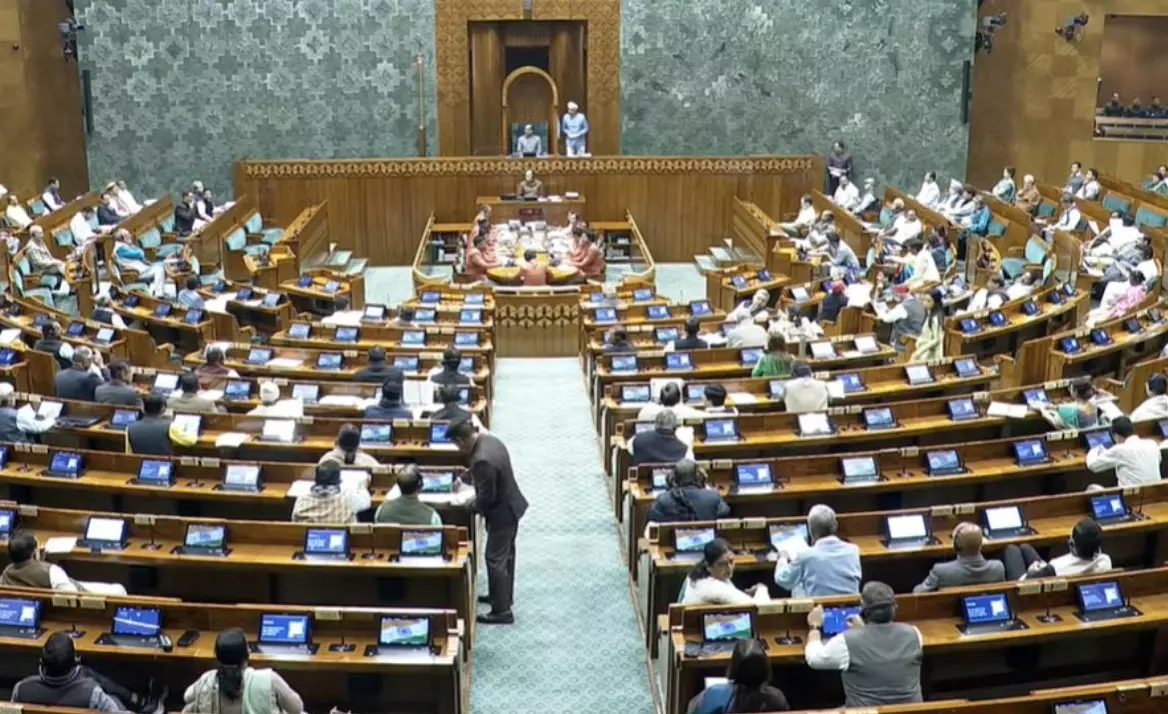
Delimitation: Govt proposes to increase Lok Sabha seats to 850
The BJP-led government to introduce Bills on Thursday (April 16); the Opposition sees a plot

The Union government proposed on Tuesday (April 14) to increase the total number of seats in the Lok Sabha to 850, comprising 815 from the states and 35 from the Union Territories.
The BJP-led NDA government is set to introduce Bills on delimitation in the Parliament on Thursday (April 16).
The Budget session of Parliament has been extended, and a special three-day sitting of the House has been convened from April 16 to 18.
With regard to delimitation, the Constitution (131) Amendment Bill has been circulated among the MPs.
33 per cent reservation for women
According to the draft Constitution Amendment Bill, which will be introduced and expected to be passed in the upcoming special sitting of Parliament, seats would also be increased in state and Union territory assemblies to accommodate 33 per cent reservation for women.
The seats reserved for women in Lok Sabha and legislative assemblies "shall be allotted by rotation to different constituencies in a state or Union territory," the Bill circulated among Lok Sabha members said.
Besides other provisions, the bill seeks to amend Article 81 of the Constitution.
It states that "The House of the People (Lok Sabha) shall consist of not more than 815 members chosen by direct election from territorial constituencies in the states; and not more than 35 members to represent the Union territories, chosen in such manner as Parliament may by law provide." The expression "population", according to the bill, means the population as ascertained at such census, "as Parliament may by law determine", of which the relevant figures have been published.
As of now figures of 2011 Census are available. The 2027 Census exercise, which began on April 1, is ongoing.
The government plans to bring a Constitution amendment Bill, a Bill on delimitation law and an enabling bill to apply the proposed law in Delhi, Jammu and Kashmir and Puducherry – three Union territories with legislature – on Thursday in Lok Sabha to fast track implementation of the women's reservation Act of 2023.
The current strength of the Lok Sabha is 543.
Betrayal of federal assurances, says Yogendra Yadav
Noted political analyst and activist Yogendra Yadav has issued a scathing critique, warning that the legislation is a "move to facilitate early delimitation" disguised as a push for women's representation.
Also Read: Delimitation explained: Will 2029 Lok Sabha elections tilt against southern states?
In a series of pointed observations on X, earlier known as Twitter, Yadav claimed the bill opens the "floodgates" for a total reallocation of Lok Sabha seats and widespread gerrymandering, potentially disenfranchising entire regions of the country.
According to Yadav, the bill — set to be introduced in this week's special parliamentary session — reneges on specific promises made by the Prime Minister and senior ministers regarding the protection of state-wise representation.
Lifting the 1971 freeze: Yadav highlights that the bill completely removes the existing freeze on seat allocation (based on the 1971 census) without the "safeguards the government was promising."
The 815-seat expansion: While the government justifies the expansion to 815 seats as a necessary step for the Women’s Reservation Bill, Yadav argues this is a tactical maneuver to bypass current constitutional protections.
No proportional guarantee: ''Contrary to the assurance of the PM," Yadav noted, "there is nothing in this bill to ensure that the present proportion of seats for each state would be maintained."
The most significant concern raised by Yadav involves a technical shift in how the census is utilised. He points out that the decision of which census will serve as the basis for redrawing boundaries is being moved from the Constitution to the "domain of law."
Yadav also sounded the alarm on the lack of judicial oversight. Under the proposed framework, the work of the Delimitation Commission—which will decide the political map of India for decades to come — cannot be challenged in a court of law. By removing the judiciary's ability to intervene, Yadav suggests the bill creates a vacuum where gerrymandering can occur without accountability, fundamentally altering the democratic balance between the North and South.
'A death warrant to federal India'
CPI(M) MP John Brittas slammed the government and said that the proposed women’s reservation and the delimitation measures a death warrant for federal India. "The government has outright rejected the opposition’s demand for detailed discussions and consultations before proceeding with these constitutional amendments," he posted on his social media handle.
Stalin warns Modi govt
Meanwhile, Tamil Nadu Chief Minister MK Stalin on Tuesday warned of massive agitations bringing Tamil Nadu to a standstill and "protests with full force," if anything was done harming the state or if the political power of northern states was disproportionately increased in delimitation.
Reiterating his allegation that secrecy shrouds the proposed delimitation process, Stalin in a video message said that without consulting not just the DMK but any political party or any state, the BJP-led Centre was attempting to proceed unilaterally.
"We do not even know how this delimitation exercise is going to be carried out. No explanation has been provided so far regarding the proposed Constitutional amendment." When such secrecy surrounds this process, it only strengthens the suspicion that a grave danger lies beneath. The people of the southern states are gripped with deep concern, he said.
Telangana Chief Minister Revanth Reddy has written an open letter to PM Modi. He shared the letter on his X account.