








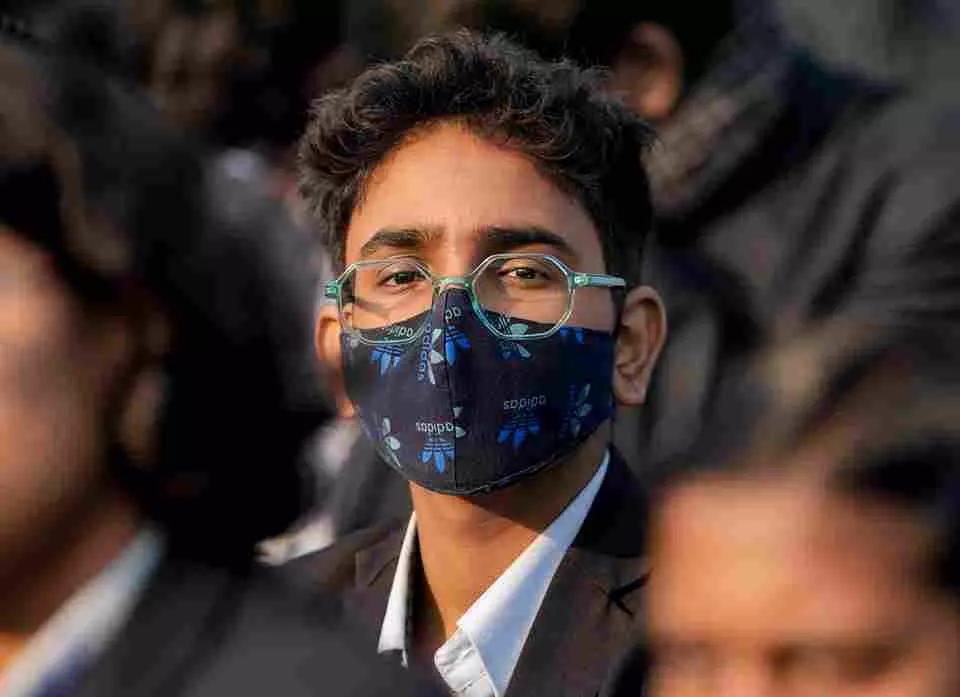
A student wears a mask during an event due to deteriorated air quality in the national capital, in Delhi, last week. Photo: PTI
India sets own norms, says global air quality rankings carry no official sanction
Centre told Parliament, WHO guidelines are advisory, as India evaluates its air quality using its own national standards, and its annual Swachh Vayu Surveksha

India sets its own air quality norms, and global rankings released by various organisations like World Health Organisation (WHO) carry no official sanction, the Centre told Parliament on Thursday (December 12).
Further, the government also said that air quality guidelines are advisory in nature and do not constitute binding standards for the country.
As air pollution continues to pose a huge challenge, the government made this statement in the Rajya Sabha, in response to a query about India’s position in global indices such as IQAir’s World Air Quality Ranking, the WHO Global Air Quality Database, the Environmental Performance Index (EPI), and the Global Burden of Disease (GBD) metrics.
Advisory tools
According to minister of state for environment, Kirti Vardhan Singh, WHO guidelines serve only as advisory tools to assist countries in developing their own standards, taking into account the geography, environmental conditions, and local circumstances.
Also, he pointed out that there are no official rankings conducted by any global authority.
India's ranking system
India has already issued its National Ambient Air Quality Standards (NAAQS) covering 12 major pollutants to safeguard public health and environmental quality, he noted. And the government, through it annual evaluates air quality within the country through its annual Swachh Vayu Surveksha.
Also read: Delhi is a 'gas chamber'; move ministries and SC benches, says DMK MP in RS
This programme ranks 130 cities under the National Clean Air Programme (NCAP) based on improvement efforts.
Swiss air quality report
Months before the Centre came up with this response to the air pollution crisis, IQAir, a Swiss air quality monitoring company, reported that India had failed to comply with the WHO’s stringent 2024 air quality norms.
The report released in March this year ranked India fifth globally for smog levels, noting that 13 of the world’s 20 most polluted cities are located in the country.”
Also read: Mumbai joins Delhi in battle against toxic air; enforces GRAP 1V as AQI dips
Byrnihat in Assam ranked first on the list, while Delhi was identified as the world’s most polluted capital. In recent months, Delhi’s Air Quality Index has repeatedly plunged to hazardous levels, underscoring its struggle for clean air.