








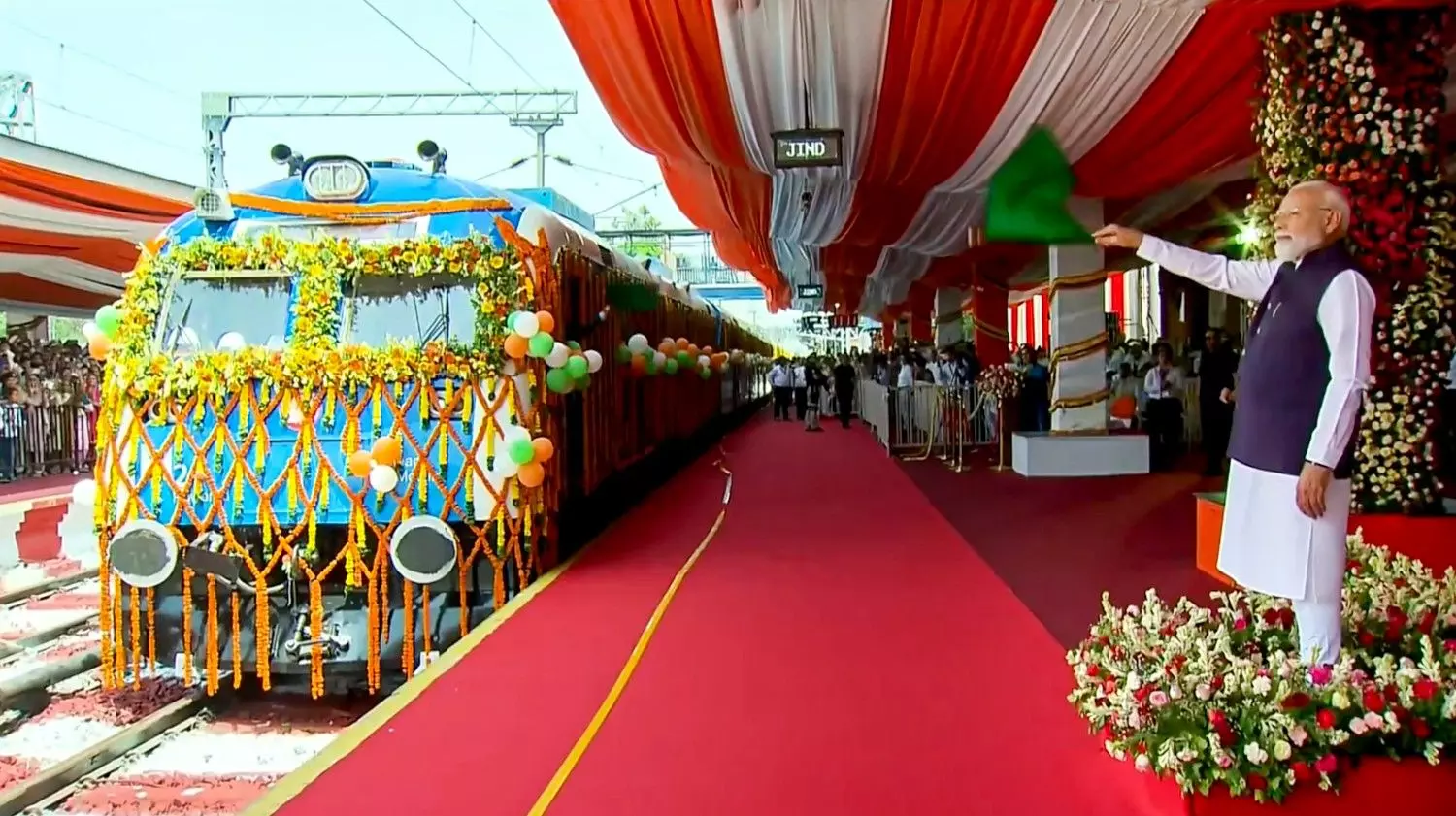
In this screengrab from a video posted on July 17, Prime Minister Narendra Modi flags off India's first hydrogen-powered train, between Jind and Sonipat, at Jind Railway Station, Haryana. (@NarendraModi/YT via PTI Photo)
India's first hydrogen train flagged off by PM Modi in Jind
The use of green hydrogen also reduces dependence on electricity generated from fossil fuel-based thermal power plants, supporting India's transition to sustainable transport

India got its first hydrogen-powered train on Friday (July 17), with Prime Minister Narendra Modi flagging off the train from Jind railway station, marking a major push towards sustainable transportation. The train connects Jind to Sonipat in Haryana, covering the 89-kilometre distance in two hours, with 12 halts.
The prime minister waved as the train, which also had many schoolchildren on board, chugged off from the Jind railway station. Railway Minister Ashwini Vaishnaw, Haryana Governor Ashim Kumar Ghosh and Chief Minister Nayab Singh Saini were among those present at the Jind railway station for the flagging-off ceremony.
Also read: India's first hydrogen train: Route, all you need to know
With the launch, India joins a select group of countries operating hydrogen-powered trains, marking a significant step in Indian Railways’ shift towards green mobility.
Indigenous technology
Designed, engineered and integrated in India, the train has been developed using indigenous technology, reflecting the country's growing capabilities in advanced railway engineering.
The train, styled in a striking sky-blue and white colour scheme, is powered by hydrogen fuel cell technology, which converts hydrogen into electricity to propel the train.
The process produces only water vapour as a by-product, resulting in zero carbon emissions during operation.
Lower emission
Compared to diesel trains, they eliminate tailpipe emissions, lower dependence on fossil fuels and fossil fuel imports, and operate with significantly less noise.
Also read: IRCTC beta website launched with faster ticket booking, passengers can test new features
Unlike conventional electric trains, they do not require continuous overhead electrification infrastructure, as electricity is generated onboard through hydrogen fuel cells, making them a clean and efficient solution.
The use of green hydrogen also reduces dependence on electricity generated from fossil fuel-based thermal power plants, supporting India's transition to sustainable transport.