








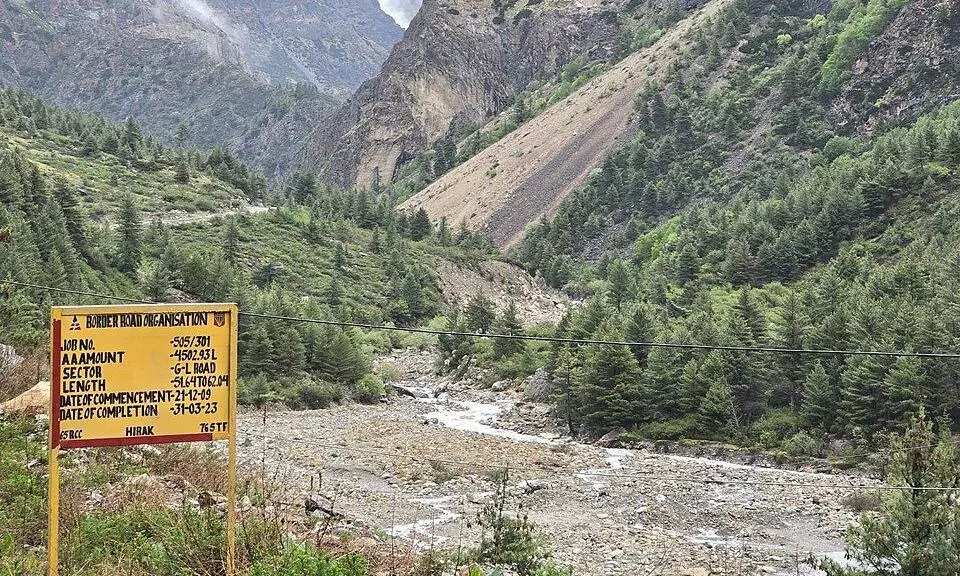
The Kali River carves a natural boundary between the mountains of India and Nepal. File Photo: Wikimedia commons
India-Nepal border row: Why Kalapani, Limpiyadhura, Lipulekh are key for both nations
Nepal Prime Minister Balen Shah recently sparked debate after he remarked that both India and Nepal have encroached on each other's territory

The sensitive India-Nepal border dispute has returned to the spotlight after Nepal Prime Minister Balendra "Balen" Shah made unusual remarks questioning the conventional narrative over India's alleged encroachment of Nepali territories.
In his first address to Parliament after assuming office, Shah, who took over in March, said the territorial issue was not a one-sided matter. He claimed that while Nepal has long accused India of occupying its territory, there are also areas where Nepal has encroached on land claimed by India.
Encroachment debate
"After becoming prime minister, I came to know that not only has India encroached on Nepal's land, but Nepal has also encroached on India's land in multiple places," the prime minister told lawmakers in parliament.
Also read: India’s Nepal challenge: From ‘neighbourhood first’ to strategic uncertainty
He also suggested that China and the United Kingdom should be involved in discussions on the dispute, a proposal that marks a departure from the long-standing bilateral approach adopted by both countries.
Shah's comments came during a discussion on the Kalapani-Limpiyadhura-Lipulekh region, a strategically important Himalayan area located near the India-Nepal-China tri-junction. India maintains that the territory is part of Uttarakhand, while Nepal claims it belongs to its far-western region.
Disputed region
The dispute traces its origins to the 1816 Treaty of Sugauli signed between Nepal and British India after the Anglo-Nepalese War. The treaty designated the Kali (Mahakali) River as Nepal's western boundary. However, disagreement over the river's true source eventually gave rise to competing claims over Kalapani, Lipulekh and Limpiyadhura.
Today, around 97 per cent of the nearly 1,850-kilometre (km) India-Nepal border has been mutually agreed upon. The remaining disputes are concentrated mainly in two regions — Kalapani-Lipulekh-Limpiyadhura in the north-west and Susta along the Bihar border in the south.
The Kalapani-Limpiyadhura-Lipulekh region remains a strategically important Himalayan area located near the India-Nepal-China tri-junction. AI generated map
The Kalapani-Lipulekh region carries significance far beyond a territorial disagreement. India has maintained administrative and military presence in the area since the 1962 India-China war, citing strategic security concerns along the Himalayan frontier.
Nepal, however, argues that historical maps and treaty provisions place the territory within its borders.
Kailash Mansarovar Yatra route
Lipulekh Pass also serves as an important route for the Kailash Mansarovar Yatra and facilitates trade with Tibet, making it a geopolitically sensitive corridor.
Also read: India rebuts Nepal’s protest over Lipulekh Pass; calls objections 'unjustified'
Tensions escalated sharply in 2020 when India inaugurated an 80-km road linking Dharchula to Lipulekh Pass. In response, Nepal amended its constitution and adopted a new political map incorporating Kalapani, Lipulekh and Limpiyadhura within its territory. India rejected the move, calling it a unilateral attempt to enlarge Nepal's territorial claims.
More recently, Kathmandu objected to the resumption of the Kailash Mansarovar Yatra through Lipulekh after India and China agreed to reopen the route, arguing that the pass lies within Nepali territory.
Diplomacy talks
Despite periodic tensions, both countries have consistently maintained that the dispute should be resolved peacefully through dialogue. Bilateral mechanisms involving surveyors, historians and boundary experts have been established to examine historical records and maps.
According to Shah, India and Nepal have now exchanged diplomatic notes and agreed to pursue structured negotiations based on objective evidence and expert assessment.
Also read: Trade lifeline under strain as Nepal’s crisis threatens ties with India
Shah's remarks have sparked debate within Nepal itself, with veteran border expert Buddhi Narayan Shrestha rejecting the claim that Nepal occupies Indian territory.
Notably, Shah's comments come a day ahead of a delegation of the ruling Rastriya Swatantra Party led by its chairman Rabi Lamichhane is set to visit India at the invitation of Bharatiya Janata Party president Nitin Nabin.
Despite these disputes, India and Nepal share one of the world's most open international borders. Citizens of both countries can travel, work and reside across the frontier without visas, creating deep economic, cultural and familial ties that continue to underpin bilateral relations.