








India now UAE’s biggest LNG buyer with USD 3-bn deal; aims for mega trade, defence ties
India and UAE set a USD 200-billion trade target by 2032 while pledging a strategic defence partnership and collaboration in nuclear energy and AI technologies

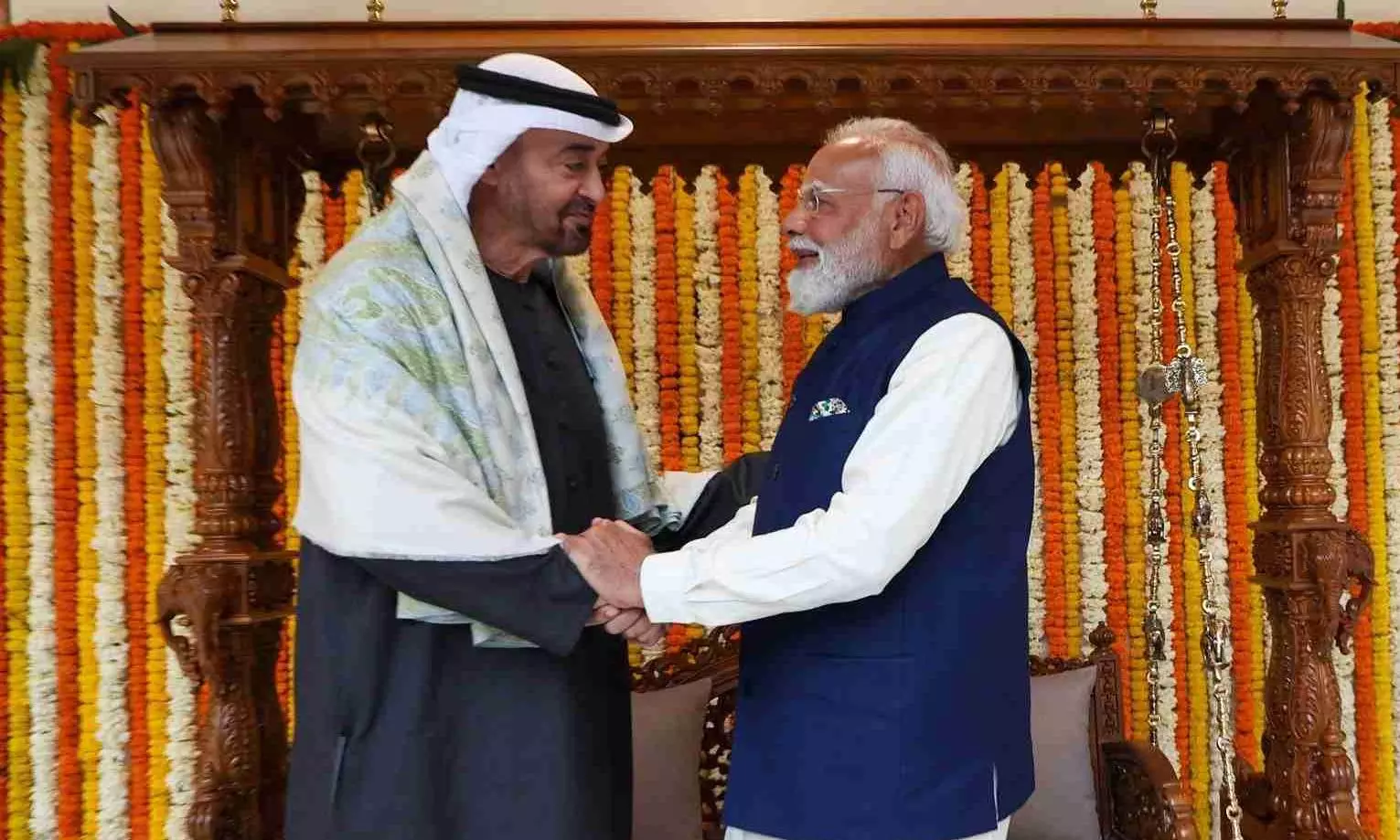
India on Monday (January 19) signed a USD 3-billion deal to buy liquefied natural gas (LNG) from the United Arab Emirates (UAE), making it the latter’s top customer, as Prime Minister Narendra Modi and UAE President Sheikh Mohamed bin Zayed Al Nahyan set a USD 200-billion annual trade target by 2032 while pledging to form a strategic defence partnership.
Abu Dhabi state firm ADNOC Gas will supply 0.5 million metric tons of LNG a year to Hindustan Petroleum Corp for 10 years, the companies said. ADNOC Gas told news agency Reuters the agreement brings the total value of its contracts with India to over USD 20 billion.
“India is now the UAE’s largest customer and a very important part of ADNOC Gas’s LNG strategy,” the company said, as quoted by Reuters. The UAE is India’s second-largest supplier of LNG after Qatar and India’s third largest trading partner.
Strategic defence partnership
Of the five documents inked by the two sides, the most striking one was the letter of intent to establish a strategic defence partnership, a move that came four months after Pakistan and Saudi Arabia sealed a defence pact to strengthen their decades-long defence ties.
Under the defence partnership, India and the UAE are eyeing defence industrial collaboration and cooperation in advanced technologies, cyberspace training, special operations, interoperability of their militaries and counter-terrorism.
Also read: Jaishankar says India ‘selectively targeted’ over Ukraine conflict
Pakistan signed a mutual defence agreement with Saudi Arabia last year, and last week, a Pakistani minister announced the preparation of a three-way draft defence agreement between Pakistan, Turkey and Saudi Arabia.
Saudi Arabia and the UAE, after being close allies for years, have increasingly diverged over regional policy, with their rift exposed in Yemen, and they have also had disagreements over oil output.
Nuclear technologies and security
Sheikh Mohammed was accompanied by a government delegation that included his defence and foreign ministers. The two sides signed a letter of intent to work towards forming a strategic defence partnership, Foreign Secretary Vikram Misri told reporters.
The two sides also decided to explore collaboration in advanced nuclear technologies, including the development of large nuclear reactors and small modular reactors, as well as cooperation in advanced reactor systems, nuclear power plant operations and maintenance and nuclear safety.
The discussions between Modi and Al Nahyan focused on cooperation in several new and emerging areas, including new opportunities for civil nuclear cooperation in the light of the passage of the Shanti Act in India.
Modi and Al Nahyan reiterated their unequivocal condemnation of terrorism in all its forms, including cross-border terrorism, and emphasised that no country should provide safe haven to those who finance, plan, support or commit terrorist acts.
Also read: EU-Mercosur trade deal latest sign of global pushback against Trump tariffs
They agreed to continue cooperation within the framework of the Financial Action Task Force (FATF) to counter terror financing and strengthen anti-money laundering efforts, the joint statement said.
Food security
Both sides also reaffirmed their strong commitment to enhancing UAE-India cooperation in food security, recognising its strategic importance in ensuring sustainable supply chains and long-term resilience, the joint statement said.
An agreement on food safety was also signed. It will provide for cooperation in the food sector and encourage food products and other agricultural exports from India to the UAE.
It will benefit the farmers of India and contribute to food security in the UAE, the foreign secretary said.
The UAE president expressed support for the success of India’s chairmanship of the BRICS grouping this year.
Commitment to IMEC reiterated
“This has been a short, but extremely substantive visit,” Misri said at the briefing after the UAE leader concluded his nearly three-and-a-half-hour visit that came amid increasing tensions in the Middle East and trade disruptions caused by Washington’s policy on tariffs.
Misri, however, said that the signing of the letter of intent with the UAE does not mean that India will get involved in regional conflicts. “Our involvement on the defence and security front with a country from the region does not necessarily lead to the conclusion that we will get involved in particular ways in the conflicts of the region,” he said.
Also read: Tariff war not one-sided; US senators complain about ‘unfair Indian tariffs’ on pulses
The two leaders also reaffirmed their commitment towards the India-Middle East-Europe Corridor (IMEC), saying it would be of great strategic importance and would significantly enhance the flow of commerce and energy between India, the Middle East and Europe.
The foreign secretary said the situation in Yemen, Gaza and Iran was discussed at the talks, but declined to elaborate on them. “All of these issues were discussed between the leaders. I cannot get into the details at this stage, but yes, both leaders had the opportunity to share their views and opinions in detail on these issues,” he said.
AI and tech
Artificial Intelligence was identified as another priority area of cooperation and it was decided to collaborate on setting up a supercomputing cluster in India with the UAE partnership, Misri said, adding the Gulf nation will also look at investments for expanding data centre capacities in India.
The foreign secretary said the two sides also set a target of USD 200 billion in annual trade by 2032. In 2024-25, the volume of two-way trade between the two sides was USD 100 billion.
To boost trade ties, Modi and Al Nahyan directed their teams to work towards interlinking the national payment platforms to enable efficient, fast and cost-effective cross-border payments.
They also called for the expeditious implementation of key initiatives, such as the Bharat Mart, the Virtual Trade Corridor and the Bharat-Africa Setu to promote MSME products across the Middle East, West Asia, Africa and the Eurasia region, according to a joint statement.
Space and digital infrastructure
Another letter of intent was also signed for joint work in developing space infrastructure. Under this initiative, both sides will look to set up new launch complexes, satellite fabrication facilities, joint missions, space academy and training centres, the foreign secretary said.
A separate document was inked to provide for the UAE’s participation in the development of a special investment region in Gujarat’s Dholera.
Also read: How Saudi bombing of Mukalla shattered the relative quiet in Yemen’s war
This initiative will look at the establishment of an international airport, a pilot training school, an MRO (Maintenance, Repair and Overhaul) facility, a greenfield port, a smart urban township, as well as projects related to railway connectivity and energy infrastructure, Misri added.
Both sides also decided to collaborate on the establishment of a supercomputing cluster in India as well as data centres.
The two leaders directed their teams to explore the possibility of establishing Digital Embassies between the UAE and India, under mutually recognised sovereignty arrangements. This is a relatively new concept, Misri said.
(With agency inputs)