








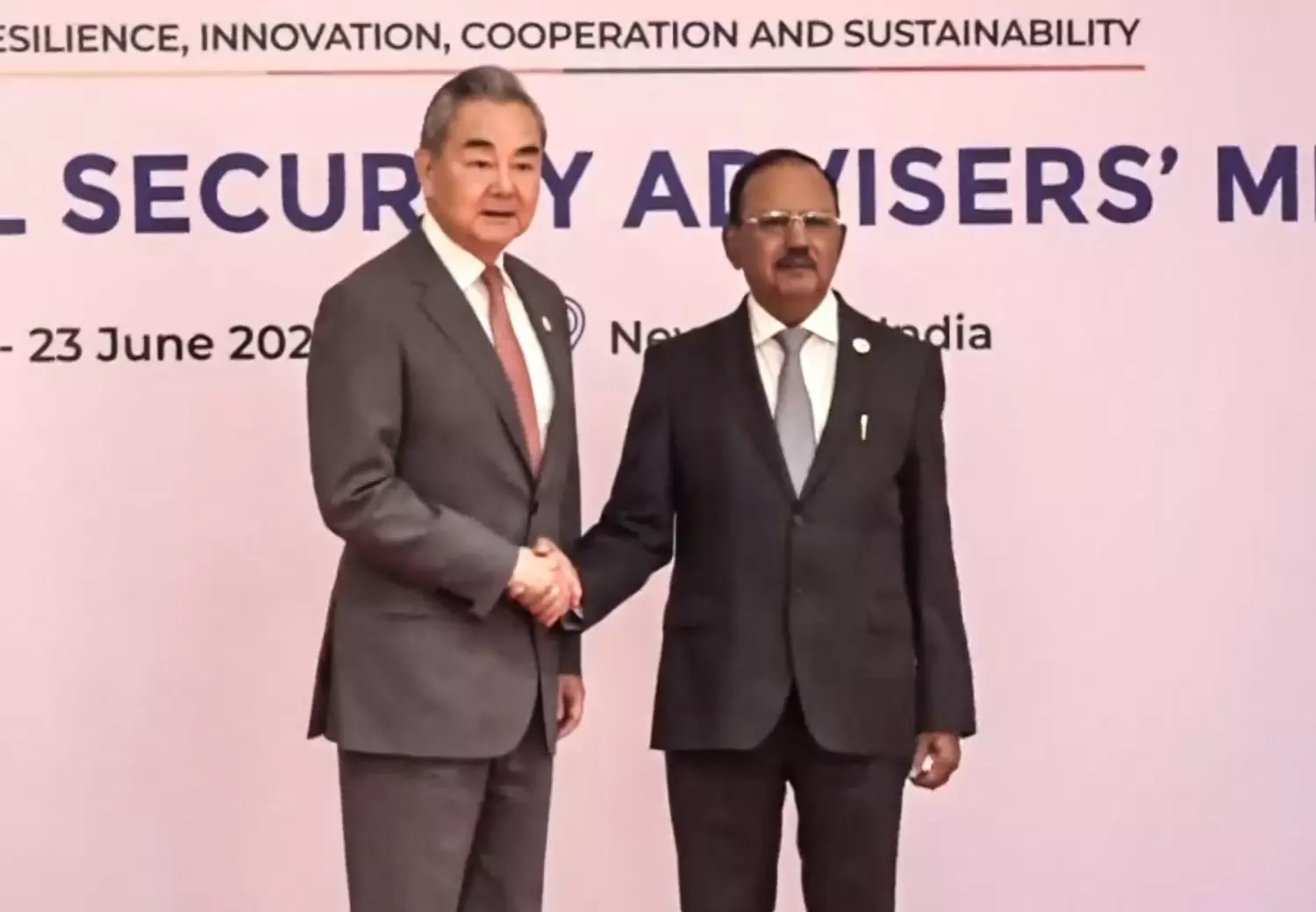
Indian NSA Ajit Doval with Chinese Foreign Minister Wang Yi in New Delhi on the sidelines of the 16th BRICS NSA meeting on June 23, 2026. Photo: PTI
Doval-Wang talks take centre stage at New Delhi BRICS meet amid regional realignment
As India and China seek a cautious reset over their border standoff, Beijing simultaneously moves to consolidate its strategic axis with Russia in the bloc

When Indian National Security Adviser (NSA) Ajit Doval sat down with Chinese Foreign Minister Wang Yi on the sidelines of the 16th BRICS National Security Advisers Meeting in New Delhi on Monday (June 22), it was the kind of meeting that carries weight beyond what the official readouts reveal.
Both men hold the designation of Special Representatives on the India-China border question, and their conversation on the sidelines of the key conclave was the latest in a series of carefully managed steps to pull a deeply strained relationship back from the edge.
Also read: What does Trump’s China visit mean for Taiwan, Iran and India? | Capital Beat
The conclave, hosted by India on June 22 and 23 in its capacity as the current chair of the grouping, brought together senior security officials from across the BRICS nations. But it was the bilateral conversation between Doval and Wang that drew the most attention.
A language of mutual sensitivity
The official Indian readout, delivered by External Affairs Ministry spokesperson Randhir Jaiswal, was measured but pointed. Doval, he said, underlined the importance of "stable, predictable and constructive bilateral relations" as a means of building trust between the two sides.
More notably, the NSA stressed that both countries must consistently display sensitivity to each other's "issues of core concern", diplomatic shorthand that encompasses everything from territorial disputes to sovereignty questions that neither side wishes to spell out in public.
Also Read: 'India moving towards single-party rule on China model': Vinod Sharma | Interview
The framing, Jaiswal added, was in keeping with India's overall approach of mutual sensitivity, mutual interests and mutual respect, a formulation that leaves room for private candour while maintaining a civil public posture.
China's broader vision
Wang's messaging, as conveyed through Chinese Ambassador Xu Feihong and state-run Xinhua news agency, was cast in wider, more strategic terms. India is an important neighbour, Wang said, and bilateral relations have returned to the "track of recovery and improvement".
He invoked the consensus reached by the two countries' leaders — that India and China are partners, not rivals — and called it the most important strategic understanding between the two sides, one that provides both impetus and guarantee for the relationship's long-term health.
As the world's two most populous economies, Wang argued, the two countries must not only view their ties through a bilateral lens but think about cooperation from a global perspective — contributing to the modernisation of the Global South and promoting their own development and revitalisation through working together.
On the border question specifically, Wang was direct. It is "imperative", he said, to respect each other's core interests, handle sensitive issues properly, and ensure the boundary dispute is placed in its appropriate position — meaning it should not be allowed to overwhelm or define the overall relationship.
Where the border stands
On the ground, both sides reviewed the situation along the Line of Actual Control. The Chinese foreign ministry spokesperson Guo Jiakun told reporters in New Delhi on Tuesday (June 23) that the border area is "generally stable" and that communication channels remain open. Both sides, he said, are actively working to implement outcomes from the 24th Round of Special Representatives talks held in August last year and are preparing for the 25th round.
Also Read: Book reveals why Trump dismissed Vance’s idea of Indian peacekeepers in Ukraine
It is a gradual, procedural rebuild, and deliberately so. The relationship was badly damaged by the deadly Galwan Valley clashes in June 2020, followed by a military standoff in eastern Ladakh that dragged on for over four years. The current diplomatic momentum, including the Special Representatives' meeting in August that produced several concrete outcomes, represents a sustained and cautious effort to normalise what became one of Asia's most fraught bilateral relationships.
Wang and Shoigu: a separate signal
On the margins of the same conclave, Wang also met Russian Security Council Secretary Sergei Shoigu — a meeting that carried its own significance. Wang called on China and Russia to strengthen coordination for the "strengthening and expansion" of the BRICS mechanism and to make it a "leading force" of the Global South.
He underlined Beijing's readiness to work with Moscow to advance the two countries' development and to make "China-Russia contributions" to the peaceful development of the world.
The meeting was a reminder that even as China tends to its relationship with India, it is simultaneously working to consolidate a separate axis within BRICS — one that lends the grouping a more assertive geopolitical character.
A grouping of growing weight
BRICS itself has grown considerably. Originally comprising Brazil, Russia, India, China and South Africa, it expanded in 2024 to include Egypt, Ethiopia, Iran, Saudi Arabia and the United Arab Emirates, with Indonesia joining in 2025. The grouping now represents close to half the world's population, around 40 per cent of global GDP and roughly a quarter of global trade — numbers that give its deliberations real consequence.
Also Read: India’s China import dependence at 16 per cent, exposes supply chain risks: GTRI
India's chairmanship has placed it at the centre of that conversation, even as it navigates the delicate task of managing its relationship with China within a multilateral forum that Beijing is keen to shape. The Doval-Wang meeting ended, in the words of India's external affairs ministry, on a note that was "constructive and forward-looking."