








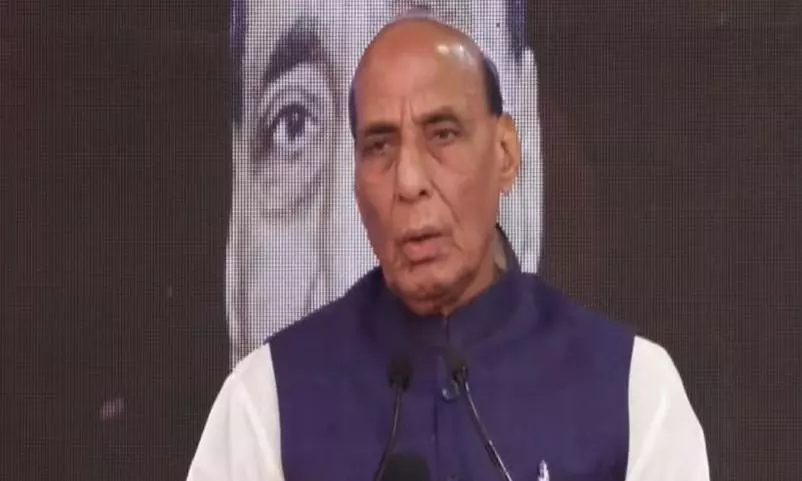
Singh said terrorism was not just limited to being an “anti-national act” but had multiple dimensions, including operational, ideological, and political. Screengrab: ANI
India halted Operation Sindoor voluntarily, was ready for long war: Rajnath Singh
Defence Minister says India paused the operation on its own terms, highlights surge defence capacity and a shift toward a more assertive counter-terror doctrine

India halted Operation Sindoor voluntarily and on its own terms, said Defence Minister Rajnath Singh on Thursday (April 30), adding that India was prepared for a long war against Pakistan if the situation demanded.
Voluntary pause, not a constraint
Elaborating further, Singh said India not only had the capability of scaling up its defence production in case of a sudden need, but it possesses the capability even now in a much more robust fashion.
Also Read: ‘Dot dot dot’: Rajnath Singh’s cryptic message to Pakistan on Pahalgam anniversary
"During Operation Sindoor, we precisely targeted those who had attacked us. And I want to clarify here again that we didn't stop this operation because our capabilities had diminished. We stopped it voluntarily, on our own terms, and if necessary, we were fully prepared for a long war,” said Singh.
Surge capacity and preparedness
"And we also had surge capacity, the ability to expand our capabilities in times of sudden need. Not only did we have it, but we still have it, and it's even more robust than before. Therefore, I don't think there's any need to say anything more," he added as quoted by ANI.
Also Read: India must stay prepared amid volatile West Asia situation: Rajnath Singh
Elaborating further, the Defence Minister said that with Operation Sindoor, India sent a clear message to the world that it no longer goes by the old way of thinking when the main response to a terrorist attack on its soil was only the issuance of diplomatic statements.
Shift in India’s response doctrine
"It's been almost a year since Operation Sindoor, and our Operation Sindoor is also a symbol of this new world order. It was a turning point that sent a message to the entire world that India is no longer the one that adheres to the old way of thinking, where terrorist attacks occur on our soil, we merely issue diplomatic statements. And under Prime Minister Modi's leadership, our government has maintained that no terrorist activity will be tolerated under any circumstances,” said Singh.
Terrorism’s multiple dimensions
The Defence Minister, speaking at the ANI National Security Summit 2.0 said terrorism was not just limited to being an “anti-national act” but had multiple dimensions, including operational, ideological, and political. He further stated that it can only be dealt with successfully if all three of the dimensions are addressed.
Also Read: Rajnath Singh warns Pakistan over ‘Kolkata’ remark, cites 1971 war consequences
"Terrorism is not just an anti-national act, it has multi-dimensions, and terrorism can only be dealt with if we tackle it in all its three dimensions--operational, ideological, and political. The true IP address of terrorism is its ideological and political roots, where it thrives. The ideological nourishment and political patronage of terrorism is the nectar in Ravana's navel, which, after cutting off one head, regenerates another. I believe it is essential to dry up this navel that gives life to terrorism,” said Singh.
Pakistan and the broader warning
"We have always seen that countries like Pakistan have consistently supported terrorism, and this is why both India and Pakistan gained independence at the same time, but today, India is known worldwide for its Information Technology, while Pakistan is considered the epicentre of other IT, i.e., International Terrorism. Our military industrial complex has proven that it is not only for the period of peace, but it is also prepared for rapid supply during wartime. We were even threatened with a nuclear attack, but we did not fall for that bluff," he added.