








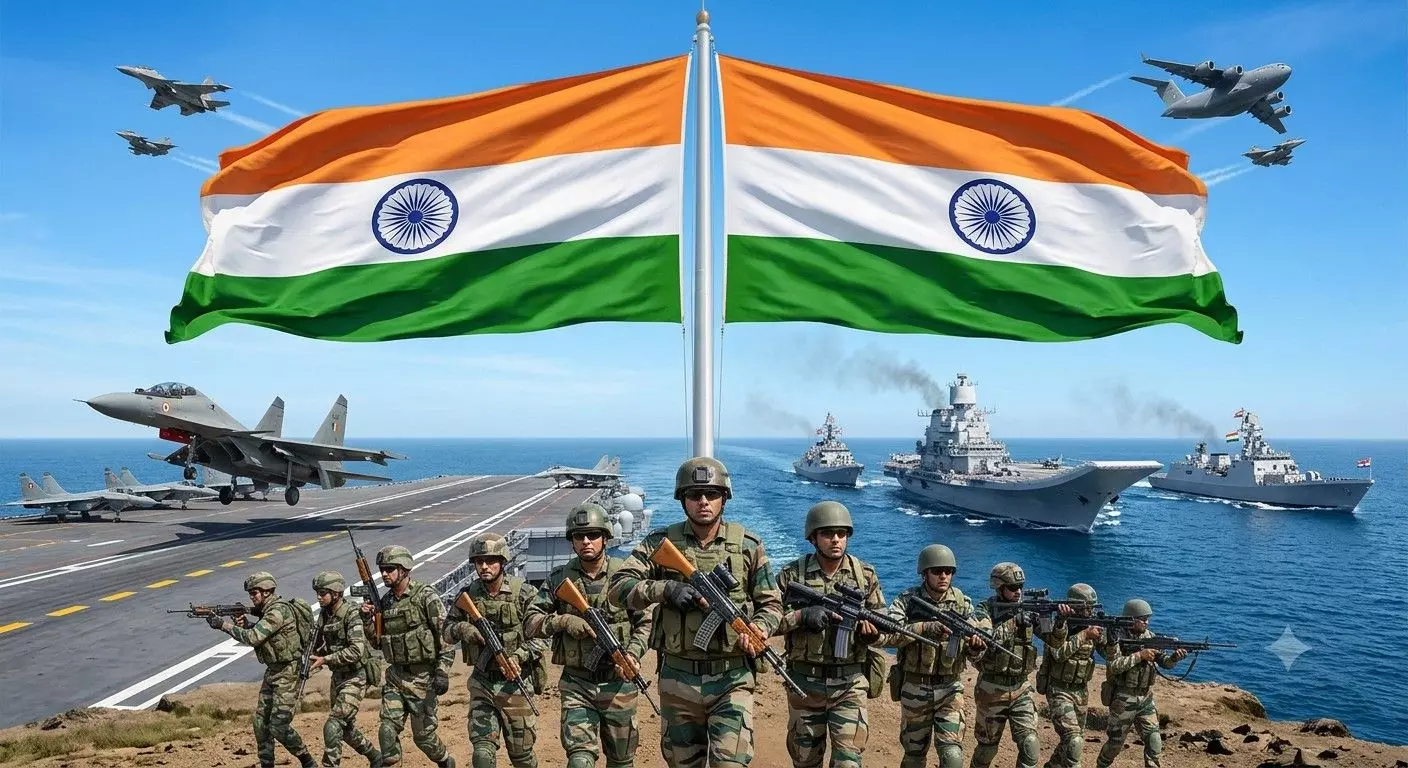
India has debated fruitlessly over more than two decades to integrate the three wings of its armed forces. However, it might soon be a reality.
After over 2 decades of debate, is India's theatre command plan close to reality?
As CDS Subramani prepares to present the theaterisation proposal to Defence Minister Rajnath Singh this month, concerns persist over asset allocation and structures

Over decades, India's strategic and academic circles have remained engaged in intense debate over reorganising the country’s armed forces into unified theatre commands. The plan, which was recommended by the Kargil Review Committee after the 1999 war with Pakistan to fix coordination loopholes, was energised by India’s first Chief of Defence Staff (CDS), Bipin Rawat, who died in a helicopter crash in December 2021, less than two years into his tenure.
Also read: Why India urgently needs to boost its air and missile defence
The three wings of the military, army, navy and air force, have been operating under their respective command structures all these years. The unified plan aims to turn the military into geographically defined unified commands where the three services will function under a single theatre commander. Such a concept is already in force in countries such as the US, China and many others.
India's theaterisation plan: A timeline
♦ 1999 — Kargil War exposes serious coordination gaps between the three wings
♦ 2000–2001 — Group of Ministers back the committee's integrated theatre command recommendations
♦ November 2001 — Integrated Defence Staff (IDS) is formed
♦ 2012, 2016 — Naresh Chandra Task Force backs reform, Shekatkar Committee recommends three theatre commands
♦ 2019 — Post of Chief of Defence Staff (CDS) is created. General Bipin Rawat becomes first post holder
♦ 2020–2021 — He proposes an initial model of four theatre commands (Air Defence, Maritime, Western, Eastern)
♦ 2022 — General Anil Chauhan takes over as the second CDS; work resumes on a revised, adversary-based model
♦ 2023 — Parliament passes Inter-Services Organisations (Command, Control & Discipline) Act to bolster jointness among the armed forces
♦ 2024 — Defence Ministry identifies headquarters: Jaipur for the Western Theatre Command, Lucknow for the Northern Theatre Command.
♦ 2025 — Defence ministry designates 2025 the "Year of Reforms",vwith theatreisation as the central goal.
♦ April 2026 — Broader leadership structure finalised by the armed forces: Northern Command led by an Army officer, Western Command by an Air Force officer, Maritime Command by a Navy officer. Formal proposal sent to government.
♦ May 2026 — General NS Raja Subramani takes over as the third CDS
♦ July 2026 — Subramani expected to make a crucial presentation on the theaterisation plan to Rajnath Singh
General Rawat championed integrated theatre commands to end service-specific silos, modernise India's military, optimise resources, quicken decision-making, and eradicate departmentalism.
For many, the theaterisation is a natural culmination of jointness of the armed forces, a concept dating back to the Integrated Defence Staff's formation in November 2001. The plan envisions dissolving existing single-service commands into three or four unified theatre commands, each under one commander.
CDS set to make presentation before defence minister
Rawat’s successors have taken equal interest in advancing the plan after his demise. General NS Raja Subramani, who took over as the third CDS in May, succeeding Anil Chauhan, is expected to make a crucial representation on the theaterisation plan before Defence Minister Rajnath Singh and other stakeholders by the end of July, reportedly after the Kargil Vijay Diwas observations, informed sources said.
After more than two decades of debate, the matter could witness a decision that could revolutionise India’s military functioning, marking its most prominent reform in the country’s history. If the proposal gets the minister’s nod, it will be sent to the Cabinet Committee on Security as a note for Prime Minister Narendra Modi’s approval. Work on the plan has been underway since 2022.
How the plan looks
The armed forces currently operate on a structure of 17 single-service commands, of which seven are under the army and air force each and three under the navy. Under the theaterisation plan, the goal is to consolidate them into three theatre commands. These three commands are: the Northern Command facing China; the Western Command facing Pakistan; and the Maritime Command to look after the coastlines’ security. As per the plan, the Northern Command will be led by an army officer, the Western Command by an air force officer and the Maritime Command by a navy officer.
The plan’s rationale, advantages
The military reforms’ rationale is that modern warfare crosses land, sea, air, cyber and space, and single-service silos can't respond fast enough. India's defence establishment has repeatedly cited last year's four-day Operation Sindoor clash with Pakistan, when the three service chiefs had to coordinate from an improvised joint set-up in the Army's war room — a workaround exposing the very institutional gap theatreisation aims to fix.
Also read: India approves Rs 79,000 crore defence procurement for Army, Navy, IAF
A unified command enables faster decisions in a crisis. It addresses coordination gaps exposed since the Kargil conflict, keeping raising and training separate from operations while bringing the services under one chain of command. Streamlined intelligence sharing and dedicated commands for China, Pakistan and maritime fronts will enable region-specific planning and quicker responses to threats.
Did you know?
The theatre command concept originated in the US. After Pearl Harbor (1941), America opened the Pacific Theatre under MacArthur and later Normandy under Eisenhower. Post-war, expanding global interests and NATO's formation led to today's 11 US combatant commands.
Modern conflict spans land, air, sea, cyber, space and information domains simultaneously. Integrated commands are meant to let forces respond across all these fronts as one system rather than as separate silos. Dedicated commands for the China and Pakistan fronts and the maritime domain allow each theatre to tailor doctrine, force posture and response plans to that specific threat, rather than applying one-size-fits-all planning. Shared logistics, training infrastructure and support functions across services can cut costs and redundancy that come from each service running parallel structures.
Intelligence and operational inputs move within a single unified chain under the system rather than being passed between separate service headquarters, reducing delays and information loss.
The reform draws on the US and Chinese theatre command systems, introducing proven structures in India's traditional two-front security environment.
What are the challenges
While the theaterisation proposal seeks to streamline the military structure, which currently operates through several commands, there are also challenges that it will need to answer. The Air Force, in particular, has been particularly hesitant, arguing its limited, high-value air assets shouldn't be tied to specific geographic theatres. It is of the opinion that the airpower, considered more flexible than either the army or the navy, can be used wherever needed rather than being permanently allocated to any of the commands.
It is apprehended that in the case of a two-front confrontation with China and Pakistan, the IAF’s firepower could be stretched further.
Command hierarchy and turf issues add to the concerns. Introducing four-star theatre commanders alongside existing service chiefs could lead to a potential clash over control areas. While chiefs traditionally held operational command, theatre commanders became more prominent under the new arrangement while chiefs focus on raising, training and equipping forces. Also, a more elaborate legal architecture is needed to formally empower tri-service theatre commanders.
Also read: INS Mahendragiri to strengthen Navy’s firepower; here’s why it is special
Upscaling infrastructure is another area that deserves to be addressed. Common command-and-control systems, communication networks, and joint logistics nodes need to be built or upgraded before theatres can function as genuinely unified structures.
The biggest hurdle, as former CDS Chauhan indicated before his term ended, is psychological.
He said the fears over any one service losing relevance under the theatre command structure were unrealistic. According to him, the biggest challenge in the integration reforms was changing mindsets within the three services. “
“Structural change is not a challenge. The challenge was always about changing mindsets,” he said at a fireside chat organised by the Centre for Joint Warfare Studies in New Delhi in May, the New Indian Express reported.
Why has the plan been delayed by decades
The Kargil committee’s recommendations were backed by several panels over the years, such as the Group of Ministers (2001), the Naresh Chandra Task Force (2012), and the Shekatkar Committee (2016), but nothing more than incremental improvements were seen. The CDS’s position (recommended by the Kargil committee) was established in 2019, yet a delayed progress was found on the theaterisation plan.
The IAF has long argued that its limited combat assets are too precious and too mobile to be permanently parcelled out to fixed geographic theatres. Also, before 2019, there was no single officer empowered to give the political leadership one unified military voice or drive tri-service reform. Each service chief answered separately to the government, and none had the mandate or incentive to cede control to a joint structure.
Also read: India’s defence exports soar to Rs 38,424 cr; what does India sell and to whom?
Besides, there were hierarchy concerns, absence of a legal and administration scaffolding, operational patterns and also change of plans under different CDSes. Political reasons, such as the government’s cautious handling of the key issue and the occurrence of events, be military or non-military, such as the COVID-19 pandemic, repeatedly distracted authorities from carrying out long-term structural reforms.
What’s next for the theaterisation plan
Should this proposal clear the CCS, implementation is expected to take a while, as new commands are raised, personnel reassigned, and doctrine aligned with the new chain of command. For now, what Rajnath does will be closely followed — whether it moves swiftly or stalls over details of control will determine if this long-discussed reform finally materialises.