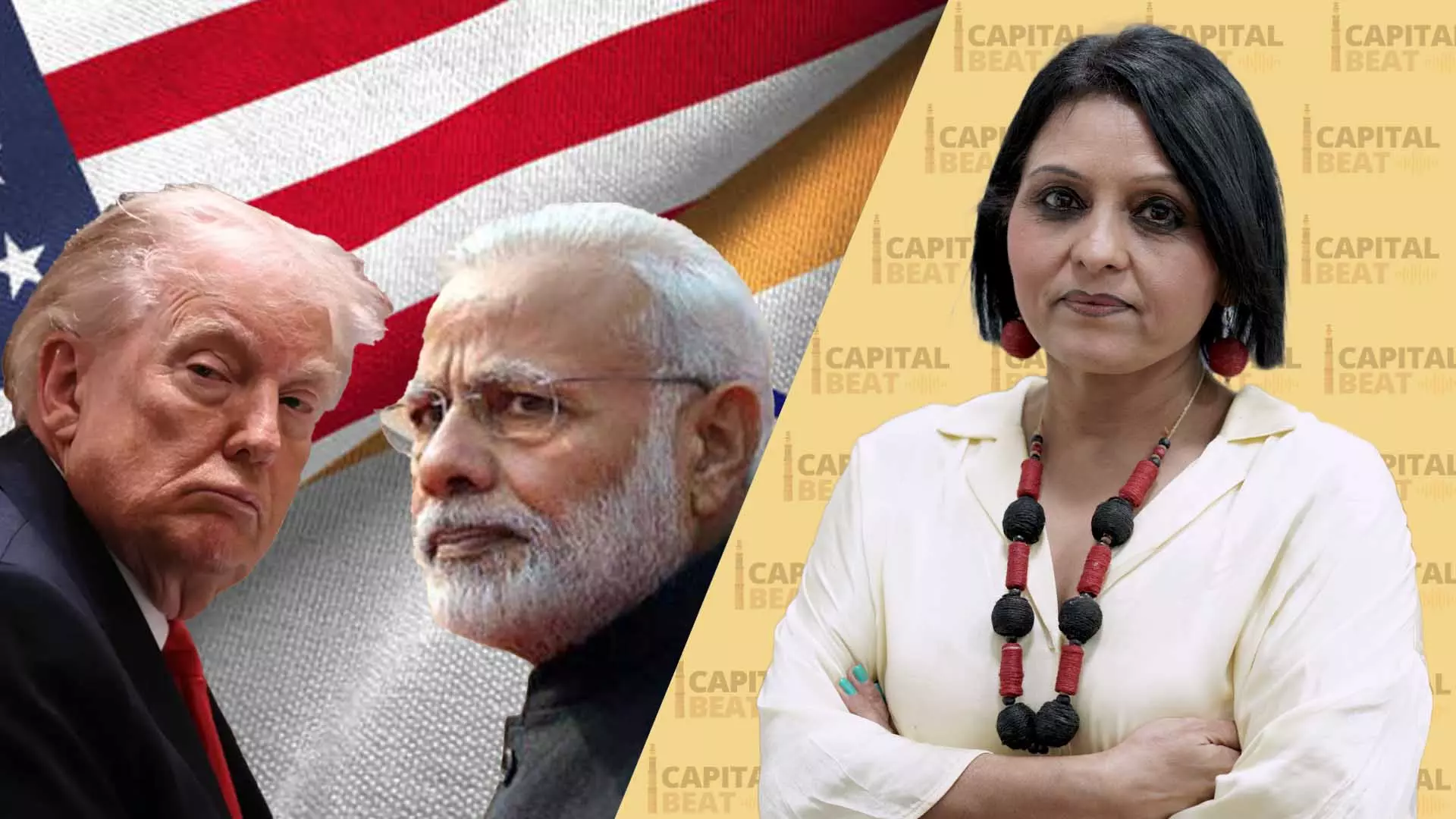
India-US trade deal clinched, but at what cost?
India-US trade deal: Is it a win or strategic compromise?
In the Capital Beat programme, critics question whether opening sectors like agriculture and increasing energy imports from the US may compromise India’s autonomy and farmers’ interests

India and the United States have agreed to a major trade deal, with the US cutting tariffs on Indian goods to 18% from much higher levels, a move announced by President Trump after talks with PM Modi. The announcement follows months of negotiations and comes soon after India’s trade agreements with the EU and UK. While supporters see a boost for exporters and stronger global ties, critics question whether opening sectors like agriculture and increasing energy imports from the US may compromise India’s autonomy and farmers’ interests. Will this deal be a win-win or a strategic risk for India? Join us on Capital Beat as we break it all down.
India-US trade deal clinched, but at what cost?
“This is not a done deal, it is political signalling,” said senior journalist TK Arun, cutting through the early celebrations around the newly announced India–US trade agreement. As opposition parties question India’s autonomy and farmers’ interests, the surprise announcement by US President Donald Trump — not New Delhi — has triggered a wider debate on sovereignty, trade-offs, and geopolitics. We spoke to TK Arun, Kallol Bhattacharya of The Hindu, and analyst Siddharth Sharma to examine whether the agreement is a win-win or a strategic compromise for India.
Surprise announcement
The controversy began when US President Donald Trump announced on Truth Social that Washington had reduced tariffs on Indian goods to 18%, down from higher punitive levels, claiming it was done at Prime Minister Narendra Modi’s request. Trump also stated that India had agreed to stop buying Russian oil, increase purchases of US and Venezuelan energy, and commit to buying over $500 billion worth of American goods across sectors such as energy, agriculture, and technology.
Prime Minister Modi later endorsed the announcement on X, calling Trump a “dear friend” and hailing the deal as a boost for “Made in India” products. However, the sequence of communication — with Trump announcing first — immediately raised political and diplomatic questions in India.
Opposition questions
The opposition moved an adjournment motion in Parliament, questioning why India did not announce the deal itself and whether national interests had been compromised. Among the concerns raised were claims that India would reduce tariffs and non-tariff barriers to zero, potentially harming domestic industry and farmers, and reports suggesting India would pivot away from Russian oil imports.
Also Read: India’s trade deal with the US is not reciprocity, it is submission
Rahul Gandhi alleged that the Prime Minister had “compromised under pressure,” arguing that the deal had been stalled for months and was suddenly cleared without transparency. He also flagged the unprecedented nature of the announcement being made by the US President rather than Indian authorities.
Tariff clarity
Addressing the confusion around tariffs, TK Arun argued that the announcement reflected a rollback of punitive measures, not a wholesale concession by India. He explained that the higher tariff levels had included penalties imposed after the US objected to India’s purchase of Russian crude.
“With India agreeing not to formally buy Russian oil, that penalty goes,” Arun said, adding that the remaining reciprocal tariff being lowered to 18% places India in a better position than countries like Pakistan, Bangladesh, and Vietnam, which face tariffs around 19–20%.
According to Arun, this amounted to a climbdown by Trump, not a loss for India.
Oil reality
On energy commitments, Arun dismissed fears that India would dramatically shift oil sourcing to the US. He pointed to logistical and cost realities, noting that American crude is expensive to transport compared to supplies from closer regions.
“Why should we buy from across the Atlantic when cheaper options exist?” he asked, adding that Venezuelan oil — which India has purchased before — is economically viable due to discounts and India’s refinery capacity.
Arun also underlined that Russian oil continues to reach India indirectly and that crude, once shipped, loses its national identity in global markets.
Agriculture fears
A sharper warning came from Siddharth Sharma, who argued that the biggest fallout would be felt in rural India. He cautioned that zero or low tariffs on US agricultural imports could lead to dumping, particularly of corn, dairy, and poultry products.
“American corn at ₹17 cannot compete with Indian farmers receiving ₹24 MSP,” Sharma said, warning that rural producers would suffer while urban consumers benefit from cheaper imports.
He framed the deal as creating a structural divide between urban consumers and rural producers, noting that two-thirds of Indians live in rural areas and that the ruling party had already lost significant rural support in the 2024 Lok Sabha elections.
Political optics
Sharma also questioned the political messaging around the deal, arguing that slogans like Atmanirbhar Bharat would lose credibility if India openly commits to “buy American” policies. He pointed out that while markets reacted positively to Trump’s announcement, they had slumped after India’s Union Budget — suggesting greater investor confidence in US signals than domestic ones.
“The headlines, not the fine print, will hurt the government in rural India,” Sharma said.
Process matters
Kallol Bhattacharya focused on the process and diplomacy, stressing that trade agreements between sovereign states require clarity, sequencing, and formal texts. He compared the announcement with India’s recent negotiations with the European Union, where officials repeatedly clarified that negotiations had concluded but agreements were not yet signed.
“If a trade deal has been done, where is the text?” Bhattacharya asked, calling the communication gap a serious issue in statecraft.
He argued that trade is inseparable from strategy, especially when dealing with a superpower like the United States, and warned against treating such agreements as political spectacles.
Also Read: Budget 2026: Business as usual in a world that is not
Strategic layers
Bhattacharya also highlighted the broader strategic entanglements surrounding the deal, including India’s relationship with Russia, participation in the Quad, the proposed “Board of Peace,” and differences with the US over regional issues in South Asia.
He cited India’s reduced visibility at Iran’s Chabahar port following renewed US pressure as an example of how American leverage constrains India’s choices, regardless of official assurances.
“When dealing with a superpower, constraints are real,” he said.
Not final yet
Returning to the core question of whether the deal compromises India’s interests, TK Arun reiterated that no final agreement has been signed. What exists, he said, is a political commitment to negotiate.
India’s total imports in 2024–25 stood at about $915 billion, with US imports only around $45 billion. “There is no scenario where India suddenly imports $500 billion from the US,” Arun said, calling Trump’s figure political messaging aimed at his domestic base.
He added that India’s multiple free trade agreements with the EU, UK, UAE, and Southeast Asia make overdependence on any one partner unrealistic.
Cautious optimism
All three panelists agreed on one point: celebration is premature. While the tariff rollback may ease short-term trade friction, the absence of fine print, parliamentary debate, and clarity on agriculture and energy commitments means the real impact remains uncertain.
As Bhattacharya summed up, engagement with the US demands “seriousness, preparation, and rigor,” not headline-driven triumphalism.
The content above has been transcribed from video using a fine-tuned AI model. To ensure accuracy, quality, and editorial integrity, we employ a Human-In-The-Loop (HITL) process. While AI assists in creating the initial draft, our experienced editorial team carefully reviews, edits, and refines the content before publication. At The Federal, we combine the efficiency of AI with the expertise of human editors to deliver reliable and insightful journalism.