








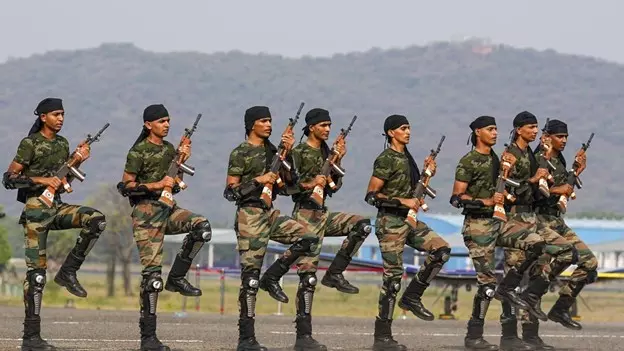
Indian Army sheds colonial dress code; ceremonial pouch belts out, bandi jackets in
Army lays down strict dress and grooming rules for male and female personnel, removes colonial terms like 'royal'

Disposing of certain archaic and colonial-era practices, and moving towards a more Indian approach towards dressing, the Indian Army has rejigged its dress code to introduce closed-neck bandi jackets in formal settings, and removing the ceremonial pouch belts in several dress categories, making it optional for officers to carry swords during parades.
According to Hindustan Times, the changes have been detailed in the ‘Army Uniforms-2026’ manual, a 174-page document, which lays new rules for uniforms, grooming and ceremonial practices.
Also read: Lt Gen Dhiraj Seth to be next Chief of Army Staff
“In keeping with the nation’s sentiments and evolving sovereign identity, a number of deliberate refinements have been incorporated. Collectively, these refinements represent a progressive review of residual colonial-era vestiges while preserving the dignity, functionality and enduring traditions of the Indian Army,” HT quoted a section titled as ‘Indigenisation and Alignment with National Ethos’ in the document as saying.
Introduction of winter dress, bandi jacket
A major addition to the dress code this time is the Winter Dress No. 3B required to be worn by personnel across ranks. The attire is an angola shirt, a battle jacket and a beret.
While male officers can now wear the bandi jacket, albeit in a solid, sober colour and over full-sleeve shirts and matching formal trousers and closed footwear, women officers can wear sarees or kurta-salwars with ankle-length straight trousers and a dupatta during authorised occasions. Sleeveless kurtas, and lower garments like palazzos and cigarette pants are prohibited.
Also read: Indian army chief rejects China’s Shaksgam Valley claim, calls 1963 pact illegal
No colonial remnants
The pouch belt has been removed from Mess Dress No. 5 and No. 6. Officers up to the rank of colonel in the armoured corps, mechanised infantry, regiment of artillery, rifle regiments, Maratha Light Infantry, Jammu and Kashmir Light Infantry, and Corps of Signals, however, are authorised to wear these belts. These belts can be used during specific regimental and corps functions.
Reviewing officers on parade will not be required to carry swords anymore.
The manual also drops colonial-era terms like “royal”.
No tattoos, religious symbols
As far as grooming is concerned, the manual made certain revisions keeping hairstyles, moustaches, tattoos, body piercings, and the use of cosmetics. The manual prohibits tattoos and body piercings for officers and states that personnel cannot wear any type of bracelet in uniform, except for a single sacred thread on the wrist on the day of pooja. Similarly, it bars soldiers from wearing any religious symbols or marking except for Sikhs.
Also read: Agnipath needs urgent correction to protect India and her armed forces
Women can’t wear bindis, lipsticks
Personnel are allowed to keep a moustache to a length of 12 cm and are barred from using deodorants and perfumes while in uniform. The use of after-shave lotions, however, is allowed.
Similarly, women personnel, as per the new rules, cannot wear lipstick, coloured nail polish, bindis, and nose pins. Sindoor can be worn, but should not be visible when the beret or peak cap is worn.