








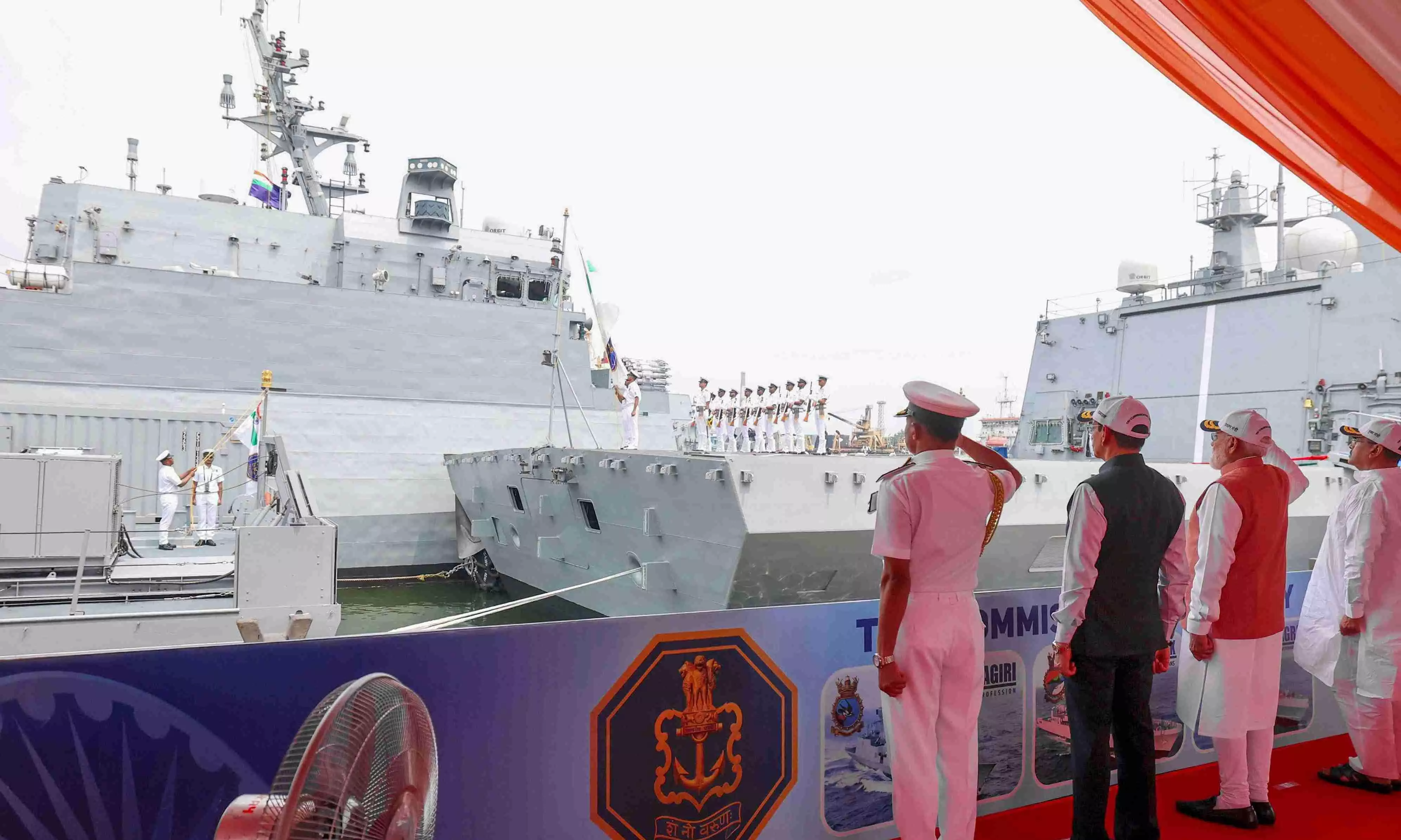
Prime Minister Narendra Modi with other dignitaries at the tri-commissioning of INS Dunagiri, INS Sanshodhak and INS Agray at Syama Prasad Mookerjee Port, in Kolkata, on June 21, 2026. Photo: PTI
PM Modi commissions 3 indigenous warships in Kolkata; know what's special about them
INS Dunagiri, INS Sanshodhak, and INS Agray join the Indian Navy, strengthening surface warfare, ocean mapping, and anti-submarine defence pillars

Prime Minister Narendra Modi on Sunday (June 21) commissioned three indigenously built naval vessels — stealth frigate INS Dunagiri, survey vessel INS Sanshodhak and anti-submarine warfare craft INS Agray, at Kolkata’s Syama Prasad Mookerjee Port, marking a significant boost to India’s maritime capabilities and defence self-reliance.
The three ships represent three different operational pillars of the Indian Navy: surface warfare, maritime surveying and underwater defence. Built with a high degree of indigenous content, the vessels are aimed at strengthening India’s ability to protect its maritime interests, monitor ocean regions and counter emerging threats.
INS Dunagiri for long operations
INS Dunagiri, a Project 17A stealth frigate, is the most combat-focused platform among the three. Designed as a next-generation frontline warship, it combines advanced stealth features with powerful weapons systems.
Also read: Indian Navy eyes 200-ship force by 2035, all new ships to be 'Made in India'
The frigate is equipped with radar-absorbing materials, a low-signature hull design and advanced systems that reduce its radar, heat and acoustic visibility. Its weapon package includes BrahMos supersonic surface-to-surface missiles, the Medium Range Surface-to-Air Missile (MRSAM) system and a 76 mm naval gun, giving it strong capabilities against aerial, surface and missile threats.
Powered by a Combined Diesel or Gas (CODOG) propulsion system, Dunagiri is built for long-duration operations and multi-domain missions, adding strength to the Navy’s surface combat fleet.
INS Sanshodhak to map oceans
INS Sanshodhak, the fourth Survey Vessel (Large) of the Indian Navy, has been designed primarily for hydrographic surveys and oceanographic research.
The vessel will help map seabeds, collect geophysical data and create detailed nautical charts required for safe naval operations as well as civilian maritime activities. Equipped with advanced survey systems, including autonomous underwater vehicles (AUVs), remotely operated vehicles (ROVs), multi-beam echo sounders and sonar technology, Sanshodhak will function as a floating ocean research platform.
Also read: Why stealth frigate 'Mahendragiri' is a big boost for Indian Navy
Beyond surveying, the ship can also support humanitarian assistance and disaster relief operations, search-and-rescue missions and can be adapted for specialised roles during emergencies.
INS Agray to neutralise underwater threats
INS Agray, an Arnala-class Anti-Submarine Warfare Shallow Water Craft, is designed to detect and neutralise underwater threats in coastal waters.
The vessel is equipped with shallow-water sonar systems, lightweight anti-submarine torpedoes and indigenous rocket launchers. Its waterjet propulsion system allows it to operate effectively in shallow regions while reducing noise levels, improving its ability to track enemy submarines.
With its focus on littoral warfare, Agray strengthens India’s ability to protect coastal regions and critical maritime infrastructure.
Part of larger naval expansion
The commissioning of the three ships comes as part of India’s broader effort to expand its indigenous naval fleet. In recent years, the Navy has inducted several major platforms, including aircraft carrier INS Vikrant, destroyers such as INS Imphal and INS Surat, and submarines such as INS Vagsheer.
Addressing the commissioning ceremony, PM Modi said a strong maritime capability was essential for India’s economic and strategic rise. He said the three ships reflected the country’s growing defence manufacturing capacity as they were “built in India and designed in India”.
Also read: Operational readiness highest priority, says new Navy chief Admiral Swaminathan
Highlighting the push for self-reliance, Modi said India could no longer remain only a buyer in the defence sector. He added that the vessels represented the skills of Indian engineers, industries and workers, with high indigenous content and participation from domestic manufacturers.
He also noted that India’s shipbuilding ecosystem was expanding, with more than 40 indigenous warships and submarines inducted in recent years and several more platforms under construction.