








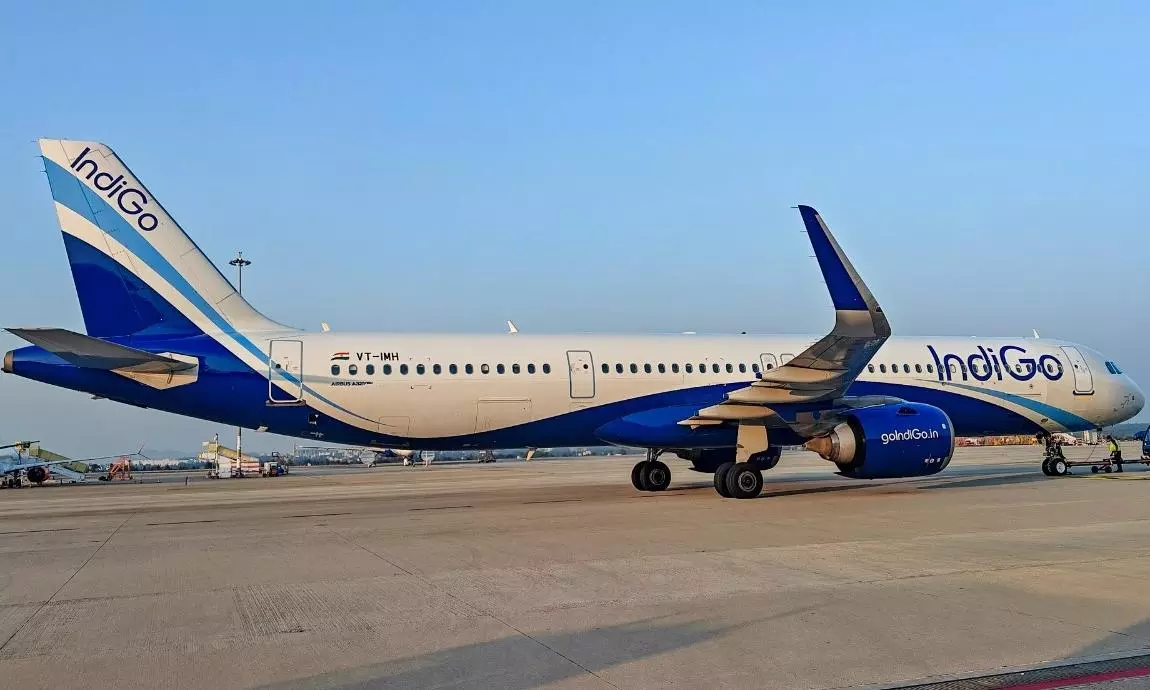
IndiGo boosts pilot crew buffer as exemption from FDTL rules ends today
IndiGo has increased pilot crew buffer and reserves to comply with FDTL rules as the exemption ends, aiming to prevent flight disruptions and cancellations

With the exemption from compliance with the new flight duty time limitation (FDTL) norms set to expire on Tuesday (February 10), IndiGo has increased its crew buffer-surplus pilot capacity beyond the minimum to operate scheduled flights, from zero in December to 3 per cent in February.
According to a report in the Hindustan Times, the move by IndiGo is aimed at resuming full compliance with the FTDL rules that led to an operational collapse in December, which forced the airline to cancel over 5000 flights and a penalty of Rs 22.2 crore was imposed on it by civil aviation authorities.
“We are expecting minimal flight disruptions due to FDTL violations,” a senior government official said under condition of anonymity as quoted in the report. Another senior official quoted in the report said, “A review of IndiGo operations was conducted on the 6th, and they are on track.”
Pilot crews to aircraft ratio increased
As per Civil Aviation Ministry data, the assumption that flight operations will stabilise is based on IndiGo’s rostering plans, which showed an increase in its pilot crews to aircraft ratio. It also revealed that the airline has increased the number of pilots in reserve and has an active hiring pipeline to offset attrition.
The airline has started planning operations at seven crew sets per aircraft, with the February roster reflecting 7.2 sets, up from 7.1 in January, a government official said. The calculation is based on 1,862 daily flights and an average block time of 3.99 hours per trip day. Crew sets indicate the number of complete pilot teams available per aircraft in the fleet.
Also Read: IndiGo cancels flights amid Iran crisis, offers full refund
In December, when operational stress peaked, the airline was operating with fewer than six crew sets per aircraft, reported the Hindustan Times.
“Crew buffers have increased from zero in December 2025 to 3 per cent in February, while standby crew levels have been raised to a minimum of 15 per cent,” the official said. Crew buffers refer to surplus pilot capacity over the minimum required to run scheduled flights, while standby crews are reserve pilots assigned to cover sickness or last-minute scheduling changes.
What aviation expert said
Aviation experts, however, cautioned that the adequacy of these measures would depend on how they align with duty-time rules and actual schedules. “To assess whether IndiGo can operate smoothly under the new FDTL, it needs to be checked whether IndiGo has at least seven crew sets per aircraft under the new FDTL,” said aviation expert Capt Mohan Ranganathan, as quoted in the report.
Also Read: Delhi HC questions DGCA over indefinite pilot duty time relaxation
“The airline claims 7.2 sets, meaning 7.2 captains and 7.2 co-pilots for each aircraft; for an operational fleet, for instance, of about 350 aircraft, that is roughly 2,520 captains and the same number of first officers. What matters is the captain-to-co-pilot ratio, not total pilot headcount, and the assessment must be based on aircraft actually flying, as many are grounded for engine issues. If the numbers given to DGCA meet this requirement, there should be no disruptions due to FDTL, but if they do not align with the claimed 7.2 sets, the roster cannot be sustained,” he added.
IndiGO’s hiring spree
Government data shared on December 8, 2025, showed that IndiGo had 5,085 pilots on its rolls, with around 350 aircraft in active service.
Officials said the airline inducted 100 trainee first officers in January and has lined up training for 20 pilots a month, along with around 75 first officers in alternate months over the next quarter. At the same time, attrition over the next six months is estimated at 81 captains and 12 first officers, with 19 captain retirements projected over the coming year.