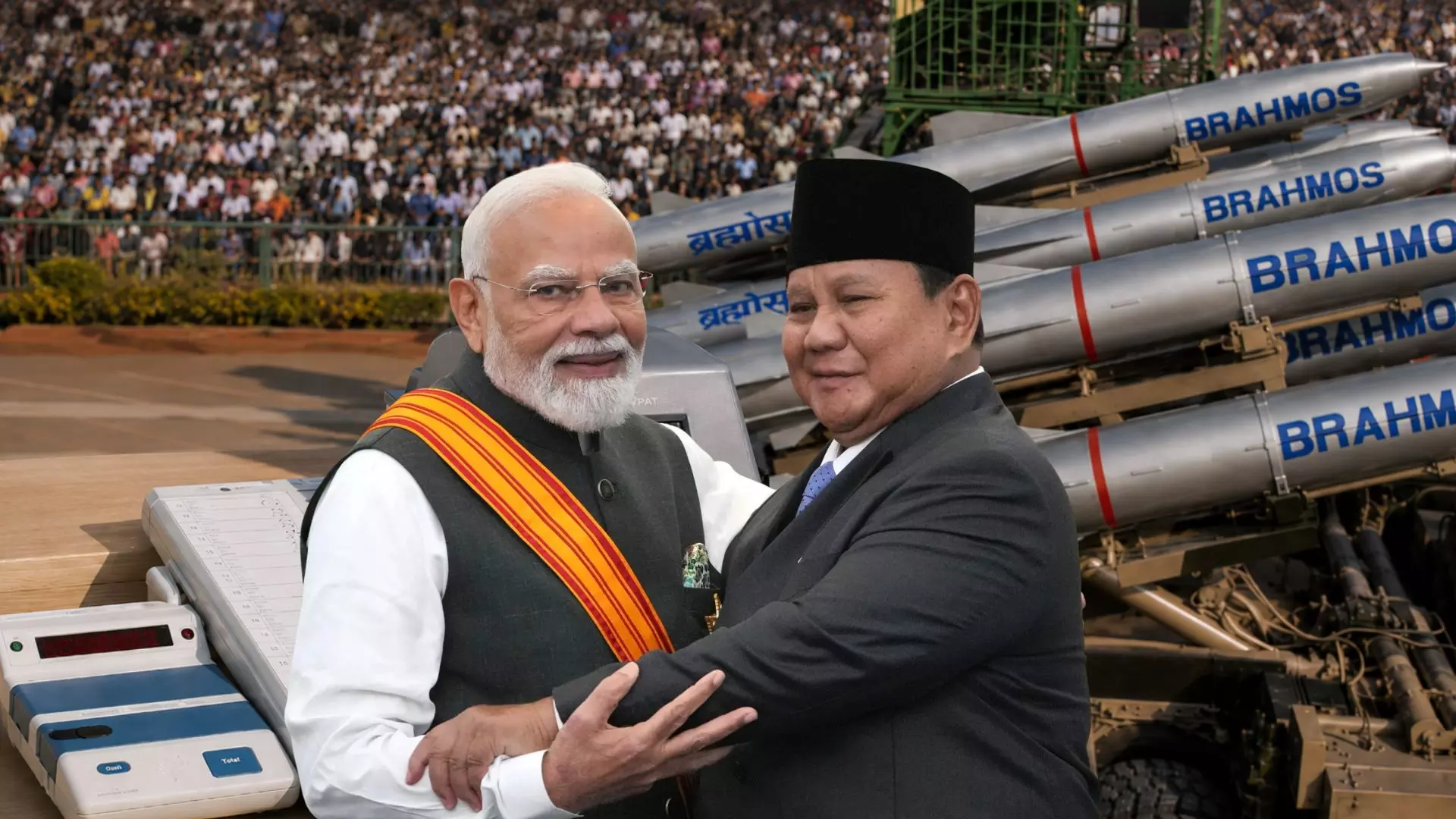
Modi’s Jakarta visit delivers BrahMos deal, Sabang Port pact, EVM adoption
Indonesia inks BrahMos, port, EVM deals with India as Modi receives Jakarta’s highest civilian honour, deepening Indo-Pacific ties

Prime Minister Narendra Modi's Indonesia visit has resulted in major strategic agreements spanning defence, maritime infrastructure and election technology. Indonesia will buy India's BrahMos supersonic cruise missiles, jointly develop the strategically located Sabang Port and adopt India's Electronic Voting Machine (EVM) technology ahead of its 2029 general elections.
The agreements were announced after talks between Modi and Indonesian President Prabowo Subianto in Jakarta. Modi was also conferred Indonesia's highest civilian honour, the Bintang Adipurna, during the visit. The deals are being seen as another step in India's efforts to strengthen its strategic presence in Southeast Asia and the wider Indo-Pacific region.
BrahMos deal
The biggest announcement was Indonesia's decision to procure India's indigenous BrahMos supersonic cruise missiles along with Astra air-to-air missiles in a deal reportedly worth around USD 630 million.
Indonesia thus becomes the third country to purchase the BrahMos missile system after Vietnam and the Philippines.
Also read: PM Modi, Indonesian President visit Prambanan Temple, launch UNESCO conservation project
Jointly developed by India and Russia, BrahMos is among the world's fastest operational supersonic cruise missiles. It can be launched from land, sea and air platforms. Interest in the missile has grown internationally after India used it in combat during last year's four-day conflict with Pakistan.
Foreign affairs expert KS Dakshina Murthy said the purchase reflects the growing importance of missile systems in modern warfare.
"The BrahMos missiles are fundamentally an India-Russia collaboration and seem to have been pretty effective in operations. In the Iran war and even in the Russia-Ukraine war, missiles have become extremely crucial. So it is not surprising that Indonesia wants to buy missiles. India and Indonesia also share a very strong trade partnership, making this a natural extension of their relationship," he said.
Strategic port
Alongside the defence agreement, India and Indonesia agreed to jointly develop the Sabang Port on the northern tip of Sumatra.
Also read: Glaring errors, aid timing: Why Seychelles’ ‘hurried’ award for Modi has sparked a row
The port overlooks the Malacca Strait, one of the world's busiest maritime trade routes through which a significant share of China's crude oil imports passes.
The project is expected to deepen maritime cooperation between the two countries while strengthening India's strategic footprint in the Indo-Pacific.
EVM partnership
Another significant outcome of the visit was Indonesia's decision to adopt India's Electronic Voting Machine (EVM) technology for its future elections.
Indonesia, home to nearly 288 million people and the world's third-largest democracy, currently conducts elections using paper ballots. The country plans to use Indian EVM technology as part of preparations for its 2029 general elections.
Also read: Modi, Japan PM reaffirm rules-based Indo-Pacific amid China concerns
India's election management system is increasingly receiving international recognition. The Election Commission of India has signed cooperation agreements with the election authorities of 28 countries. Indian-made EVMs are already used in Bhutan, Nepal and Namibia, while India also supplies indelible ink for elections to several countries across Africa and Asia.
Officials described the Indonesia agreement as another sign of growing international confidence in India's election technology.
Debate at home
The development comes amid renewed political debate over EVMs in India.
Last week, 23 Opposition parties, including the Congress, DMK, Trinamool Congress, and Aam Aadmi Party, wrote to Chief Justice Surya Kant, expressing concerns over the Election Commission's Special Intensive Revision of electoral rolls exercise and reiterating their demand for a wider discussion on returning to paper ballots.
The parties argued that public confidence in elections should remain paramount and called for a fresh debate on EVMs. However, the letter did not cite any verified instance of EVM tampering.
Also read: Diplomacy helped India import fuel from 40 countries during West Asia crisis: PM Modi
Responding to the criticism, BJP national spokesperson Shehzad Poonawalla said Opposition parties routinely question EVMs after electoral defeats, noting that similar allegations were raised after elections in states including Kerala.
Dakshina Murthy drew a distinction between the Indian political debate and Indonesia's objective.
"Indonesia is only looking at the EVMs as a replacement for the ballot paper. In that sense, it is good for India because the EVMs get some validity. Indonesia is not the only country that has appreciated India's EVMs. There have been other countries around the world that have been interested in them," he said.
Indo-Pacific push
From advanced missile systems to strategic ports and election technology, the agreements signed in Jakarta underline India's expanding engagement with Southeast Asia.
Also read: PM Modi in Seychelles: India signs agreements on defence, UPI, healthcare
Following his Indonesia visit, Modi is scheduled to travel to Australia and New Zealand as part of his broader Indo-Pacific outreach.