








Introduce third language from Class 6 instead of Class 9: Justice Nagarathna urges Centre
During the Supreme Court hearing on Tamil Nadu's challenge to Jawahar Navodaya Vidyalayas, Justice BV Nagarathna questioned introducing a third language in Class 9

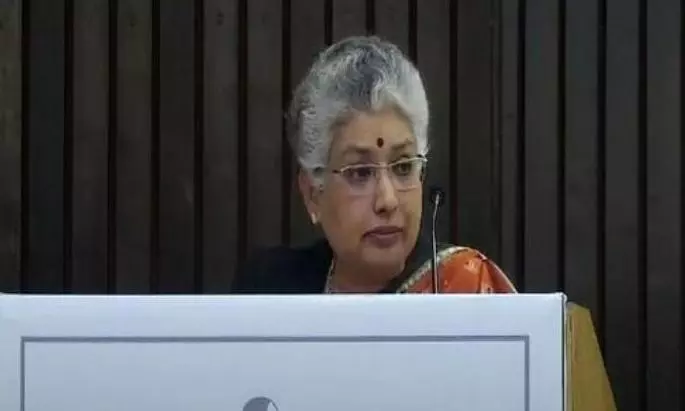
At a time when the CBSE’s three-language policy has been challenged before the Supreme Court, apex court judge Justice BV Nagarathna on Thursday (July 16) expressed concern over the introduction of a third language in Class 9, urging the Centre to introduce it in Class 6 instead.
The judge made the remarks during the hearing of the Tamil Nadu government's appeal against a Madras High Court order directing the establishment of Jawahar Navodaya Vidyalayas (JNVs) in every district of the state.
The state government has been opposing the setting up of JNVs due to concerns over the three-language policy being implemented in the schools.
‘It doesn't say Hindi’
During the hearing, the judge pointed out that, as per the policy, the state language must be taught along with English and any third language, which need not be Hindi.
Also Read: Is English native or foreign? CBSE third-language rule sparks confusion in schools
"The State language has to be taught, English has to be taught and any third language. It doesn't say Hindi," she stated as quoted by Live Law.
When the counsel of the Tamil Nadu government stated that the third language becomes compulsory only from Class 9, Justice Nagarathna expressed concern over it, stating that the ninth standard was already stressful for students.
Suggests starting in Class 6
"No, that is very bad. Ninth standard is stressful. Why do you introduce a new language in 9th? You introduce it in 6th," she said.
"Union of India, please don't have third language in 9th standard. CBSE, ICSE, State Board, 10th standard is a board exam. From the end of 8th standard onwards, the pressure starts,” added the judge.
Tamil Nadu opposes JNVs
The matter concerns the Tamil Nadu Government's appeal against a Madras High Court judgment directing the establishment of a Jawahar Navodaya Vidyalaya (JNV) in every district of the State.
Also Read: SC refuses to stay CBSE three-language policy, Centre asked to reply in 10 days
The High Court had held that the refusal to permit JNVs curtailed students' right to choose educational institutions and was inconsistent with the Right of Children to Free and Compulsory Education Act. The Supreme Court stayed the directions in December 2017.
On December 15, 2025, the apex court directed the Centre and State governments to hold consultations on setting up JNVs and place the outcome before it. A meeting was held on January 5, 2026.
Centre cites policy deadlock
The Centre informed the Court that 689 JNVs have been sanctioned in 666 districts, but none in Tamil Nadu as the State has not accepted the scheme.
Tamil Nadu argued that the scheme's three-language framework conflicts with its statutory two-language policy and said its 38 Model Residential Schools already fulfil the scheme's objectives.