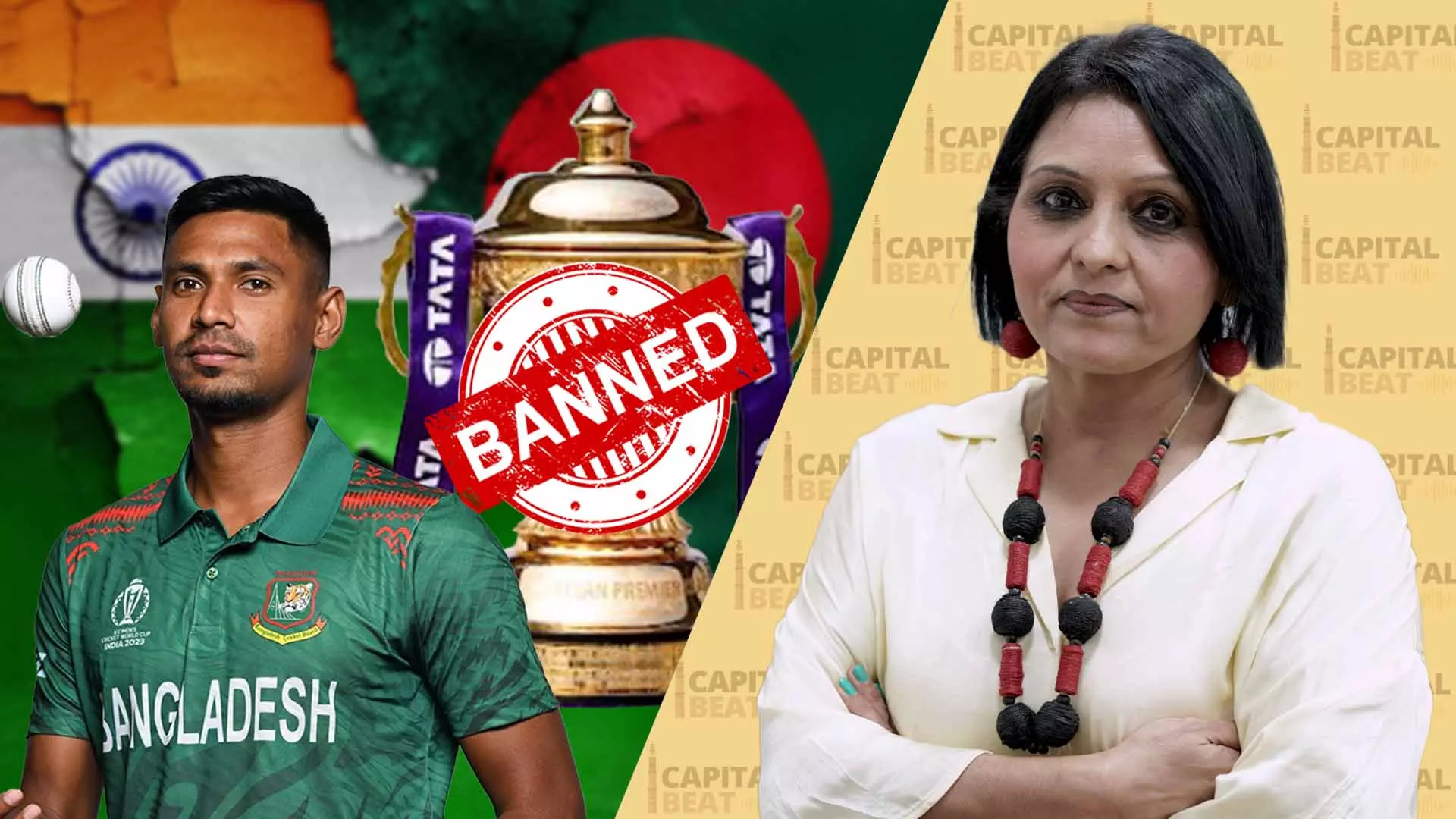
Is politics pushing India-Bangladesh cricket ties to a breaking point?
BJP allies flag concerns after BCCI directive on Mustafizur Rahman coincides with diplomatic tensions and Bangladesh halting IPL telecast

India-Bangladesh cricket relations came under scrutiny in the latest episode of Capital Beat, with panellists Chandrashekhar Luthra, Mahavir Rawat, Sanjay Kapoor, and Siddharta Sharma examining how political developments have intersected with the sport.
The discussion focused on the BCCI directive that led to the IPL franchise Kolkata Knight Riders releasing Bangladesh cricketer Mustafizur Rahman, and the chain of political and diplomatic reactions that followed.
In the weeks preceding the controversy, tensions between India and Bangladesh escalated after a Hindu man was lynched and his body burned in Bangladesh following allegations of blasphemy. India’s Ministry of External Affairs formally condemned what it described as continuing hostility against minorities in the neighbouring country. However, when the controversy arose, leaders of BJP allies Janata Dal (United) and Telugu Desam Party publicly cautioned against mixing cricket with politics.
Bangladesh response and IPL fallout
The panellists noted that Bangladesh responded to developments by ordering an indefinite halt to the telecast of the Indian Premier League in the country. This step was directly linked during the discussion to the release of Mustafizur Rahman following the BCCI directive. The suspension of IPL broadcasts was presented as a significant move, given the league’s popularity among Bangladeshi audiences.
Also read: Cricketers, filmstars and the games they have to play
The panellists also referred to parallel developments, including Bangladesh hiring a Hindu cricketer, to underline the complexity of the situation. These contrasting actions were cited to show how sport, diplomacy, and domestic politics were increasingly overlapping rather than operating in isolation.
Mahavir Rawat, cricket and sports anchor, described the moment as one where electoral considerations across countries were shaping sporting decisions. He said the situation reflected a phase in which cricket administration in South Asia was being driven less by sporting logic and more by political calculations.
Claims of politicisation of cricket
Rawat argued that cricket boards across the region were under heavy political influence, resulting in decisions framed by nationalism rather than the interests of the game. He referred to past instances involving India-Pakistan fixtures and neutral venues to highlight what he described as inconsistent application of security and political considerations.
In one of the programme’s most pointed remarks, Rawat said, “This is totally politics,” while discussing how governing authorities were determining cricketing outcomes. He also highlighted what he described as double standards in international cricket governance, particularly when comparing arrangements made for different countries.
Also read: With Mustafizur episode, India risks pushing Dhaka further towards Islamabad
The discussion raised broader questions about the viability of international tournaments if teams increasingly refused to travel, broadcast events, or participate under prevailing conditions. Rawat suggested that repeated forfeits or walkovers could undermine both the competitive integrity and commercial appeal of global cricket events.
ICC, BCCI and governance questions
Sports journalist Chandrashekhar Luthra addressed rumours about possible ICC action against Bangladesh. He stated during the programme that there had been no formal ICC discussion or decision directing Bangladesh to forfeit points or mandating travel to India at that stage.
Luthra explained that Bangladesh had earlier sought neutral venues for matches on security grounds, drawing parallels with India’s position on travelling to Pakistan. He said there had been an understanding within international cricket that internal security and foreign ministry clearances were prerequisites for teams travelling abroad, and that Bangladesh was invoking similar grounds.
He also referred to voting dynamics within the ICC, noting that Bangladesh is a full member with voting rights. The programme highlighted that Bangladesh’s cricket board had historically supported India in ICC matters, a relationship now facing strain due to the current dispute.
Domestic politics and ally caution
Political analyst Siddharta Sharma focused on the domestic political calculations behind the public statements by JD(U) and TDP. He noted that while both parties support the BJP as part of the NDA, they retain separate political identities and constituencies. Their caution against politicising cricket was presented as an attempt to draw a line between alliance politics and policy decisions.
Also read: Mustafizur Rahman-KKR row: Bangladesh made a Hindu captain, says JDU’s Tyagi
Sharma questioned inconsistencies in the treatment of Bangladeshi players across different franchises and leagues. He contrasted criticism directed at Kolkata Knight Riders with the continued presence of Bangladeshi players in other teams and competitions, pointing to what he described as selective responses.
He also referred to international precedents where sport and politics were separated through mechanisms such as neutral flags, arguing that skill and performance, rather than nationality, had traditionally defined sporting admiration.
Diplomatic implications beyond sport
International affairs expert Sanjay Kapoor expanded the discussion to include diplomatic consequences. He expressed concern over narratives questioning the loyalty and citizenship of minorities in neighbouring countries and how such narratives were spilling over into sports. Kapoor described the situation as damaging not only to cricket but also to regional relations.
Kapoor criticised the close overlap between political authority and cricket administration, referring to leadership structures within global cricket bodies. He warned that continued politicisation could isolate India within international cricket forums and weaken cooperation with neighbouring cricketing nations.
In a key line during the discussion, Kapoor said, “The entire politics of sports is greatly destroying the game,” reflecting the broader concern raised across the panel.
Economic and broadcast stakes
Returning to the commercial dimension, Luthra discussed the financial implications of losing broadcast markets such as Bangladesh. He noted that television rights account for the bulk of cricket revenue, particularly for the IPL, and that reduced viewership directly affects valuations, sponsorships, and long-term sustainability.
Also read: Bangladesh bans IPL telecast over Mustafizur Rahman’s exit from KKR
The programme pointed out that broadcasters had already flagged difficulties in sustaining high rights fees amid falling returns. The potential loss of Bangladeshi viewership was described as a significant economic setback for the league and for cricket administrators.
The discussion concluded with Mahavir Rawat stating that he saw little immediate prospect of restoring cricket ties without political change in one or both countries. He framed the moment as a bleak phase for players, journalists, and fans, with cricket increasingly overshadowed by political considerations.
(The content above has been transcribed from video using a fine-tuned AI model. To ensure accuracy, quality, and editorial integrity, we employ a Human-In-The-Loop (HITL) process. While AI assists in creating the initial draft, our experienced editorial team carefully reviews, edits, and refines the content before publication. At The Federal, we combine the efficiency of AI with the expertise of human editors to deliver reliable and insightful journalism.)