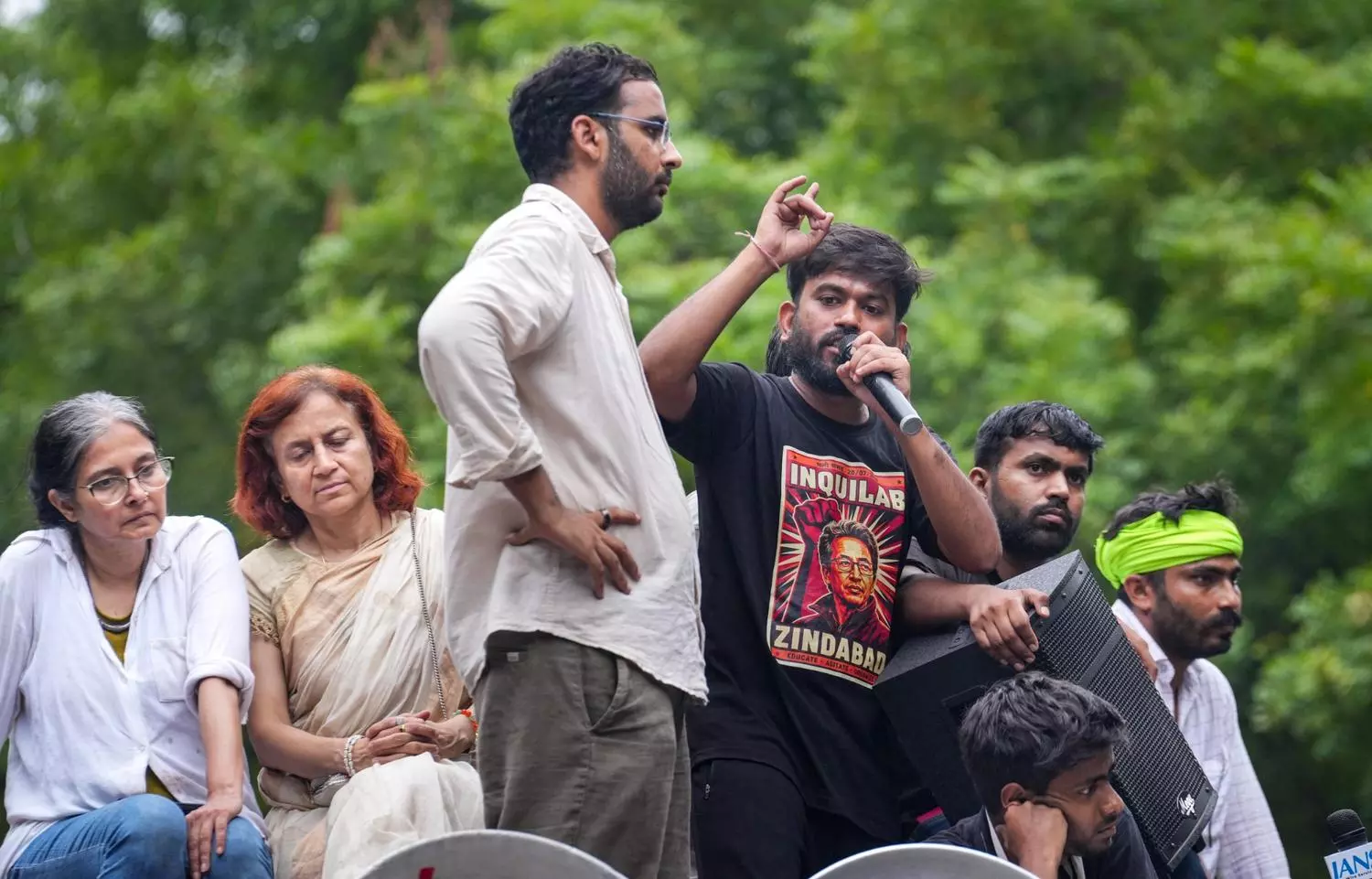
Cockroach Janata Party (CJP) founder Abhijeet Dipke speaks at a protest demanding Union Education Minister Dharmendra Pradhan's resignation over alleged NEET exam irregularities, at Jantar Mantar, New Delhi, on Monday. Gitanjali J Angmo, wife of climate activist Sonam Wangchuk, is also seen. PTI
Delhi's student uprising: Did Centre misread the mood?
Political observers say the Centre's decision to avoid dialogue or accountability only deepened the perception of a government unwilling to listen

Delhi witnessed its biggest street mobilisation in over a decade on Monday (July 20), and by evening, the question dominating the discourse was no longer just about students on the streets — it was whether the government had completely failed to read the public mood before it erupted.
What began as a routine sit-in demonstration at Jantar Mantar, the designated protest site in the national capital, spiralled into something the administration was visibly unprepared for. Drone visuals from around 9 am showed the venue packed beyond capacity, with the crowd spilling onto Sansad Marg, the road leading directly to Parliament, and even reaching the Central Secretariat area.
Also read: What are the CJP’s 3 demands of the govt?
Delhi Police's response — shutting metro stations, blocking roads and denying assembly at the designated protest site — appears to have backfired. Rather than containing the protest, the barricades created what analysts described as "satellite protests", with each blockade point becoming a new site of demonstration, thereby multiplying the disruption rather than containing it.
So the question is: has the government goofed up in analysing the situation?
Intelligence failure
Former IPS officer and former Intelligence Bureau Special Director Yashvardhan Azad said periodic, transparent health checks on climate activist and educator Sonam Wangchuk at the protest site, rather than a sudden removal, could have reassured demonstrators that their constitutional right to protest was being respected. He called the episode a clear intelligence and crowd-management failure, while noting that the New Delhi Police Commissioner is otherwise a capable officer.
Azad added that the controversy extends beyond Union Education Minister Dharmendra Pradhan's resignation, describing it as a significant setback for the government. He argued that regardless of whether Pradhan remains in office, the incident sends a strong political signal about public dissatisfaction. He pointed out that concerns over education, unemployment and growing social inequalities could trigger more such protests in the future, calling the government's handling of the issue both inadequate and a warning of greater challenges ahead.
‘Spontaneous youth movement’
Senior journalist Javed Ansari, who has covered demonstrations and protests in New Delhi for over four decades, including the Anna Hazare movement and the 2012 Nirbhaya protests, said he had not seen anything this organic and widespread in 15 years. He described young people arriving from as far as Lucknow, Odisha and Bengaluru, cutting across caste, religion and gender lines, driven purely by anxiety over jobs and education outcomes. He described the agitation as largely spontaneous and lacking a formal organisational structure, but said it had struck a powerful chord among young people.
Also read: CJP’s Parliament march: From clashes to talks with ministers, key developments
Ansari argued that the government's response reflected what he called "hubris", claiming it has adopted a standard approach of avoiding resignations or engagement with protesters because it views such actions as signs of weakness. According to him, the government projects itself as decisive and action-oriented and is therefore reluctant to remove ministers facing criticism or hold talks with agitators.
Accountability issue
Samajwadi Party spokesperson Ghanshyam Tiwari argued that the absence of any political party's visible backing was precisely what gave the protest its moral force. He accused the government of habitually delegitimising dissent — whether from the judiciary, the media or unaffiliated students — rather than engaging with it.
Tiwari accused the BJP of attempting to "de-legitimise or capture" institutions and political opponents, arguing that the government's response to the student protests reflected an unwillingness to engage with dissent. He alleged that the Centre continued to project political strength despite growing public anger and viewed dialogue with protesters or ministerial resignations as signs of weakness.
Also read: ‘Is this not our country’: What CJP protesters said as they defied police crackdown
He also claimed the controversy extended beyond Pradhan, arguing that it reflected a broader failure of accountability within the government. He accused the BJP of ignoring public sentiment while taking a hard line against protesting students, and said the issue had cast a shadow over the government's overall credibility.
Panellists suggested the government's reluctance goes beyond loyalty to one minister; rather, it reflects an institutional aversion to appearing to concede to public pressure for fear of setting a precedent that could be applied to other ministers facing criticism.