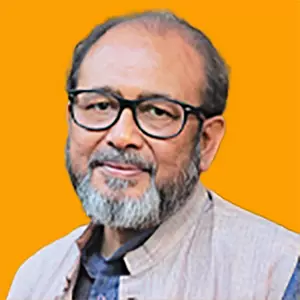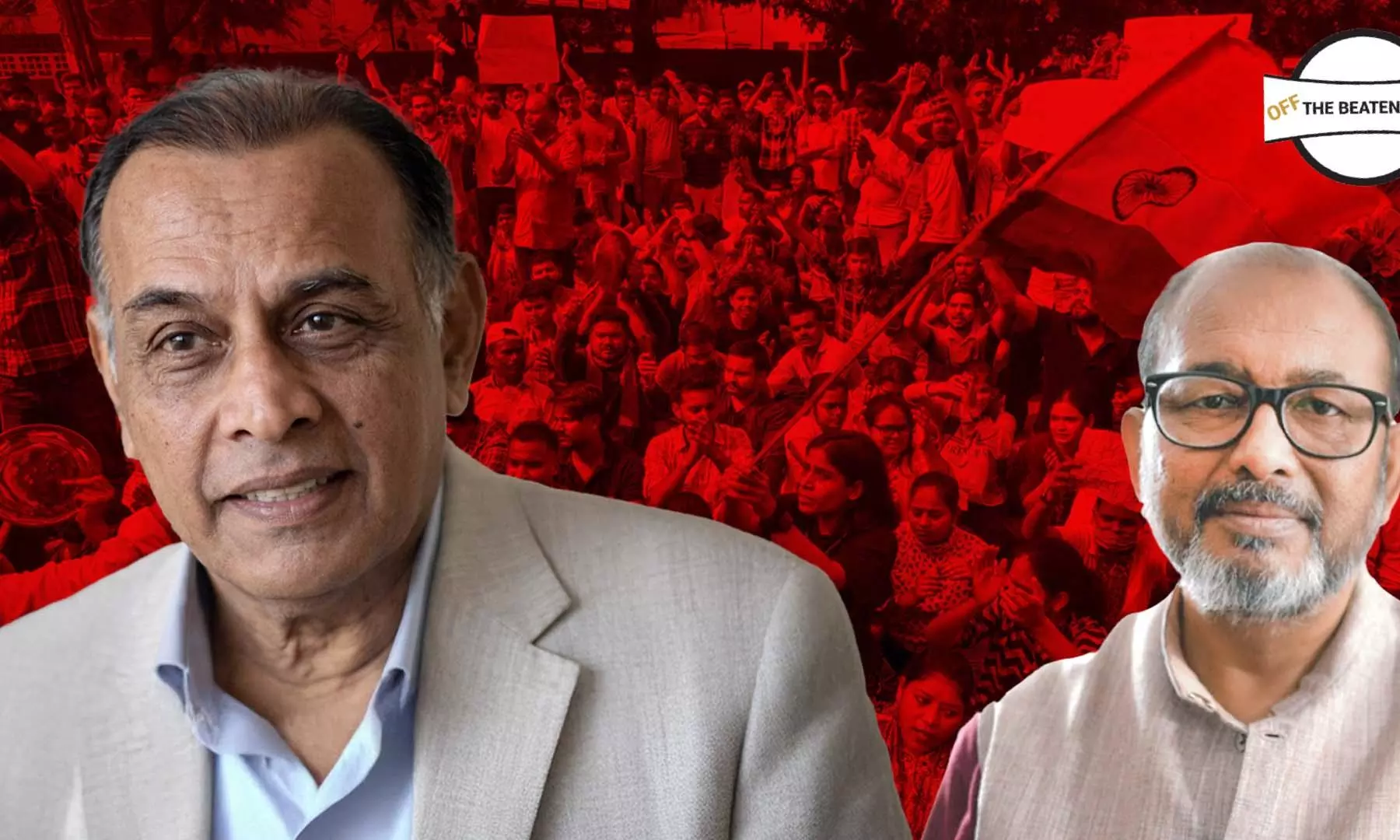
Anand Kumar, former president of both the Banaras Hindu University Students’ Union and the Jawaharlal Nehru University Students’ Union, talks about the changing nature of student politics, the role of free speech in a democracy.
'Campus democracy is dying': Sociologist Anand Kumar on why students' protest matter
In this episode of Off The Beaten Track, Anand Kumar reflects on student politics, free speech and warns suffocating student protests is a death knell for democracy

Tensions at Jawaharlal Nehru University (JNU) reached a boiling point in late February and early March 2026, as hundreds of students attempted a "Long March" to the Ministry of Education (MoE). The protest came after controversial comments made by vice-chancellor Santishree Dhulipudi Pandit during a podcast, where she compared the struggles of Dalits in India to Black people in the US, stating they should not progress by "playing the victim card".
The protesting students were barred from entering the MoE.
The Indian Youth Congress’s high-profile ‘shirtless’ protest during the India AI Impact Summit drew strong political reactions, with ministers condemning the act and 14 members were detained.
Also read: Why student union elections remain suspended in several universities
Triggered by the recent campus unrest and political reactions to dissent, Anand Kumar, former president of both the Banaras Hindu University Students’ Union and the Jawaharlal Nehru University Students’ Union, talks about the changing nature of student politics, the role of free speech in a democracy, and whether India is witnessing a broader democratic recession.
Drawing from decades of experience in student activism and public life, Kumar reflects on how campuses once nurtured dialogue and citizenship and questions what happens when protest spaces narrow down.In this episode of Off The Beaten Track (OTBT), speaking to The Federal, Kumar examines whether India’s democratic culture of protest is shrinking. A stark warning comes from the veteran sociologist and former student leader, who says the space for protest in universities has shrunk drastically compared to earlier decades.
How do you compare student politics in the 1960s and 1970s with the situation today? What has changed in the attitude of governments and universities?
There is a very strange contrast between the 1970s and today, even though the gap is only about 50 years.
In the 1960s and 1970s, when we were undergraduate and postgraduate students and later research scholars at JNU, campuses provided space for cultivating citizenship and learning the art and science of democratic politics and mobilisation.
Student unions were considered an essential part of co-curricular activities. Vice-chancellors saw it as their responsibility to ensure that campuses had a culture of mobilisation, protest, cooperation, competition, conflict, and conflict resolution.
Also read: DU cracks down on protests, public meeting on campus for a month
Today, there is almost an absolute ban on such activities. If you protest, you are immediately branded anti-national, anti-democratic, or anti-constitutional.
This is strange because if citizenship becomes passive, rulers have no way to understand how policies appear at the grassroots level. Student protests serve as an internal check — a safety valve.
Most students come to universities to build careers and futures. If they are protesting, something is fundamentally wrong. Their concerns should be seen as warning signals. But today there is absolute intolerance. That promotes lack of communication, dialogue, and debate.
Democracy is about living with differences in India. Even within families, living with differences is difficult, yet it is essential for respecting each other's freedoms and rights. If you compare the 1970s with today, the difference is stark. Governments did not welcome protests then either, but they took them seriously. There were forums where student leaders could present views even if those views opposed the government.
Today, that space has disappeared. Many universities do not even have student unions anymore. Even where they exist, like in JNU, they are denied dialogue and engagement. That is dangerous.
Do you believe this trend reflects a broader democratic recession in India?
Most certainly. There is also a clear hypocrisy among political parties, especially the ruling party.
On one hand, they spend crores during student union elections such as those at Delhi University. On the other hand, they deny genuine space for student representatives to express their concerns. Students talk about unemployment, joblessness, and commercialisation of education. They are future leaders of the country. If they are raising these issues, you should listen.
Ignoring them means missing important signals.
Also read: Is Delhi University’s protest ban an abdication of duty? Apoorvanand questions move
This creates a crisis for democracy’s future. If young citizens are not trained in democratic mobilisation, dialogue with adversaries, and collective action, they will lack those democratic skills later. Today, we see a democratic deficit developing. Universities are witnessing violence, attacks on teachers, and attacks on women students, yet no one addresses the deeper problem.
Campus democracy is dying. And if campus democracy dies — along with nepotism in political parties and shrinking media space — then how can we claim democracy is healthy and growing?
You mentioned incidents from JNU during the 1970s. What memories from that period are relevant today?
In the 1970s, there was a strong culture of protest, but it was handled with care. At JNU, for example, the student union organised a gherao around 1972–73 when certain demands were ignored. The protest continued for hours.
At one point there was tension because university officials needed food and medicines. Meanwhile, Prime Minister Indira Gandhi’s office called Vice-Chancellor G. Parthasarathi asking whether police should be sent. To his credit, Parthasarathi told her, “Madam Prime Minister, you take care of the country. These are my students. Let me negotiate with them.” The police were not called.
Also read: JNU move to rusticate top student leaders over last year’s protest sparks row
Later that night, we ourselves realised the protest had gone on too long and withdrew the gherao. The next day we expected disciplinary action. Instead, the Dean of Students invited the student union to renegotiate our demands with the vice-chancellor.
Such a positive attitude prevented escalation. Another example occurred in 1970 during the Indian Science Congress in Banaras, which Indira Gandhi was inaugurating. Students had announced they would show black flags in protest. When they did so, they were detained briefly but not beaten or expelled. That was the culture of the time.
Today, vice-chancellors refuse to meet elected student leaders. Instead, they are rusticated or expelled. But they are elected representatives who understand the pulse of students better than administrators. If you close all doors of dialogue, what option remains for students?
We have also seen incidents where violence occurred on campuses, including attacks on students and teachers. What does that signify?
It is very shocking. In the capital city, student leaders — including a woman student union president — and faculty members were beaten by masked attackers. FIRs were registered but no one was arrested.
If such lawlessness occurs with the government’s tacit approval, it destroys students’ faith in democratic methods. It encourages lawlessness and lumpenisation. That is very dangerous.
Many current leaders of the ruling establishment themselves emerged from student politics. Why then such hostility toward student protests?
It clearly indicates hypocrisy. Prime Minister Narendra Modi himself entered public life through the Nav Nirman student movement in Gujarat during the 1970s. Arun Jaitley was the president of the Delhi University Students’ Union during the JP movement. I worked with him in the student action committee.
Several governors and ministers today were student leaders in their youth. They benefited from student politics and campus democracy.
Also read: Spectre of student-led revolution: Why India must focus on education quality
Yet today they condemn peaceful student protests as shameless or anti-national. Organisations like the Akhil Bharatiya Vidyarthi Parishad (ABVP) have long mobilised students into political life. Similar student wings exist for all major parties across the world.
Students must understand ideological diversity and democratic protest. If you suppress this energy, you push young people toward non-constitutional methods.
How deeply is the culture of protest connected to India’s national movement?
Very deeply. India’s freedom struggle itself was built on protest movements — from the anti-partition movement in Bengal in 1905 to Gandhi’s calls for students to boycott colonial institutions in the 1920s.
Many leaders of independent India — including Jawaharlal Nehru and Subhas Chandra Bose — actively engaged with students and encouraged political awareness on campuses. Even after independence, leaders like Atal Bihari Vajpayee and others regularly visited campuses to speak with students.
The idea was that universities produce enlightened citizens. But today, instead of critical thinking, there is pressure to conform. There is promotion of orthodoxy rather than critical consciousness. Yet, critical thinking is essential for progress.
Why is free speech and the right to protest so essential in a democracy?
Free speech is the dividing line between democracy and authoritarian systems. It distinguishes democracy from feudalism, monarchy, fascism, and Nazism.
India historically had millions of voiceless people. Leaders like B R Ambedkar and Mahatma Gandhi gave voice to those who had none.
Also read: JNU protest march: Student leaders among 14 protesters released from jail
Jawaharlal Nehru taught the country how to exercise freedom responsibly. But if today fear, intolerance, and hatred dominate public life that represents a dark chapter. Students still protest about environment, gender justice, and caste discrimination. These are positive contributions to nation-building.
Yet they are labelled anti-national. That definition of democracy is wrong.
Globally, scholars speak of democratic recession. Do you think India reflects that trend? I want to believe India remains a growing democracy. But we must examine the indicators. Farmers protested for a year before the government finally responded. Manipur has been burning for two years, yet the prime minister has not visited.
Trade unions protest labour reforms, but dialogue is limited. If communication disappears, democracy enters recession.
Some analysts say India is becoming an electoral democracy — where elections exist but institutions weaken. Elections today require enormous financial resources. Campaigns often involve crores of rupees. In some places, votes are openly purchased. That is transactional democracy.
If elections are polluted, parliament weakened, media controlled, and critics labelled anti-national, democracy becomes fragile. India fought hard for democracy and will not easily surrender it.
If the culture of protest is under pressure, what can concerned citizens do today?
Many people feel helpless because institutional spaces have shrunk. Parliament debates less, media space is limited, and there is fear of harassment.
But citizens must not withdraw.
Also read: How Indian universities have systematically crushed student dissent since 2014
Democracy requires engaged citizens. People should start with local issues — water, electricity, education, healthcare, price rise, and corruption.
Micro-level protests matter. Civil society organisations still exist. Citizens can join groups that defend civil liberties and democratic rights. There have been inspiring examples — such as Gandhian activists walking for months in protest after their headquarters was demolished. If citizens believe someone else will defend democracy for them, they are mistaken.
Democracy survives through collective, peaceful, and institutional resistance. Concerned citizens still outnumber those who simply endorse power.
The content above has been transcribed from video using a fine-tuned AI model. To ensure accuracy, quality, and editorial integrity, we employ a Human-In-The-Loop (HITL) process. While AI assists in creating the initial draft, our experienced editorial team carefully reviews, edits, and refines the content before publication. At The Federal, we combine the efficiency of AI with the expertise of human editors to deliver reliable and insightful journalism.