








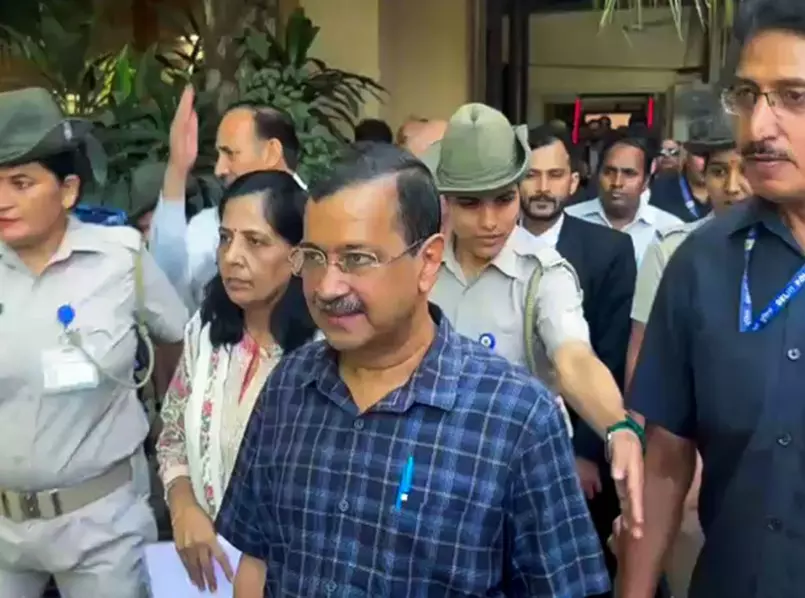
Kejriwal stated that earlier observations of the High Court were “so strong” they appeared to carry the weight of final findings. Screengrab: ANI
Kejriwal seeks recusal of Delhi HC judge in excise policy case, cites apprehension of bias
Kejriwal tells the Delhi High Court he fears an unfair hearing, while the Central Bureau of Investigation opposes the plea as “baseless"

Former Chief Minister and AAP supremo Arvind Kejriwal, arguing in person seeking recusal of Justice Swarana Kanta Sharma in the CBI's excise policy case, told the Delhi High Court on Monday (April 13) that he was not questioning the Court’s integrity but only expressing his “reasonable apprehension” that he might not get an impartial hearing.
"I am not questioning the integrity of the court, but I have a real and reasonable apprehension that I may not get a fair hearing", said Kejriwal. He further stated that his plea was based on 10 specific grounds, adding that the issue lies in perception and not in actual evidence of bias.
Concerns over prior observations
Elaborating further, he stated that earlier observations of the High Court were “so strong” they appeared to carry the weight of final findings.
Also Read: Excise policy case: Delhi HC seeks Kejriwal's response on ED challenge to acquittal
"The question is whether those earlier views continue to weigh in the mind of the court," he added as quoted by ANI. He also pointed out that according to the trial court’s discharge order there were no offence, bribery or proceeds of crime were established, while also questioning the reliability of approver statements.
March 9 order and its implications
Kejriwal also claimed that the High Court’s March 9 order was issued without hearing all parties. "What was the urgency for such an order?" he stated, claiming that it had created serious doubt in his mind.
Also Read: Clean chit in liquor case puts Team Kejriwal back in the game
Kejriwal further argued that discharge orders are not meant to be stayed routinely, placing reliance on Supreme Court precedent to contend that such relief must be exercised sparingly. He submitted that the partial stay granted in the present matter had, in effect, weakened the findings returned by the trial court.
Parity and pace of proceedings
He also flagged the pace at which the proceedings were being taken up, stating that his case was moving at an unusually accelerated rate when compared with other criminal revisions, including those involving opposition leaders.
Referring to past instances, he pointed out that recusal had been accepted even on the basis of apprehension alone. "I am only asking for the same standard," he said, adding that his apprehensions are on "stronger footing."
Scope of plea and court’s response
Maintaining that his plea was confined to a limited procedural question, Kejriwal emphasised that the issue of recusal is “between the court and the party” and does not call for intervention by the prosecuting agency.
Also Read: Kejriwal's acquittal in liquor scam: A verdict that indicts more than CBI
The Court, however, observed that it would restrict the scope of the present hearing to the recusal application and the grounds urged, indicating that questions touching upon the merits of the trial court’s order would be dealt with independently.
CBI’s opposition and arguments
Opposing the plea, the Central Bureau of Investigation, represented by Solicitor General Tushar Mehta, described the application as "frivolous, vexatious and baseless," submitting that it rests on conjecture and seeks to erode the credibility of the judicial process. He argued that disagreement with interim observations cannot be a ground for recusal and cautioned that permitting such pleas would encourage "bench hunting."
Also Read: Naidu and Siddaramaiah: Latest examples of ‘self-acquittal’ by chief ministers
The agency maintained that interim observations remain tentative in nature and cannot be read as indicative of bias. It defended the March 9 order, stating that courts are empowered to issue interim directions based on the material available and the legal questions involved, even without a complete examination of the trial court record at that stage.
It was also submitted that service of notice through counsel is legally valid and that proceedings under the Prevention of Money Laundering Act continue unless there is a final acquittal in the predicate offence.
Case background and current status
Denying any undue haste, the agency pointed to the need for expeditious adjudication in matters involving public representatives. It urged dismissal of the plea with costs, terming it an abuse of process.
The High Court is currently hearing the CBI’s challenge to the trial court’s discharge of Kejriwal, former Deputy Chief Minister Manish Sisodia and others in the Delhi Excise Policy 2021–22 case. An earlier transfer request had been declined by the Chief Justice, leaving the issue of recusal to the concerned bench.
Declining to comment outside court, he told reporters, "I will speak only before the Court. Matter is sub-judice."