








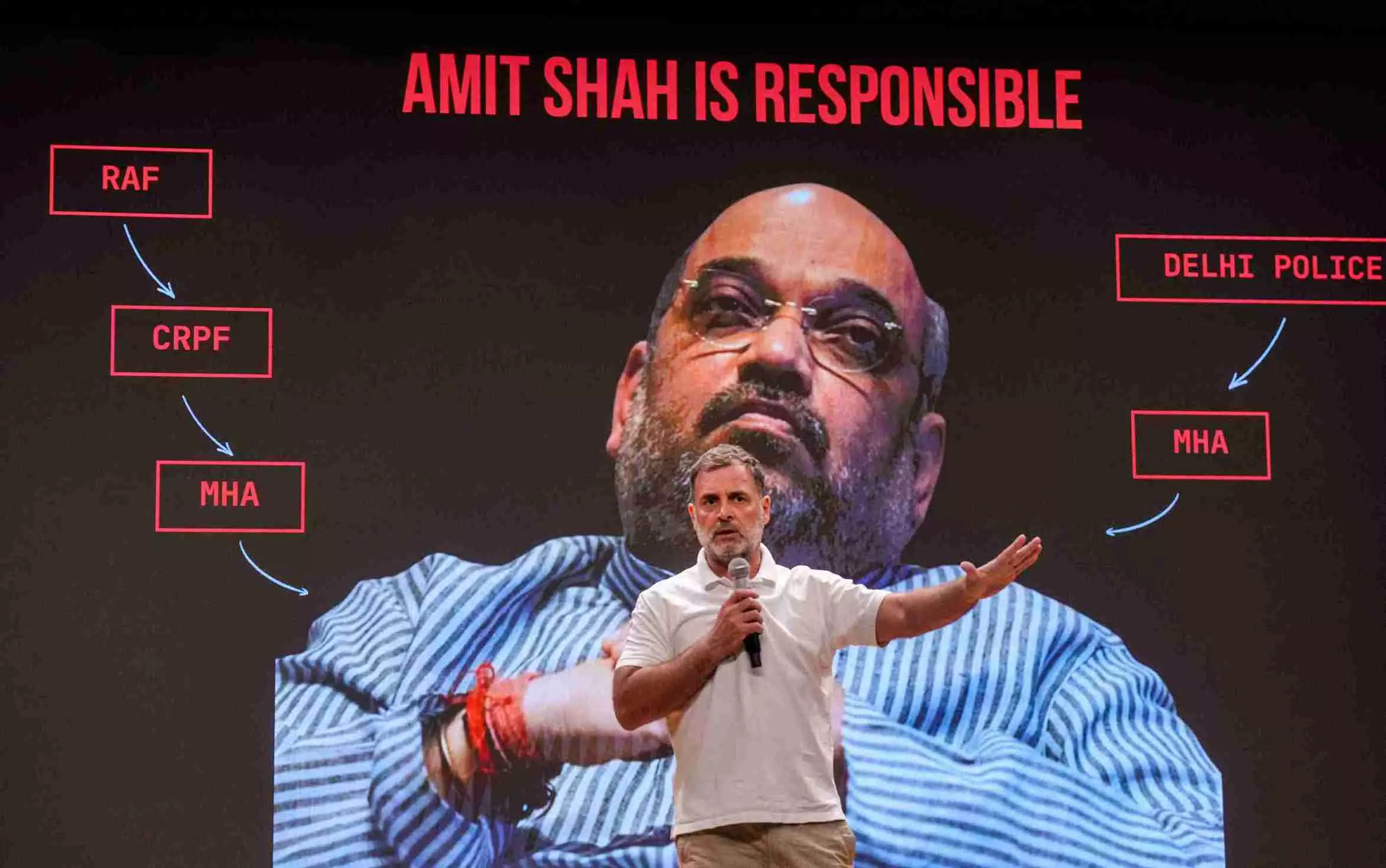
LIVE | Amit Shah either culpable or incompetent, either way has to go: Rahul
Lok Sabha passes Public Examinations (Prevention of Unfair Means) Amendment Bill, 2026 by a voice vote amid heavy sloganeering by Opposition members

The anti-paper leak bill was passed on Wednesday (July 29) after a stormy Lok Sabha debate marked by repeated disruptions over Leader of the Opposition Rahul Gandhi's allegation that Union Home Minister Amit Shah had authorised the use of force against students protesting at Jantar Mantar during the CJP agitations.
Participating in the debate, Rahul alleged that Shah, who was absent from the House at the time, bore the responsibility for the police action against the protesting students
The government introduced the Bill on Monday in Lok Sabha days after nationwide student protests over the NEET fiasco culminated in the resignation of Dharmendra Pradhan as education minister.
Follow live updates here.
Live Updates
- 29 July 2026 7:37 AM IST
Opposition did not speak on anti-paper leak Bill, indulged in politics: Rijiju
Union Parliamentary Affairs Minister Kiren Rijiju on Tuesday slammed the Congress and other Opposition parties for not speaking on the anti-paper leak Bill, saying the discussion should have focused on its merits.
After six days of stalemate, a discussion on the anti-paper leak Bill began on Tuesday in the Lok Sabha with the government describing it as a reaffirmation of the ruling dispensation's commitment to safeguard the welfare of students.
The Opposition hit back over the lathi-charge on protesters, saying every blow on them hurt the government's prestige more than the backs of the youth.
Initiating the debate on the Public Examination (Prevention of Unfair Means) Amendment Bill, 2026, Union Minister of State for PMO Jitendra Singh said the Narendra Modi government finished an unaccomplished task to bring a law to prevent examination malpractices in 2024.
Speaking to reporters outside Parliament, Rijiju said the discussion should have been on the merits of the Bill but the Opposition failed to speak on its provisions.
"Discussion is taking place on the Bill but nobody has spoken about the bill itself. They were only indulging in politics. Everyone was making political speeches. This is not right.
"When a bill is discussed, people should speak about its provisions on merit. They should debate the procedures and the stringent legal measures it brings to prevent examination-related irregularities. Such a discussion would be beneficial," he said.
Rijiju claimed that while the BJP and NDA MPs spoke on the bill, members of the Congress and other opposition parties did not.
"I listened carefully. All the BJP and NDA MPs spoke about the bill. But none of the Congress or opposition members spoke about the bill," he said.
Asked about Congress MP Priyanka Gandhi Vadra's remarks that the bill did not contain constructive measures to safeguard the interests of the youth, Rijiju said if the opposition had spoken on the bill, it would have understood its importance.
"If they are not discussing the bill, what answer can we give? Tell me, should Parliament continue for so long without discussing the legislation?" he said.
"They can offer constructive suggestions and criticism. They are free to make suggestions. If there are shortcomings in the bill, then point them out," Rijiju added.
- 29 July 2026 7:33 AM IST
Bengal govt not to take coercive action against students protesting NEET paper leak
The West Bengal government on Tuesday announced that no coercive measures would be taken against students participating in protests over the NEET paper leak, while clarifying that the protection would not apply to persons with criminal antecedents.
In a statement issued by the Home and Hill Affairs Department, the government said the decision was taken after examining all aspects of the case and in view of the Supreme Court's order passed on July 28.
Leftist student organisations held a rally against the NEET paper leak in the city on Friday. Several journalists were injured when some people attacked them during the march from Sealdah station to Esplanade in central Kolkata.
One case had been registered in the state till 6 pm on July 26 on a police complaint in connection with the protests over the alleged NEET-UG irregularities. Sixteen people have been arrested in connection with the case, it stated.
Provisions of the newly legislated stringent Goonda Act have been applied against the arrested people. A court on Tuesday granted bail to the accused after initially remanding them to two days of judicial custody.
"After due consideration, the government has decided that no coercive measures shall be taken against the students participating in the protests relating to the alleged irregularities in the NEET (UG) Examination," the statement said.
- 29 July 2026 7:33 AM IST
Govt Bill not enough, focus must be on preventing paper leaks: Tharoor
Congress MP Shashi Tharoor on Tuesday said the bill brought by the government to tackle paper leaks was "not enough" and asserted that the ambition cannot simply be to punish a leak more severely, but to prevent it from happening in the first place.
Participating in the debate on The Public Examination (Prevention of Unfair Means) Amendment Bill-2026 in the Lok Sabha, Tharoor called for a comprehensive reform of India's examination architecture and said the country must move away from the current "single, high-stakes, high-stress, examination model, where the future of millions is decided in a few gruelling hours".
"The success of this law should not ultimately be measured by the number of people we send to prison. It should be measured by the number of paper leaks that never happen," he said.
"It should be measured by examinations that take place on time, results that students can trust, and institutions that accept responsibility. More importantly, it should be measured by whether a young Indian can walk into an examination hall believing one simple thing is true: that nobody has bought an advantage that they have spent years working to earn," Tharoor said.
All students were asking of the government was a fair examination where their performance alone decided their future, he said.
"When a question paper is leaked, therefore, what is stolen is the value of somebody's hard work. Your bill introduces all sorts of punishments; 10 years imprisonment, Rs 10 crore fines... if somebody makes a business out of selling the futures of our children, yes, the law must come down heavily on them. But, punishment begins after the damage has already been done. By the time we arrest the person who leaked a NEET paper, lakhs of students have already suffered," he said.
"Our ambition cannot simply be to punish a paper leak more severely, but it must be to prevent it from happening," he asserted.


