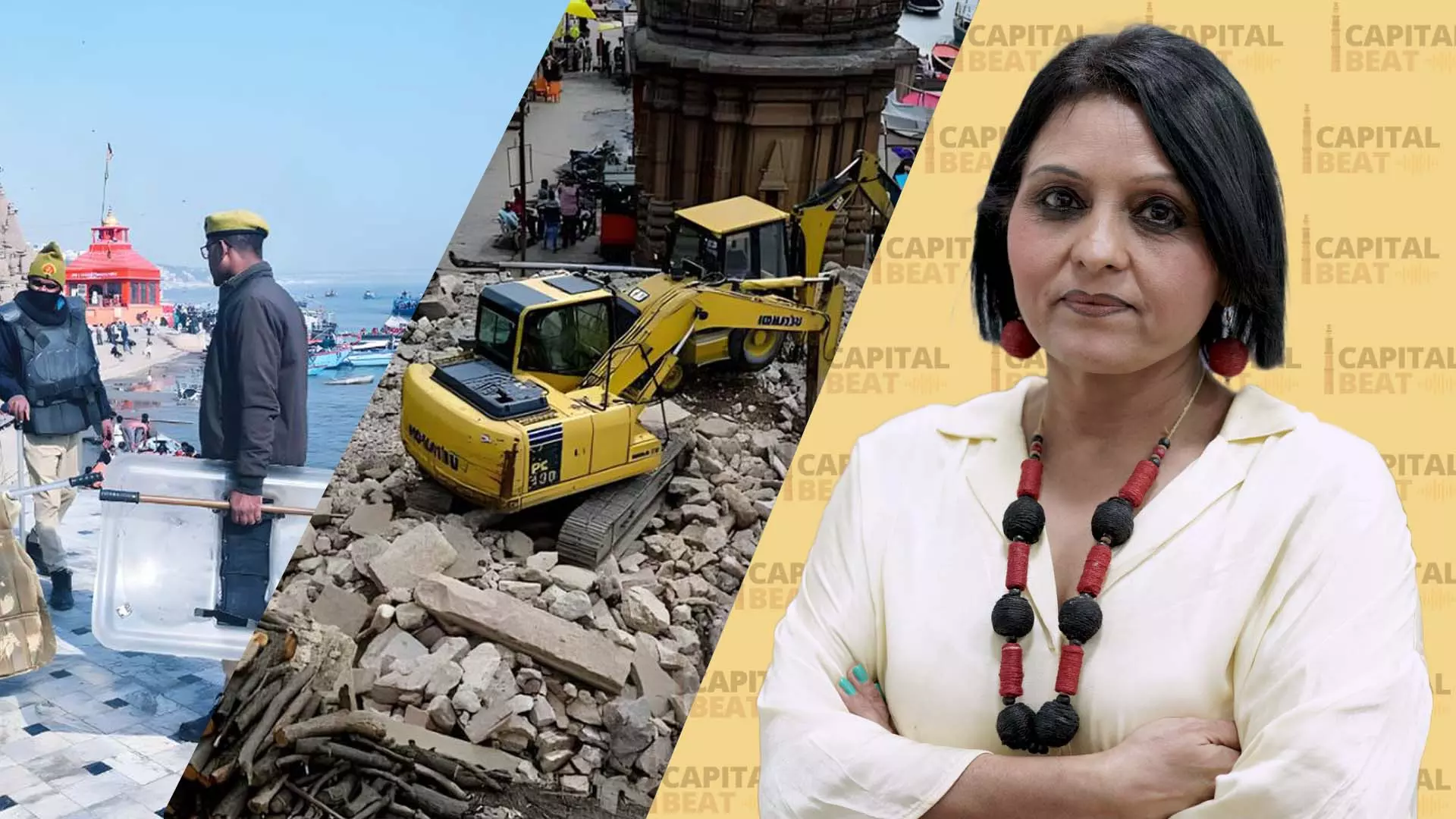
Manikarnika Ghat demolition: Should development come at the cost of heritage?
Capital Beat examines objections from Holkar trust, political protests, and claims of damage control as heritage and redevelopment collide. Is history being erased?

In a Capital Beat episode, panelists Mridula Mukherjee, historian, Anuram Acharya, Congress spokesperson, and Shaira Naim, senior journalist and political commentator, discussed the controversy surrounding the demolition of structures at Varanasi’s Manikarnika Ghat during renovation work, including a structure linked to Maratha queen Ahilya Bai Holkar.
The discussion focused on heritage concerns, political reactions, protests, and the government’s response as redevelopment at one of Hinduism’s most sacred cremation sites sparked nationwide debate.
Manikarnika Ghat, among the oldest and most sacred cremation grounds in Hindu tradition, holds deep religious, cultural, and historical significance. The descendants of Ahilya Bai Holkar and trusts associated with her legacy objected to the demolition, stating that the structure was removed without prior notice or consultation.
Also read: UP police lodge 8 cases over ‘fake’ images of Manikarnika Ghat project
The family and associated trusts demanded that damaged statues and heritage artefacts be traced and recovered and called for accountability, saying the demolition hurt sentiments linked to a ruler revered for restoring temples and ghats across India.
Heritage objections
Public anger spread among local residents, historians, and political leaders, with protesters arguing that development should not come at the cost of history. Objections were raised that heritage sites linked to important historical figures and religious belief systems must be protected during redevelopment.
Legal petitions were also filed seeking to halt further demolition in the name of redevelopment, rejuvenation, and purification, as concerns grew over irreversible damage to the ghat’s historical fabric.
Mridula Mukherjee said the controversy followed a pattern seen in other redevelopment projects. “This is in keeping with a lot of other things we have been seeing,” she said, referring to earlier protests over the renovation of the Sabarmati Ashram and the Central Vista project.
She noted that historians, architects, urban planners, and citizens had objected to changes that disrupted the integrity of historically significant spaces.
Pattern of redevelopment
Mukherjee highlighted protests linked to redevelopment in Varanasi even before the current controversy. “There were protests by local religious figures and mahants who were associated with that area,” she said, adding that several small temples of local significance had already been destroyed during earlier phases of the project.
Also read: Varanasi: Protest erupts over Manikarnika Ghat demolition; officials deny charges
She stated that the controversy intensified because of Ahilya Bai Holkar’s legacy, but similar damage to smaller temples had gone unnoticed earlier.
“This is not how you do development,” Mukherjee said, pointing to international examples where redevelopment preserved heritage integrity by working around existing structures. She also expressed concern over commercialisation within sacred landscapes, saying reports of malls or large commercial structures near such sites were “absurd” and undermined the sanctity of heritage locations.
Authenticity concerns
Mukherjee stressed that restoration should preserve originality. “You do redevelopment in a manner that keeps the integrity of the site intact,” she said, adding that heritage should not be destroyed for beautification.
She cited examples from Rome, where restoration preserves structures over 2,000 years old without disturbing their historical layers, and said India possessed the technology and expertise to do the same.
Mukherjee also raised concerns about large redevelopment projects replacing historical value with symbolism, stating that heritage buildings and institutions carried memories that could not be recreated once destroyed.
Political protests
Congress spokesperson Anuram Acharya described the demolition as a civilisational issue rather than a routine redevelopment matter. “Manikarnika Ghat is not a normal ghat,” he said, calling it a civilisational symbol.
Acharya said that rebuilding demolished structures would not restore what was lost. “When you break an original heritage structure, you don’t restore history. You replace it,” he said. He warned that using bulldozers at heritage sites was a “cultural warning sign” and questioned whether reinstalling idols could restore authenticity.
Also read: Photos: Lakhs of devotees take holy dip in Sangam as Magh Mela begins in Prayagraj
“They may reinstall idols, but they cannot reinstall authenticity,” Acharya said.
Corridor culture
Acharya criticised what he described as a uniform redevelopment model. “One template, one design, one political branding applied everywhere,” he said, adding that Kashi required protection rather than redesign.
He said Congress workers had protested against the demolition and reiterated that Manikarnika Ghat’s sacredness lay in its raw, ancient character. “Over-polishing it destroys its soul,” he said.
The discussion also touched on protests by political parties, including the Samajwadi Party and Congress, over what they described as desecration in the name of beautification.
Damage control
Senior journalist Shaira Naim said political damage control had already begun. She described protests in Mainpuri by communities associated with Ahilya Bai Holkar, including demonstrations by the Ahilya Bai Holkar Kisan Seva Sangathan.
Naim said effigies were burnt and protests were held, with demonstrators saying sentiments had been deeply hurt. She said Chief Minister Yogi Adityanath later claimed that images of the demolition were AI-generated and blamed the Congress.
“The demolition has been stopped temporarily,” Naim said, adding that debris had been covered with soil and work paused.
She questioned whether claims of AI-generated visuals would convince people who had witnessed the demolition. “People have seen it with their own eyes,” she said.
Local impact
Naim pointed to economic disruption in Varanasi’s Dal Mandi area, a major commercial zone, where shops remained closed for days amid protests. She said between 1,200 and 1,400 shops were affected, impacting livelihoods.
She also referred to the political sensitivity of the issue, noting that Varanasi is the parliamentary constituency of Prime Minister Narendra Modi and that redevelopment controversies had earlier affected victory margins.
Naim said concerns had spread to Madhya Pradesh, where members of the Holkar Trust questioned why they were not informed before demolition began.
Commercialisation debate
The panel discussed broader concerns over the commercialisation of religious spaces. Naim said redevelopment projects had transformed sacred cities into religious tourism hubs, citing food courts and commercial facilities near ghats.
“People come for bhakti, not for food plazas,” she said, adding that similar patterns were seen in Ayodhya, Prayagraj, and other pilgrimage centres.
Mukherjee responded that improving hygiene and basic amenities could be done without bulldozers. “You don’t need to destroy heritage to make a place clean and accessible,” she said, emphasising that redevelopment should serve ordinary pilgrims rather than visual spectacle.
Identity and memory
The discussion expanded to the symbolic use of heritage and national icons. Mukherjee questioned the intent behind large-scale monuments and projects, arguing that respect for history and democracy could not be reduced to concrete structures.
She cited examples of heritage, institutions, and welfare schemes, saying symbolism had overtaken substance in public policy and redevelopment.
Anuram Acharya reiterated that visuals of demolition were widely available across media platforms and rejected claims that the footage was fabricated. “Heritage is not a backdrop for selfies,” he said, calling it India’s identity.
The episode concluded with panelists reiterating that heritage destruction, once done, could not be undone by reconstruction or narrative management.
The content above has been transcribed from video using a fine-tuned AI model. To ensure accuracy, quality, and editorial integrity, we employ a Human-In-The-Loop (HITL) process. While AI assists in creating the initial draft, our experienced editorial team carefully reviews, edits, and refines the content before publication. At The Federal, we combine the efficiency of AI with the expertise of human editors to deliver reliable and insightful journalism.