








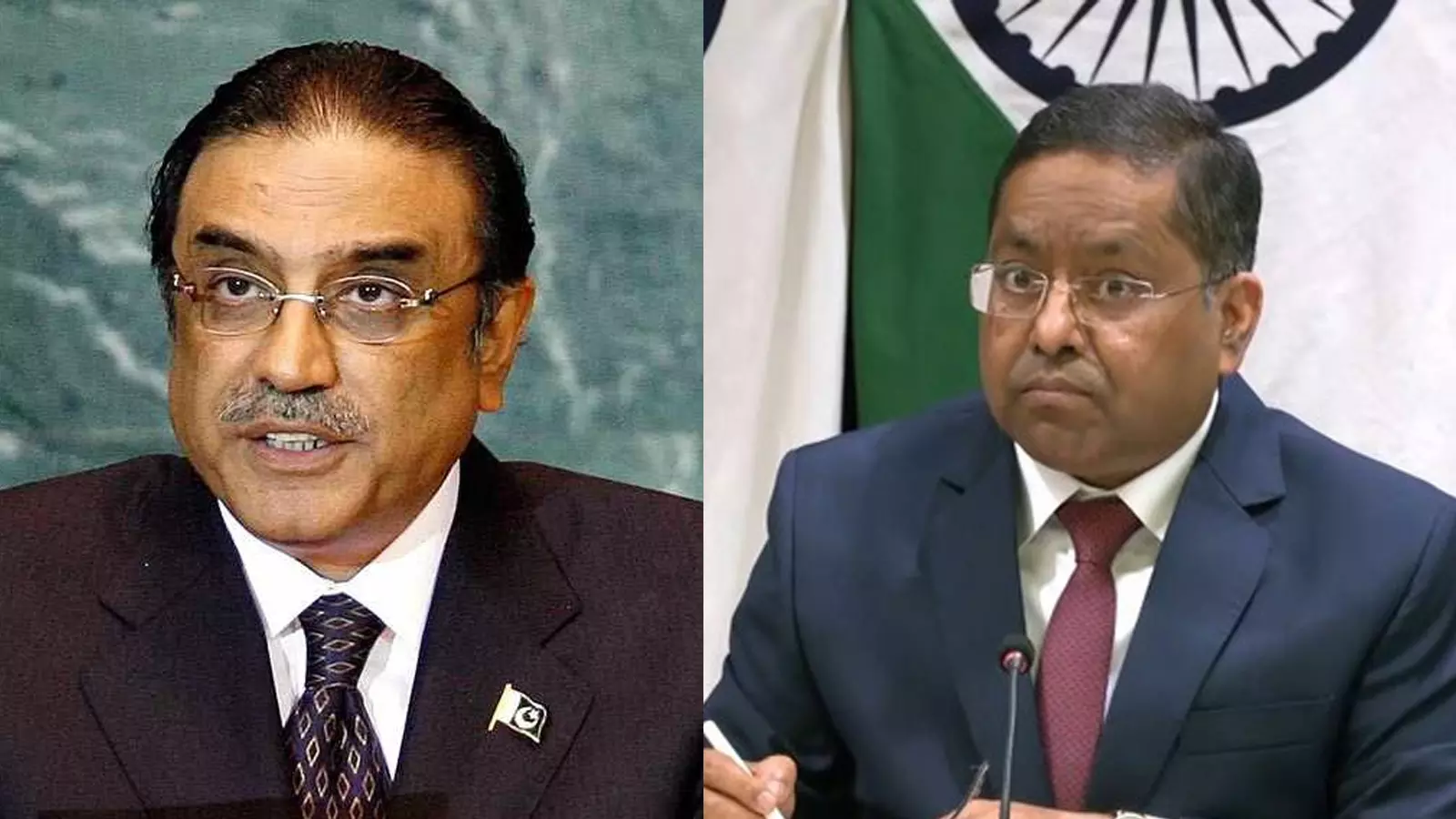
India and Pakistan have engaged in a war of words after Pakistani President Asif Ali Zardari (left) raised questions over safety of minority rights in India. To the right is MEA spokesperson Randhir Jaiswal
India flays Pakistan President Zardari over threat to Muslim sites remark: 'Bigotry, hatred'
MEA rejects the Pakistani leader's remarks on a Varanasi mosque, stating Islamabad has no locus standi and points to Pakistan's own 'abysmal' human rights record

India lashed out at Pakistani President Asif Ali Zardari on Saturday (June 20) over his remarks condemning alleged threats to Muslim sites in the country, calling them “absurd” and a “deliberate political attack” bred by bigotry and hatred. The Ministry of Foreign Affairs (MEA) said the neighbouring country lacks a locus standi to speak on India’s internal affairs.
Ministry spokesperson Randhir Jaiswal said the same day, “India categorically rejects the unwarranted comments made by the President of Pakistan. He has, in any case, no locus standi to comment on matters that are internal to India.”
'Absurd comments'
He also said that Pakistan itself has an “abysmal” human rights record.
Also read: India must recalibrate its Pakistan policy as isolation strategy fails
“These comments are particularly absurd given Pakistan's own abysmal record on human rights, which is a matter of global commentary. Pakistan's long history of systematically targeting and victimising minorities across various faiths is notorious,” the spokesperson added.
Our response to media queries regarding comments made by the President of Pakistan ⬇️
— Randhir Jaiswal (@MEAIndia) June 20, 2026
🔗 https://t.co/L4HsM7PzIl pic.twitter.com/f4AP4E0JgB
Jaiswal also said Zardari’s remarks appeared to be politically motivated by Pakistan’s policies of “bigotry and hatred”.
“Given this reality, the President's remarks can only be read as a deliberate political attack, driven by Pakistan's national policies of bigotry and hatred,” he said.
The MEA official’s remarks came in response to the Pakistani leader’s remarks on the social media platform X about an alleged threat to demolish the 1,000-year-old Masjid Ganj Shaheeda in Varanasi in Uttar Pradesh. He asked India to pause such actions, warning that they could lead to “disintegration and perennial chaos” of India. He also expressed concerns over minority rights and sought their protection.
Also read: India unleashes double diplomatic strike on Pakistan over Gilgit-Baltistan polls, UN rants
In a post made from the account of the Pakistani president, it was said, “President Asif Ali Zardari expressed deep concern over the demolitions and threats to historic Muslim religious sites in India, including the 1,000-year-old Masjid Ganj Shaheeda in Varanasi. He asked India to immediately stop such actions, warning that they risk leading to the disintegration and perennial chaos of India. He called for an immediate halt to such actions and urged the protection of minority rights and shared cultural heritage.”
President Asif Ali Zardari expressed deep concern over the demolitions and threats to historic Muslim religious sites in India, including the 1,000-year-old Masjid Ganj Shaheeda in Varanasi. He asked India to immediately stop such actions, warning that they risk leading to the…
— The President of Pakistan (@PresOfPakistan) June 20, 2026
Pakistan’s own human rights record has come under scrutiny several times. Over the years, non-governmental organisations (NGOs) and watchdogs in the country have documented persistent religion-based violence, particularly targeting Hindus and the Ahmadiyya community. Attacks linked to blasphemy accusations, partly fuelled by state-sanctioned persecution and discriminatory legislation, remain rampant across Pakistan, say human rights organisations.
Also read: Who ended the India–Pakistan conflict — and why the world wants the credit
As far as Zardari is concerned, it is not the first time that he has made remarks against India. In March, he accused India of preparing for another war and asked it to return to meaningful talks.
During a joint parliamentary session, the veteran Pakistan Peoples Party leader said that Islamabad is ready for dialogue and that the only way regional security can endure is through meaningful negotiations.