Austerity for masses, luxury for leaders? Critics slam BJP's austerity plan | Capital Beat
An economist and activist question PM Modi's sudden calls for public sacrifice as fuel hikes hit citizens while ruling party leaders continue to flaunt big convoys

Prime Minister Narendra Modi recently made public appeals to austerity, urging citizens to cut fuel consumption, reduce edible oil use, and avoid foreign travel, as India's energy security remains vulnerable due to the West Asian crisis.
Also read: After days of austerity calls, Modi meets ministers, retreats to Viksit Bharat
However, as leaders of his Bharatiya Janata Party (BJP) were seen flouting the same in public, questions were asked whether the PM's appeal amounted to a genuine economic stance or political theatrics. Development economist Santosh Mehrotra and lawyer-activist Ayushman Pandey joined this episode of Capital Beat to discuss the issue.
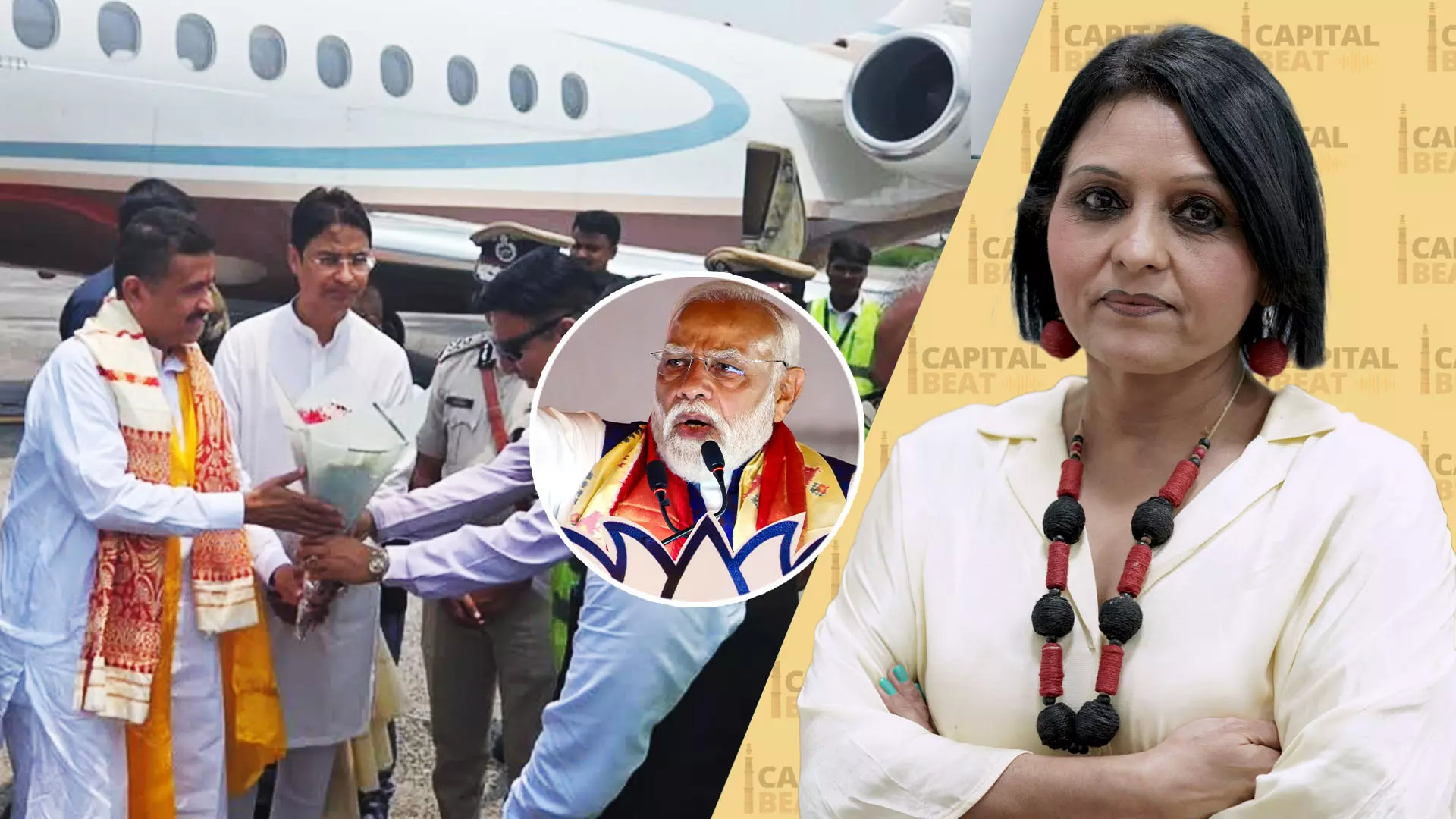
West Bengal Chief Minister Suvendu Adhikari, who recently took charge, travelled to New Delhi on Friday (May 22) by chartered flight just days after Modi's appeals, drawing widespread criticism on social media.
Also, visuals of Adhikari perched atop the front car of a large convoy in Bengal a few days ago circulated widely online.
Maharashtra Chief Minister Devendra Fadnavis drew attention after a photograph of him travelling economy class on a flight surfaced publicly, appearing to endorse the PM's message. It may be recalled here that the BJP leader rode a motorcycle to the state secretariat in Mumbai after the PM's appeals.
In Madhya Pradesh, another BJP-ruled state, a large convoy of several speeding vehicles was seen, prompting questions about the consistency of the stated commitment.
'Not appeals but diktats'
Mehrotra characterised the appeals as emblematic of what he called the consistent pattern of doublespeak from the Rashtriya Swayamsevak Sangh (RSS) and the BJP.
"Both the RSS and the BJP are known and famous for their doublespeak," he said, drawing a parallel with the organisation's simultaneous articulation of Hindu-Muslim unity while its members, he alleged, carried out incidents of mob violence.
Also read: Soaring govt spending versus PM Modi’s austerity call to citizens
On the specific issue of convoys, Mehrotra noted that PM Modi's own convoy had comprised dozens of vehicles in the days after his own appeals, only reducing to two cars after public criticism intensified. He described Adhikari's chartered flight as the behaviour of a newly installed chief minister in a moment of political celebration, adding: "Who cares about the gas prices, the petrol prices, the diesel prices? They are all meant only for us."
These are not austerity measures. The money has been spent already. Now, the people are being told that no more we can afford you. You are on your own.
Pandey, who disclosed at the outset that he is associated with the Indian National Congress but was not appearing as a party spokesperson, argued that the framing of these statements as appeals was itself inaccurate.
"These are not appeals. These are diktats given to the 97 per cent of this population," he said, adding that in his reading, the PM was effectively instructing the vast majority of citizens to reduce consumption to free up resources for other ends.
The economic backdrop
Mehrotra placed the austerity controversy within a broader economic context. He pointed out that the government raised the price of petrol and diesel by Rs 3 shortly after the PM's public messaging on fuel conservation, arguing that the timing exposed a fundamental contradiction.
"If you are very concerned about inflation, then why are you raising the price of diesel?" he asked, noting that diesel price increases raise the cost of transporting virtually every category of goods across the country.
He further cited a March 2026 working paper published by the US-based Peterson Institute for International Economics, co-authored by Arvind Subramanian, Abhishek Anand, and Josh Felman, which argues that India's official GDP growth figures between 2012 and 2023 were overstated by approximately 1.5 to 2 percentage points annually.
Mehrotra described the paper as confirming what he and other economists outside government had been arguing for years.
Also read: Why the new-age version of PM Modi’s austere lifestyle comes with a price tag
The economist also referred to government economist Surjit Bhalla — a former member of the Economic Advisory Council to the Prime Minister and former executive director for India at the International Monetary Fund — as having recently acknowledged that private investment and foreign direct investment were not materialising at the required scale.
"Why FDI will come when you can't get your own corporates to invest?" Mehrotra asked.
Austerity or optics?
Pandey argued that the BJP and RSS had not engaged in mere doublespeak but had, in his assessment, been consistently converting citizens into subjects — a relationship in which the governed are not expected to question those in power.
He invoked the precedent of demonetisation on November 8, 2016, drawing a parallel between that announcement and the current round of austerity messaging: both, in his reading, were statements about what citizens would henceforth be expected to do, not consultations.
"Appeal is made by a government which is bound to the people of the country. They are not bound to the people of the country," Pandey said.
He also addressed the government's response to the Abhijeet Dipke-founded Cockroach Janta Party, whose Instagram following reportedly surpassed the BJP's own account within days of its launch. According to him, the BJP's attempt to discredit the group by claiming its followers were from Bangladesh and Pakistan backfired when actual follower data showed 99 per cent were Indian.
He framed the episode as evidence of a deeper crisis of youth unemployment, referencing Mehrotra's book India Out of Work, published and available on Amazon.
'Govt can't afford people anymore'
Both panellists noted that the government's own sources had, approximately 10 to 15 days before the discussion, explicitly stated that describing the PM's appeals as austerity measures was misleading — yet the PM's messaging had continued in that vein, creating an internal contradiction in official communication.
Also read: Why PM Modi's 'austerity' plea undermines India's stature on global stage
Mehrotra pointed to the long fiscal windfall the government had accumulated over 10 years when international crude oil prices were largely in the USD 30–USD 60 per barrel range, arguing that the government had collected something in the order of Rs 43 lakh crore in fuel taxes over that period, with only a brief exception during the months immediately after the Ukraine war began in 2022.
"These are not austerity measures. The money has been spent already. Now, the people are being told that no more we can afford you," Pandey said, summarising what he described as the practical meaning of the PM's recent public statements.
He added, "The moment Mr Modi came on the television and said this, they should understand that he is telling them: you are on your own."
The content above has been transcribed from video using a fine-tuned AI model. To ensure accuracy, quality, and editorial integrity, we employ a Human-In-The-Loop (HITL) process. While AI assists in creating the initial draft, our experienced editorial team carefully reviews, edits, and refines the content before publication. At The Federal, we combine the efficiency of AI with the expertise of human editors to deliver reliable and insightful journalism.