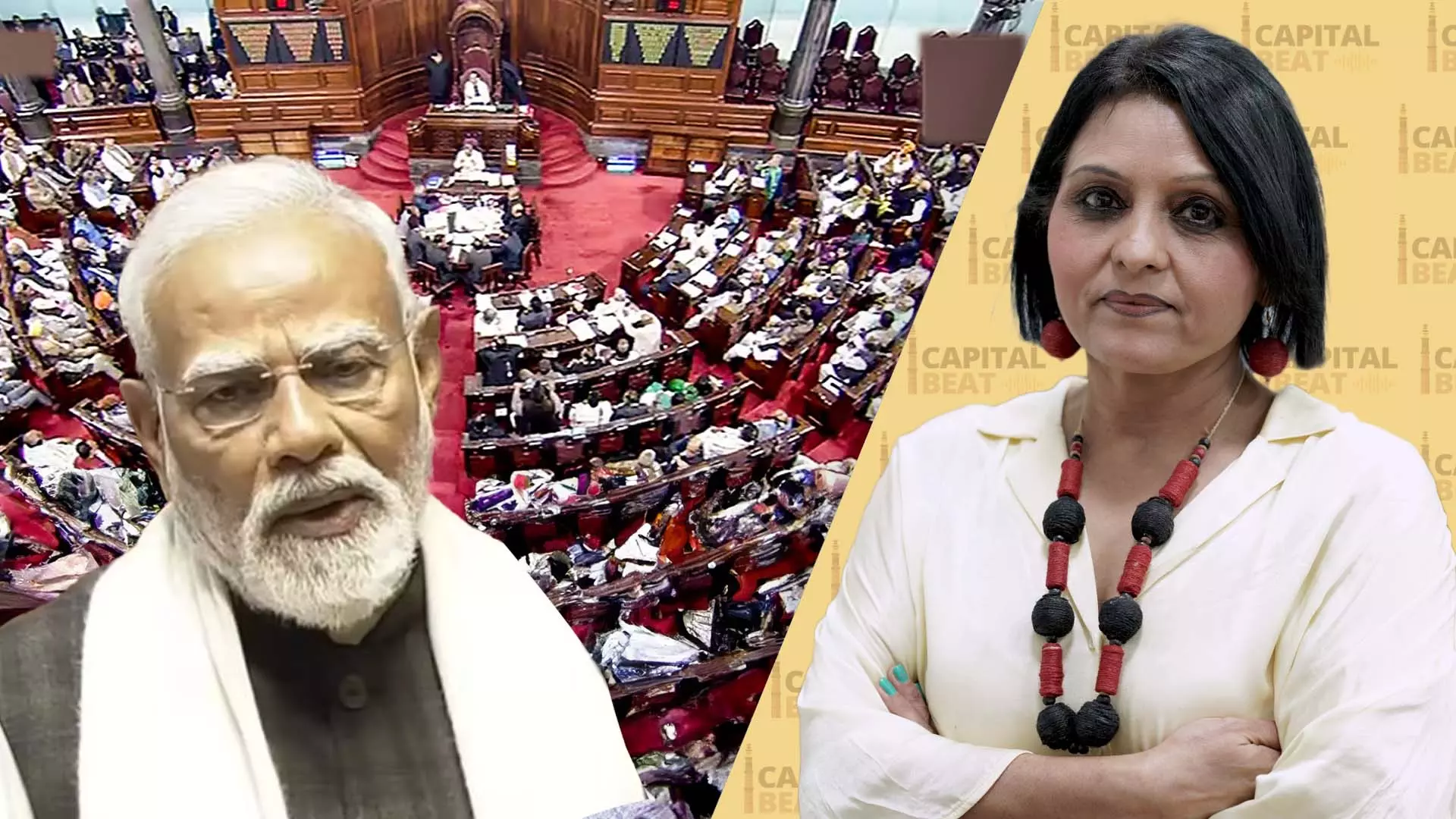
Did Modi use RS to defend trade deals and target Congress? | Capital Beat
PM Modi touts India’s global trade push, attacks Congress in Rajya Sabha; Opposition protests. Was it policy or political messaging?

Prime Minister Narendra Modi’s assertion that India has “finalised” future-ready trade deals with the United States and the European Union triggered sharp reactions from political analysts and senior journalists, with several questioning whether Parliament was told the full truth. Capital Beat panelists also criticised the prime minister, saying he used the Rajya Sabha floor as an election platform while sidestepping unanswered questions on agriculture, energy imports, and economic fallout.
Against the backdrop of opposition parties walking out of the Rajya Sabha, The Federal spoke to senior journalists Kallol Bhattacharya and TK Rajalakshmi, TMC spokesperson Shubhankar Bhattacharya, and political analyst Siddhartha Sharma to examine whether Modi’s 97-minute reply to the Motion of Thanks was substantive policy communication or political theatre.
Trade deal claims
A central flashpoint of the discussion was Modi’s declaration that India’s trade agreement with the United States was effectively “done”. Kallol Bhattacharya said this claim raised more questions than answers, especially after conflicting statements from the government itself.
Also Read: India-US trade deal raises key questions of diplomacy
He pointed out that US officials, including the White House spokesperson and the US agriculture secretary, had publicly claimed India agreed to open its markets to American agricultural products. “Whether India has agreed to open its agricultural market is something Indians deserve clarity on,” Bhattacharya said.
He argued that Parliament offered the prime minister the most authoritative space to settle doubts, especially after US President Donald Trump’s claims that India would stop buying Russian crude and increase energy imports from the US. “These are not minor details. These are decisions that affect energy security, farmers, and consumers,” he said.
Bhattacharya also flagged the contradiction in External Affairs Minister S Jaishankar’s remarks, where he said Commerce Minister Piyush Goyal knew more about the deal. “If the foreign minister himself says he wasn’t directly involved, then the prime minister should have clarified the terms on the floor of Parliament,” he added.
PM avoids key questions
Bhattacharya stressed that while American officials were offering daily updates, the Indian government remained largely silent. “Every day there are new claims from the American side. The Indian side hasn’t responded with specifics,” he said.
He argued that Modi’s speech could have addressed whether India would stop purchasing Russian oil, open its agricultural sector, or alter fuel procurement strategy. “Instead, those questions were left unanswered,” he said.
According to him, the prime minister used Parliament’s authority to make broad claims without backing them up. “That space is sacred because what is said there is taken as final,” he noted.
Opposition walkout
TMC spokesperson Shubhankar Bhattacharya defended the Opposition’s decision to walk out, calling it an expression of dissent rather than disruption.
He said Parliament had increasingly begun equating disagreement with chaos. “If dissent is chaos, then Parliament itself is meant for chaos,” he said, adding that legislative debate had been systematically curtailed.
Bhattacharya pointed to the repeated denial of speaking time to Leader of Opposition Rahul Gandhi. “Allow him to speak. Later you can expunge it if needed,” he said. “Stopping him mid-sentence undermines democracy.”
He also criticised the Speaker’s conduct, alleging differential behaviour towards the ruling party and the Opposition. “The Speaker’s expression changes depending on who he is facing,” he remarked.
Political discourse declines
Shubhankar Bhattacharya accused Modi of lowering political discourse while simultaneously complaining about it. He cited repeated references to slogans like “Modi teri kabar khudegi” and personal attacks on Opposition leaders.
“Why should the language of Parliament sink to this level?” he asked. “Whether it’s Modi, Rahul Gandhi, or anyone else, this kind of language shouldn’t be normalised.”
He also criticised factual claims made during the speech, including statements on unmanned railway crossings. Bhattacharya said a simple verification showed hundreds of such crossings still existed. “A prime minister must be careful with facts,” he said.
Focus on Bengal elections
The TMC spokesperson said Modi’s attacks on Mamata Banerjee and Trinamool Congress were clearly election-driven. He said the prime minister accused the Bengal government of protecting illegal immigrants and pressuring courts, without naming her directly.
Bhattacharya defended Banerjee’s approach, including her visit to the Supreme Court, saying it was a legitimate constitutional act. He also accused the Centre of mocking her accent and language instead of engaging with substance.
He claimed the prime minister offered Bengal no concrete commitments beyond routine infrastructure mentions. “There was no special package, no vision for Bengal—only threats and fear politics,” he said.
Election overtones
Rajalakshmi said Modi’s speech bore all the hallmarks of an election address rather than a parliamentary reply. She said the prime minister repeatedly targeted states facing upcoming elections, referenced figures like Bhupen Hazarika, and revived familiar attacks on Jawaharlal Nehru and the Congress.
“It was less about the President’s address and more about campaigning,” she said. Rajalakshmi noted that even treasury benches appeared subdued during the speech.
She also highlighted Modi’s repetition of old government schemes such as Mudra loans and PM-Kisan payouts. “Rs 6,000 a year is a pittance when you look at farmers’ real incomes,” she said, citing official agricultural surveys.
Trade deal risks
Political analyst Siddhartha Sharma described Modi’s speech as “a lot of smoke with a hidden gun”. He argued that while attacks on opposition parties dominated headlines, the real story lay in the trade policy shift.
Sharma said Modi’s use of the phrase “America se trade deal ho gaya” indicated finality. “That means the deal is done,” he said, adding that Modi also urged India to face global markets “bravely”.
He warned that moving away from cheaper Russian energy to costlier US imports would raise production costs across agriculture and manufacturing. Sharma cited comparative prices of corn, milk powder, cattle feed, and energy inputs to argue that Indian farmers would struggle to compete.
“Nearly 60 crore Indians depend on agriculture and small-scale industry,” he said. “How will they survive this competition?” Sharma also pointed to a joint India-US statement issued a year earlier mentioning energy and agricultural imports, suggesting the current deal followed that trajectory.
Bigger picture
Rajalakshmi concluded that Modi was attempting to project the trade deal as a historic foreign policy success while avoiding scrutiny. “People are not fools,” she said. “They know why resource-rich countries seek deals with labour-intensive economies like India.”
Shubhankar Bhattacharya echoed that sentiment, saying Modi’s oratory had failed in Bengal before and was unlikely to succeed again. “Fear and polarisation can only go so far,” he said.
The content above has been transcribed from video using a fine-tuned AI model. To ensure accuracy, quality, and editorial integrity, we employ a Human-In-The-Loop (HITL) process. While AI assists in creating the initial draft, our experienced editorial team carefully reviews, edits, and refines the content before publication. At The Federal, we combine the efficiency of AI with the expertise of human editors to deliver reliable and insightful journalism.