








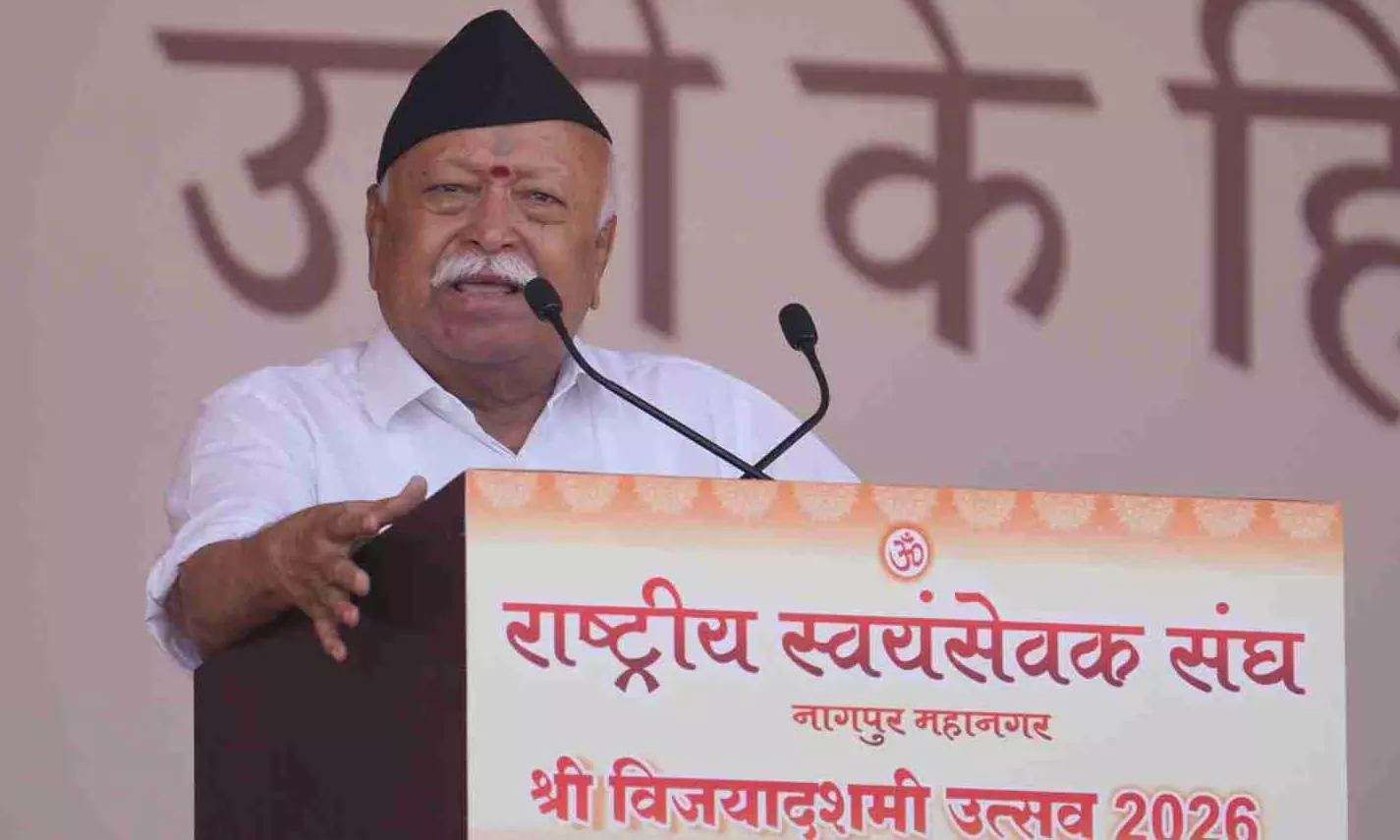
Protests are inevitable, but regime change is no solution: Mohan Bhagwat
In his Vijayadashami speech, RSS chief cautions against foreign hand in protests, says stirs should resolve public issues rather than serve political interests

In his annual Vijayadashami speech, Rashtriya Swayamsevak Sangh (RSS) chief Mohan Bhagwat has cautioned that regime-change agitations do not resolve fundamental problems, warning that protests could become instruments of political interests and fuel divisions in society rather than delivering solutions.
The RSS chief’s Vijayadashami speech is regarded as the organisation’s most important annual address, setting out its ideological priorities, strategic direction and views on key national and international issues for the year ahead.
Delivered on the day the RSS was founded in 1925, the speech is closely watched by political observers because it often signals the broader thinking of the Sangh Parivar and sparks debate on policy, governance, culture and social issues.
Changing regime never changes situation: Bhagwat
Addressing the Vijayadashami Utsav gathering in Nagpur on Tuesday (October 20), Bhagwat cited the recent upheavals in Bangladesh, Nepal, France, and Albania, asserting that forces pursuing their own interests use regime change as a means to alter political circumstances, rarely achieving intended results.
Also read: Bhagwat's global tour is all about image management, not ideological change
France is currently the focal point of a widening wave of unrest across Europe, as protests fuelled by a cost-of-living crisis, economic pressures and political discontent escalated into some of the country’s worst street violence in years. Over the October 17-18 weekend, clashes with police, looting and arson led to more than 2,300 arrests, prompting the authorities to impose strict overnight curfews in parts of France, including capital Paris, to restore order.
“They claim that changing a regime will change the situation, but that has never really happened,” Bhagwat said. He added that while some global powers want India to develop, “they do not want it to become too powerful, as it could challenge their dominance”. He claimed that a stronger India would constrain such forces, making the country a target of attempts to weaken and divide it.
His speech comes amid sustained youth protests led by the Cockroach Janta Party (CJP) and the major Opposition parties in Delhi and elsewhere in the country. Currently, two CJP leaders, Saurav Das and Ashutosh Ranka, are in judicial custody for protests against CEC Gyanesh Kumar.
‘Protests should be aimed at finding solutions’
On protests in a democracy, the RSS chief said their purpose should be to resolve problems rather than deepen social divisions. “Problems will remain, and protests are inevitable in a democracy. But what should the purpose of protests be? They should be aimed at finding solutions,” he said.
Also read: 'World needs India’s knowledge’: Mohan Bhagwat says Dharma and Rashtra are linked
He cautioned that protests could become political instruments when driven by objectives other than public welfare, fuelling hostility towards individuals, groups or ideologies.
Bhagwat also urged political leaders, protesters and the administration to ensure that their actions did not create bitterness or divisions in society. “However intense our emotions may be, we must respect the limits set by our Constitution, the norms of civilised public discourse and standards of decent conduct,” he said.
RSS chief urges government to consider regulating online content
Bhagwat highlighted the need for greater discernment among the younger generation in consuming information. Citing concerns over the adverse effects of unchecked content, particularly on OTT platforms, he urged the government to consider appropriate regulations in the interest of society.
Having experienced the adverse consequences, many countries have introduced regulations and restrictions on social media platforms, he said. In India also, society is increasingly recognising the need for such measures, particularly with regard to OTT platforms, he added.
Also read: 75-year retirement to caste census: Decoding Mohan Bhagwat’s speech
At the same time, even when information is freely accessible, the younger generation must be taught to exercise discernment and distinguish between what is appropriate and what is not, Bhagwat said. Balanced and holistic development must go beyond material comforts, he said.
Nepal flood and ‘one-sided development’ in Himalayas
Science and technology can improve lives and promote rational thinking, but they are only means, not ends, he added. Development driven solely by consumerism and materialism may bring convenience at the cost of greater social and human loss, he said.
Drug addiction is a serious national problem, and the government and society must timely address it and start taking measures to overcome it, Bhagwat said. Parents and elders in the society must impart this discernment to the younger generation, which must keep itself away from all influences and activities that can lead to the development of such harmful habits, he said.
Also read: RSS chief Mohan Bhagwat: Gen Z is highly emotional, easily drawn to 'visibly authentic' causes
The recent devastating floods in Nepal can be partly attributed to the consequences of one-sided development across the Himalayan region, which spans several countries, Bhagwat said.
On Sangh’s Sampark Abhiyan
Sharing details of the Sangh’s Sampark Abhiyan among its centenary initiatives, Bhagwat said the RSS reached out to more than 10 crore households across the country, and its workers visited Western nations to counter misunderstandings about Hindutva during its year-long centenary campaign. He said RSS workers held thousands of outreach meetings and youth conventions in cities and villages, contacting 10,19,88,511 households across 4,61,527 villages and 41,076 urban areas.
He noted that RSS workers visited Western nations, with the objective of providing correct information about India, Hindutva, and the Sangh. “The true and authentic understanding of our Sanatan, all-embracing Bharatiya culture and the inclusive and all-encompassing nature of Hindu society and the objectives and work of the RSS was placed before people (in Western countries),” he said.
Bhagwat said a sense of curiosity about India is awakening. “Despite being materially prosperous, these (Western) countries are beset with concerns because of an incomplete worldview based on materialism, individualism, and unrestrained consumption. They have no answers to questions such as how to manage diversity, how to harmonise development with the environment, and how to prevent the erosion of family life,” he said.
Bhagwat noted that global struggles for dominance have led to geopolitical tensions, economic uncertainty, and environmental crises, and the world is aware that India has answers to these problems.
(With agency inputs)