








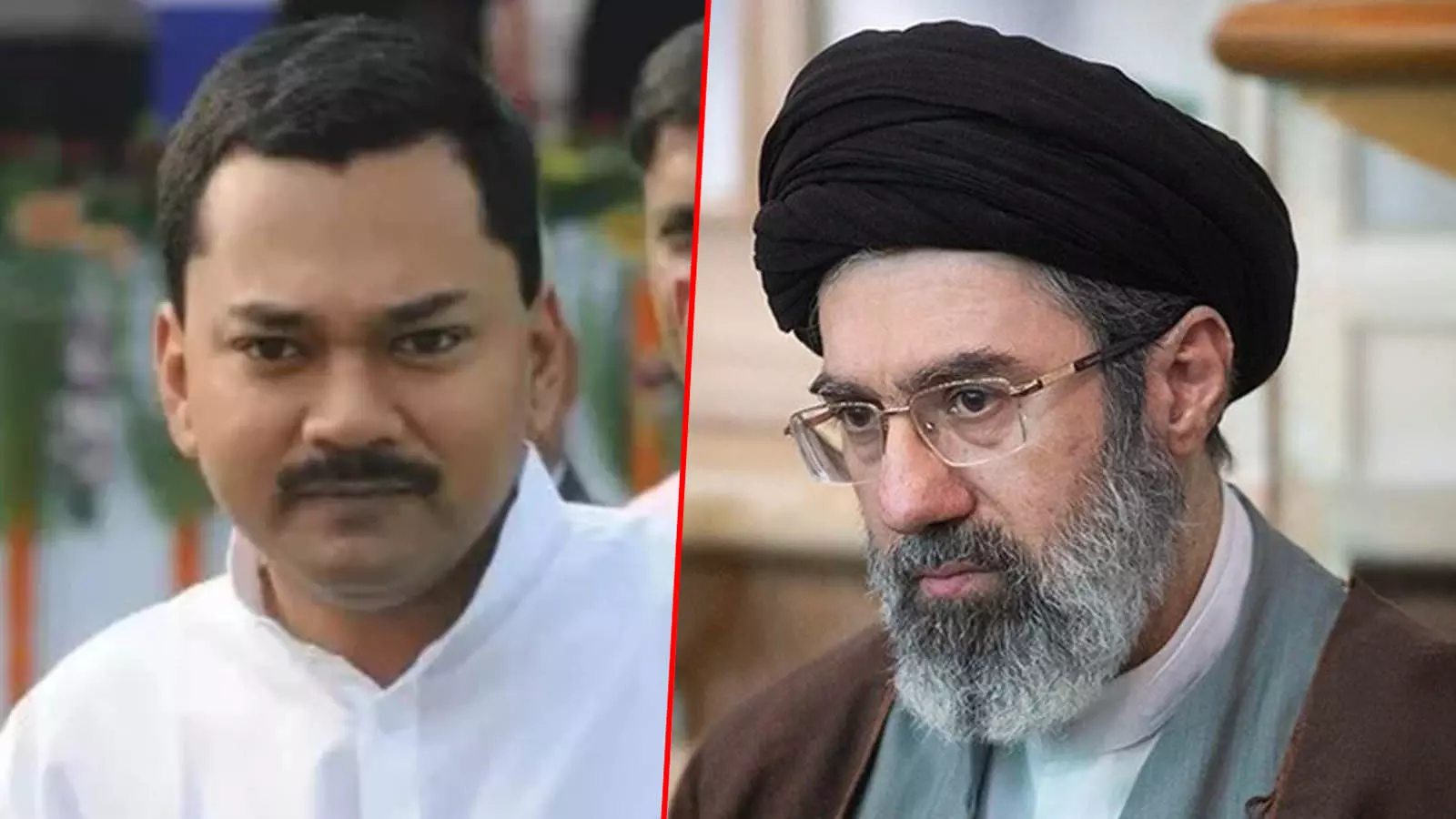
The cleric (right) Mojtaba and the engineer Nishant Kumar
Mojtaba Khamenei and Nishant Kumar: Two sons thrown into the ring
On March 8, 2026, two "un-political" sons claimed their fathers' legacies—marking a wartime coronation in Tehran and a strategic dynastic debut in Bihar

In March 2026, two "reclusive sons" belonging to different parts of the world, stepped out of their fathers' shadows to claim their dynastic inheritance.
One is Mojtaba Khamenei, the second son of the late Ayatollah Khamenei, who was killed in a US-Israel strike, and the other is Nishant Kumar, son of JD(U) leader and veteran politician Nitish Kumar in Bihar. While their geopolitical contexts couldn't be more different, their rise to power offers a striking study in dynastic succession.
Both appear to have made historic transitions from reclusive figures to formal heirs of their fathers' massive political legacies. One is an elevation to absolute, uncheckered power; the other makes an entry into a highly competitive, multi-party electoral battlefield.
Also read: Live! With Mojtaba as Supreme Leader, Iran launches more missiles towards Israel
While Mojtaba has been thrown into the ring as a Leader of a theocratic state where the stakes are existential survival, Nishant has become a legacy Keeper in a democratic state, where the stakes are the survival of JD-U after its founder steps back.
Here a few similarities between the two heirs under the spotlight:
Shadowy figures
For decades, both men were seen as intensely private figures, who avoided official titles while wielding significant influence. Mojtaba acted as his father’s "gatekeeper" in the Office of the Supreme Leader, while Nishant, a software engineer, was the quiet confidant behind Nitish Kumar’s "clean" image.
Khamenei has never run for office or been subjected to a public vote, but has for decades been a highly influential figure in the inner circle of the previous supreme leader, cultivating deep ties with the paramilitary Islamic Revolutionary Guard Corps (IRGC). Khamenei has largely kept a low profile, not giving public lectures, Friday sermons, or political addresses – to the point that many Iranians have not heard his voice, despite knowing for years that he was a star rising within the theocratic establishment.
Like Khamenei, for decades, Nishant Kumar, an engineer by education, stayed away from the spotlight despite being the Chief Minister's son. He stayed away from political meetings, campaigns or party activities linked to the Janata Dal. For years, he was seen only at family events and public functions along with his father.
This was in line with Nitish Kumar's stand against dynasty politics.
Away from dynasty politics
Both successions represent a fundamental pivot in their political systems.
In Iran, the 1979 Revolution was built on rejecting hereditary Pahlavis monarchy, yet Mojtaba’s elevation to Supreme Leader on March 8, 2026, cements a new clerical dynasty. Similarly, Nitish Kumar built his career on "anti-parivarvad" (anti-dynasty) rhetoric, only to formally induct Nishant into the JD(U).
Also read: Nitish Kumar's son Nishant joins JD(U), tipped for deputy CM role
Khamenei has never discussed the issue of succession publicly, considering that his ascension to the position of supreme leader would effectively create a dynasty reminiscent of the Pahlavi monarchy overthrown by the 1979 islamic revolution. In fact, Mojtaba selections marks a rare hereditary transition at the top of Iran’s political system.
The Assembly of Experts ultimately prioritised continuity during a time of war and political uncertainty.
Crisis as a catalyst
The timing for their succession was dictated by emergency. Mojtaba was elected by the Assembly of Experts after the assassination of his father Ali Khamenei in US-Israeli strikes.
Meanwhile, Nishant's entry was triggered by Nitish Kumar’s decision to suddenly move to the Rajya Sabha and vacate the CM's chair amid health concerns and party stability fears.
Clean alternatives
Supporters of both heirs argue that they are not "entitled" heirs but "clean" alternatives.
Nishant is touted for his "humility and simplicity," while Mojtaba is presented as a "pure" ideological successor untainted by the administrative failures of the presidency.
Fundamental differences
The essential differences between the two are:
Mojtaba will get the prestigious title of Supreme Leader of Iran, while Nishant Kumar has become just a primary member of JD(U) and speculated to be deputy CM.
Also read: Political leap? Message to BJP? Why is Nishant repeatedly batting for father Nitish?
Power base
Khamenei is deeply intertwined with the IRGC (Revolutionary Guard) and military apparatus. While Nishant Kumar is anchored in the "Lav-Kush" (Kurmi-Koeri) social coalition of Bihar.
Khamenei's relationship with the force reportedly dates back to the later years of the Iran-Iraq war in the 1980s, when he served in a combat unit. Over time, analysts and diplomats have suggested that he built strong ties with conservative factions and the security establishment, giving him influence inside the country’s political power structure even without holding a formal office.
Induction
Mojtaba was elected via an opaque, virtual election by the Assembly of Experts during wartime.
While Nishant's public political induction is followed by democratic speculation and potential cabinet entry.
Education
Khamenei studied Islamic theology in the holy city of Qom, Iran’s most important center of Shiite religious scholarship. He later taught religious studies there and attained the clerical rank of Hujjat al-Islam, a mid-level title below the rank of Ayatollah held by his father.
His clerical status, along with his family lineage, being a descendant of the Prophet Mohammed, has played a role in reinforcing his religious credentials within Iran’s clerical establishment.
Meanwhile, Nishant pursued a degree in software engineering at the Birla Institute of Technology (BIT), Mesra, in Ranchi. Despite his engineering background, he revealed a preference for spirituality and a simple, private life.