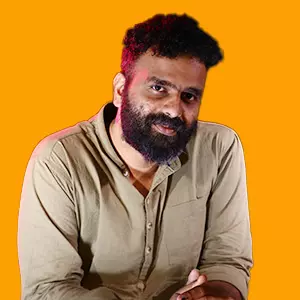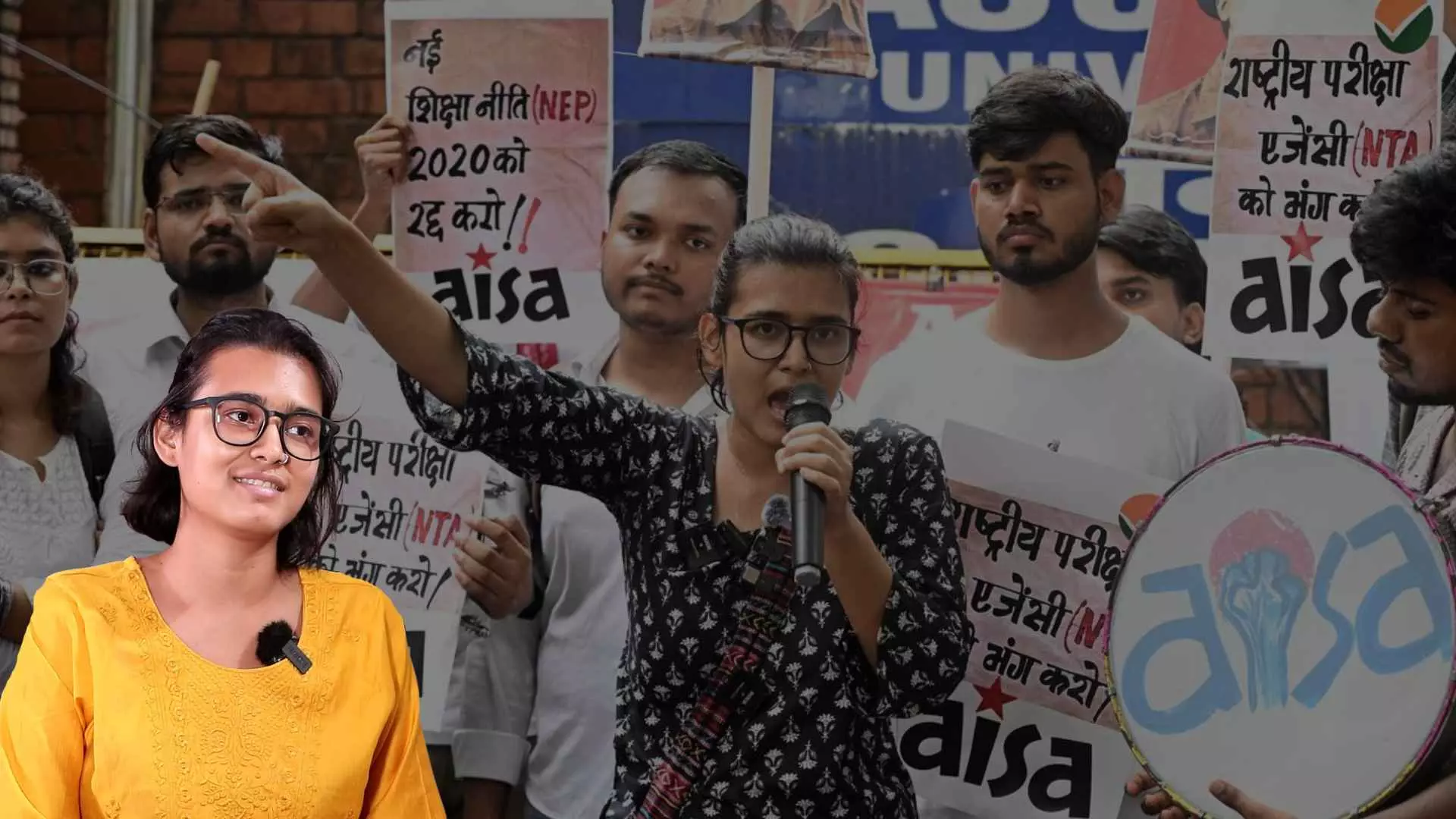
Neha Bora exclusive |'BJP is the largest source of content for youth now'
AISA leader shares views on Gen Z protests, what ails education and jobs in India, Modi's coinage of 'Naxal' names, and what youth thinks of his Reels outreach

For 23 days, Neha Bora ate nothing. The 29-year-old PhD scholar at JNU joined educationist Sonam Wangchuk and fellow AISA activists on an indefinite hunger strike at Delhi's Jantar Mantar, demanding that the NTA be scrapped and Dharmendra Pradhan resign as Union Education Minister over the NEET-UG paper leak.
The Gen Z protest has since travelled from Delhi to Jharkhand to the streets of Chennai. In an exclusive interaction with The Federal, Bora spoke about what the fast did to her body and mind, why the government reaches for words like "urban naxal," and why, for her, protest has become the only language left to speak to power.
Edited excerpts:
When people talk about a hunger strike, they usually talk about the weight loss because that's visible. What actually goes on in your head during 23 days without food?
Actually, it felt like we were less human — because our body's needs, the changes taking place in it, and what our brain was telling us and how it was responding, had become so loud to us, especially towards the end of the hunger strike, that we became reduced to our body. Our body's needs — the headache, the emptiness, a black hole, acid in the stomach — like that.
Also Read: Ink thrown at AISA chief during Jharkhand exam protest march; accused arrested
Was there a point when you wanted to give up? What kept you going?
I think you do feel that it's too difficult sometimes, but it's a matter of how you articulate it. While some people might articulate it as "oh, let's give up," how we articulated it was — "oh man, now this guy (Pradhan) has made us sit hungry for so long, if this guy doesn't go, then we are going to go." We turned it into humour and all of that.
Videos from Jantar Mantar showed Gen Z protesters chanting slogans mocking the Prime Minister. Soon after, he coined the phrase dimagi naxal. What do you make of that?
Well, I think when videos came out of Jantar Mantar where people were giving the slogan "56 inch ka chhota bandar, Bal Narendra, Bal Narendra," Narendra Modi took it to heart and felt he had to come up with something of his own — so he came up with dimagi naxal.
In a functioning democracy, people raise a problem, and the government listens — it doesn't respond with pellet guns.
He has labelled every section of this country something or the other, and we are united in the fact that the Prime Minister has labelled us something. The government is alone now. It's in one corner, and the rest of us — who've been labelled anti-national, dimagi naxal, urban naxal, Pakistani — are in the other. This government has cemented this unity. So we would like to thank the government for this unity.
What do you make of the word "Naxal" itself being attached to so many people and movements now?
The government uses such words to scare people — to make an example out of them. By turning these words into something frightening, it stops people from engaging with them rationally, from asking what the word actually means, what history and context it carries. That's the real agenda: to create so much noise around a word like "urban naxal" or a name like Umar Khalid that people stop thinking and start reacting on instinct instead.
That's how you get a large, educated democracy to keep voting for leaders whose politics is irrational and cruel — you cut people off from their ability to think. It's on us, as young people, to keep giving these words their real meanings back.
Union Minister Kiren Rijiju had to step in to control the narrative after the backlash over dimagi naxal. Do you think these labels are losing their power?
I really think that whatever Kiren Rijiju did is actually a disservice (to the government). The BJP needs to fix its PR and stop asking people like Rijiju to respond, because whatever they say gets made fun of. Whatever the Home Minister and the Prime Minister say now gets made fun of.
The PM thought coming onto Reels would be amicable to the young people of this country, and people are now saying — you came on television, we shut down our screens; you came in the newspapers, we stopped reading newspapers; now you're here on Instagram, what do you want from us, leave something for us.
Modi has labelled every section of this country something or the other, and we are united in the fact that the PM has labelled us something.
All of that fear, that big spectacle, has broken down, and people are just making fun. The BJP is the largest source of content for us as young people now.
You want the NTA (National Testing Agency) scrapped and the NEP (National Education Policy) rolled back. What should replace them?
The NTA has to go completely, and the responsibility for conducting exams should sit with the government itself — not with an outsourced agency that also institutionalises "one nation, one exam." Why should a student from a state board and a student from CBSE, who haven't had access to the same quality of schooling, be forced to compete in the same exam?
Centralisation of exams should end. State governments should run their own examinations, government institutions like AIIMS should conduct their own entrance tests, and public universities like JNU and Hyderabad Central University should get back the autonomy they once had to conduct their own exams without paper leaks.
As for the NEP, at its core it dismantles public education and replaces it with private education. Once education becomes a business instead of a right, the outcomes are predictable — mass illiteracy, higher dropout rates, worsening social disparities, rising female and child mortality, and a hit to employment. It needs to be rolled back and replaced with a policy that treats education as the state's responsibility, not an individual's private struggle.
Is this Gen Z protest really only about NEET and the NTA, or is there something bigger behind it?
No, no, not at all. The education system is only part of a larger system, all of which is crumbling. The protests were also because we have seen such naked violence on the streets of this country. We have seen how easy it has become for us to hate one another on the basis of caste, gender, religion — there was an anger against that.
There was a hope that this movement would be able to consolidate unity and solidarity and do away with this politics of hate. There was a hope that this movement would highlight the crisis of unemployment this country faces.
The government is alone now — it's in one corner, and the rest of us, who've been labelled anti-national, dimagi naxal, urban naxal, Pakistani, are in the other.
The majority of the young people of this country don't even enter higher education; they don't have access to it. And even those students who do have access to higher education go out of their universities and colleges with degrees in hand and no job. So there was also an expectation that this would be highlighted, that it would come to the fore through this protest. It was a consolidation of a lot of disappointment, with a lot of small institutions pointing at a larger crumbling of the larger institution in this country.
AISA (All India Students' Association) was founded in the 1990s, but people are only really noticing it now — and a lot of that credit goes to you. What does it mean to be seen as its face?
I carry the history of AISA with me, including that of Chandrashekhar Prasad, who was a JNU student and chose not to take up a comfortable academic job. He went back to his home in Siwan, Bihar, to work with young people, students, farmers and landless labourers there — and he was shot dead in the middle of a market for it.
I'm honoured to come from that legacy, and from the legacy of lesser-known people who fought to get OBC reservation properly implemented in higher education — through struggle on the ground and in court, against groups like "Youth for Equality," which was really the ABVP dressed up as an equality movement.
I come from a decade that saw both a rise in anti-reservation, communal politics around the Rath Yatra, and a radical student assertion against it through AISA. If a hunger strike helps that legacy reach more people, that's a privilege, not a burden.
Abhijeet Dipke said, "Don't make me a hero. The country has been ruined because we made one person a hero.” But can a movement survive on ideology alone, without a leader?
No, I think people — I mean, symbols — are important. Symbols have always been important in the history of human society. Symbols have consolidated people, given them a sense of belonging and community. And when we try to find leaders, and try to make people larger than life, it is our attempt to do that.
We have seen how easy it has become for us to hate one another on the basis of caste, gender, religion — there was an anger against that.
But we should, of course, be careful. It is important — and I find it very nice — that a lot of student protesters from different states are being hailed as leaders. Because that is true. It is so nice that, because we live in the age of social media, so many young people who are detained, or who are at the protest, their photographs are being run, their videos are being run, and they are getting to become the face of the movement — because that is actually true of mass movements, that people in their own capacities contribute to it and make the movement much bigger, much larger — even those people who might be on the stage but don't know these people.
Without acknowledgement from such people, without acknowledgement from the mic, people contribute and make movements bigger, more meaningful, sharper, more — I don't know — undeniable. So I think it was nice, what is happening nowadays. That's truly what it should be.
The government did eventually respond after the protests in Jantar Mantar and Jharkhand. But can protest be the only form of conversation between people and the government?
In a functioning democracy, people raise a problem, and the government listens — it doesn't respond with pellet guns. So the breakdown of democracy has come from the government's side, not ours. We've submitted memoranda to the Ministry of Education and to NTA headquarters.
Also Read: Rahul stages sit-in outside police station over alleged refusal to lodge FIR on pellet gun use
The fact that it took a 23-day hunger strike to get any response tells you the government wants to push people to breaking point before it gives an inch. It's only when we refuse to break that its resolve does.
It took years of struggle to end 200 years of British rule — if it takes just as long to push back against what this government and the RSS are imposing on us, so be it. Let the era of protest begin, and let governments finally become accountable to the citizens they're supposed to answer to.