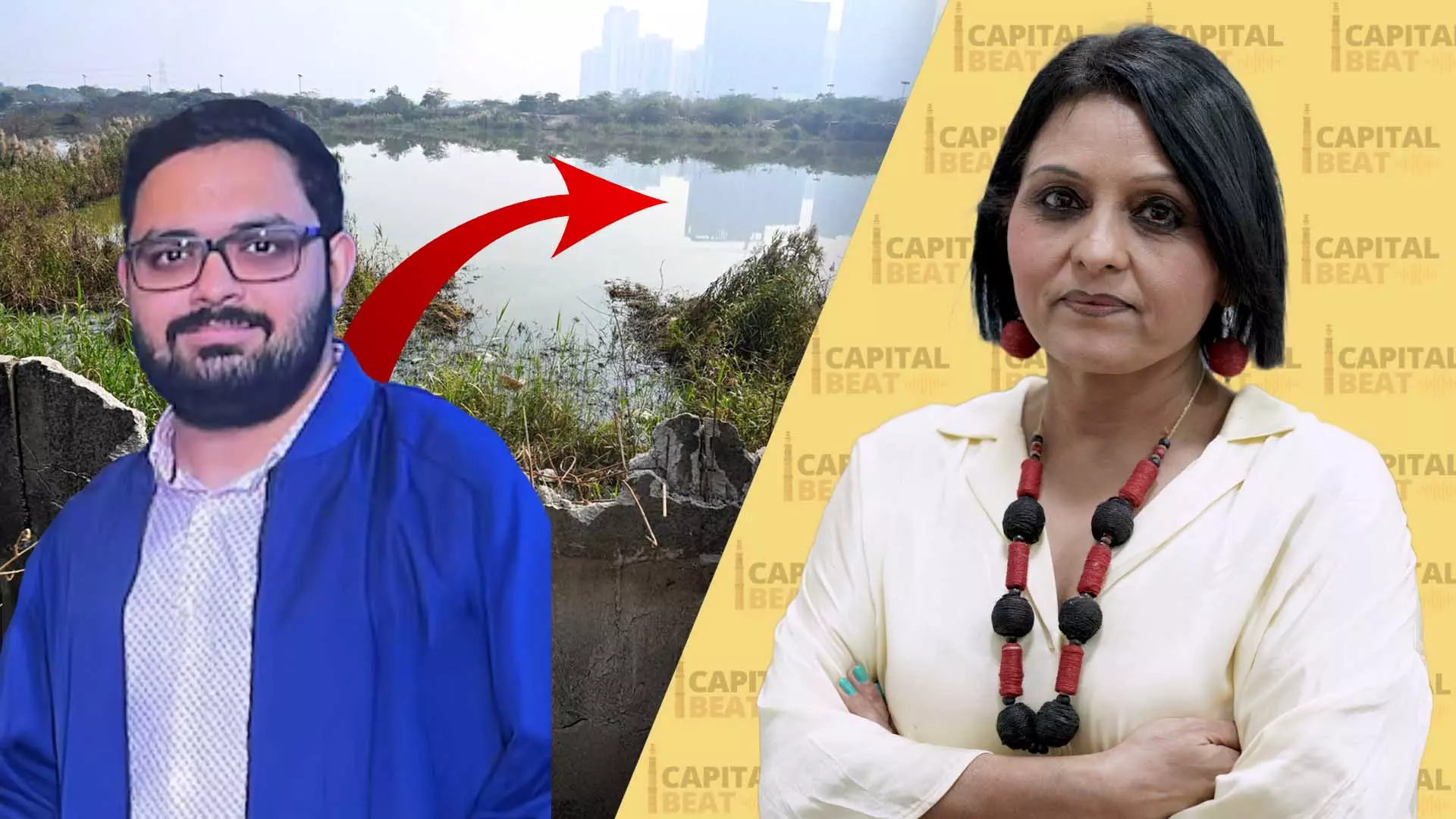
Noida techie’s death in a water-filled pit
Are governance failures and accountability lapses to blame for Noida techie’s death?
Panellists raise concerns over urban governance failures, emergency response lapses, and the handling of the probe into Yuvraj Mehta’s death in Noida

The latest episode of Capital Beat episode examined the death of 27-year-old IT professional Yuvraj Mehta in Noida, with panellists, former IPS officer Yashovardhan Jha Azad, activist Anil Sood, and Samajwadi Party spokesperson Sarvesh Tripathi, questioning administrative accountability, urban planning failures, and the conduct of the investigation following the incident.
Mehta died after his car fell into an unmarked, water-filled construction pit on a foggy night in Noida. The pit, dug several years ago for a stalled infrastructure project, remained open without barricading or warning signage. Mehta climbed onto the roof of his car as it sank and remained stranded for nearly two hours while emergency responders failed to rescue him.
Seven days after the incident, questions persisted over responsibility, the adequacy of administrative action, and the decision to publicly circulate visuals and bills portraying Mehta as having consumed alcohol before the accident.
Questions over administrative action
The discussion opened with concerns over whether removing the Noida Authority CEO and forming a Special Investigation Team (SIT) addressed the structural failures that led to the incident. The panellists pointed to gaps in road design approval, safety compliance, and enforcement of Indian Roads Congress (IRC) norms.
Sood described the administrative response as ineffective, stating, “Throwing out the CEO of Noida Authority is inconsequential. The main question arises: how did this road pass the test of IRC guidelines?” He flagged the absence of warning signs, luminous paint, barricading, and accountability for officials who approved and monitored the road.
He said responsibility extended across agencies, including the traffic police, Public Works Department, and district administration, adding, “This is a failure of the complete system, not only one department.”
Road design and safety lapses
Satellite imagery of the accident site showed a sharp 90-degree turn on the road leading to the pit. The panellists said such a design, combined with dense fog and lack of signage, created a predictable hazard.
Sood questioned who approved the road layout and why repeated warnings were ignored. He said dangerous roads require signage to be placed at least 200 metres in advance, a standard that was not followed at the site.
The programme highlighted that residents in the area had previously reported accidents at the same spot, raising concerns about why corrective measures were never implemented.
Leaked visuals and privacy concerns
The panel examined the circulation of CCTV footage showing Mehta partying before the accident, along with food and liquor bills that went viral on social media. These were discussed as attempts to frame the incident as drunk driving.
Azad called the release of such material a violation of privacy, stating, “These kinds of CCTV images are there only for police investigation. Giving it out to the press is absolutely wrong.”
He said Mehta’s personal activities had no bearing on the responsibility of authorities to ensure road safety and emergency response, adding that such leaks diverted attention from systemic failure.
Urban governance and stalled projects
Azad traced the origins of the pit to a stalled sports city project first proposed in 2004. He cited audit findings and court observations on corruption linked to the project, noting that incomplete infrastructure was left unsecured for years.
He stated, “This points to a dangerous collapse of urban governance in our country.” According to Azad, district authorities, including the DM and senior police officials, are mandated regulatory authorities, regardless of whether a road is national, state, or municipal.
The discussion highlighted that no protected covering or barricading was installed despite prolonged delays and legal scrutiny of the project.
Emergency response failures
The panel scrutinised the rescue operation, during which multiple agencies, including the police, fire brigade, SDRF, and NDRF, were present but failed to extract Mehta while he was alive.
Azad described the response as incompetent, stating, “They carried the boats, but they forgot the rowers.” He questioned how disaster response forces equipped for national and international operations failed to rescue a single individual from a flooded pit near the national capital.
The programme discussed the lack of basic equipment, trained personnel on site, and coordinated response protocols during the rescue attempt.
Police role and pace of investigation
Questions were raised about the pace and direction of the investigation, including whether accountability was being deflected toward junior officials.
Azad said the case involved “rash and negligent acts amounting to homicide,” adding that while engineers might be identified, the larger issue lay with governance and oversight. He questioned why district-level leadership was not being examined.
He also pointed to the absence of disciplinary action within the police department, even though traffic design flaws were evident and remained unaddressed.
DM and disaster management
Tripathi focused on the role of the district magistrate (DM), noting that the DM is the chairperson of the District Disaster Management Authority. He stated, “Any SIT investigation cannot function without the DM of that district being transferred.” He said a serious assessment should have led to an immediate SDRF deployment, given the risk posed by the water-filled pit.
Drawing from his experience in uniformed service, Tripathi said personnel across police and disaster response forces are trained to swim and handle such situations, questioning why rescue efforts were delayed and ineffective.
Accountability and arrests
The discussion also covered the arrest of builders linked to the project. Panellists questioned whether these arrests addressed the root responsibility or amounted to scapegoating.
Sood argued that lapses in monitoring and prevention were being overlooked, stating that responsibility lay with officials mandated to inspect, approve, and secure infrastructure. He said public safety was consistently sidelined in favour of investor interests.
Tripathi added that accountability could not be fixed without examining senior administrative roles, particularly when repeated warnings and past accidents had gone unaddressed.
Broader implications
The panel linked the incident to a wider pattern of governance failures across urban India, citing recurring infrastructure-related deaths, delayed projects, and lack of enforcement.
Azad said, “At this rate, we will have a wide range of collapse,” referring to repeated civic failures across cities. He called for naming and fixing responsibility rather than symbolic actions.
The programme concluded with calls for suspensions, prosecution of those responsible, and a public white paper detailing how the incident occurred and how similar deaths would be prevented.
The content above has been transcribed from video using a fine-tuned AI model. To ensure accuracy, quality, and editorial integrity, we employ a Human-In-The-Loop (HITL) process. While AI assists in creating the initial draft, our experienced editorial team carefully reviews, edits, and refines the content before publication. At The Federal, we combine the efficiency of AI with the expertise of human editors to deliver reliable and insightful journalism.