Despite poll risk, Opposition to fight Centre's delimitation ‘trap’ tooth and nail
Accusing the BJP-led govt of using women’s empowerment as a political shield for a seat-reallocation power grab, the opponents vow to vote against three key Bills

Taking a bold stand despite its inherent political risks, the Opposition has decided to oppose the Constitution (131st Amendment) Bill, the Delimitation Bill and Union Territories Laws (Amendment) Bill in the extended budget session of Parliament starting Thursday (April 16).
The “unanimous decision” by the Indian National Developmental Inclusive Alliance (INDIA) bloc, as well as the Aam Aadmi Party (AAP), comes a day after the Centre finally unveiled the three draft laws.
Also read: Is BJP electoral juggernaut deciding the shape of women’s quota, delimitation bills?
The latter has been insisting that enacting the draft laws, which will be introduced in the Lok Sabha on Thursday, is a prerequisite for operationalising the Naari Shakti Vandan Adhiniyam, 2023, which mandates reserving one-third of seats in the Lok Sabha and all state legislatures for women.
For the Opposition, the decision to vote against the three Bills couldn’t have been an easy one to make.
The ruling Bharatiya Janata Party (BJP) and its allies are bound to accuse the Opposition of stalling the early rollout of women’s reservation, which, despite being brought on the statute 30 months ago, has been in a state of limbo due to the provisions the Centre had woven into the 2023 Act.
Bengal, TN polls a hurdle for Opposition?
With polling for the assembly elections in West Bengal (first phase) and Tamil Nadu scheduled next week, the BJP is expected to attempt weaponising the Opposition’s decision to its advantage by accusing parties such as the Congress, MK Stalin’s Dravida Munnetra Kazhagam (DMK), Mamata Banerjee’s Trinamool Congress (TMC), the Communist Party of India (Marxist), the Communist Party of India, and others, for denying women their fair share of representation in public offices.
Congress party unequivocally supports Women’s Reservation. Parliament unanimously passed the bill in 2023, it is already part of our Constitution.
— Rahul Gandhi (@RahulGandhi) April 15, 2026
What the government is proposing now has nothing to do with women’s reservation. This amendment is an attempted power grab using… pic.twitter.com/FFI2LwHBk4
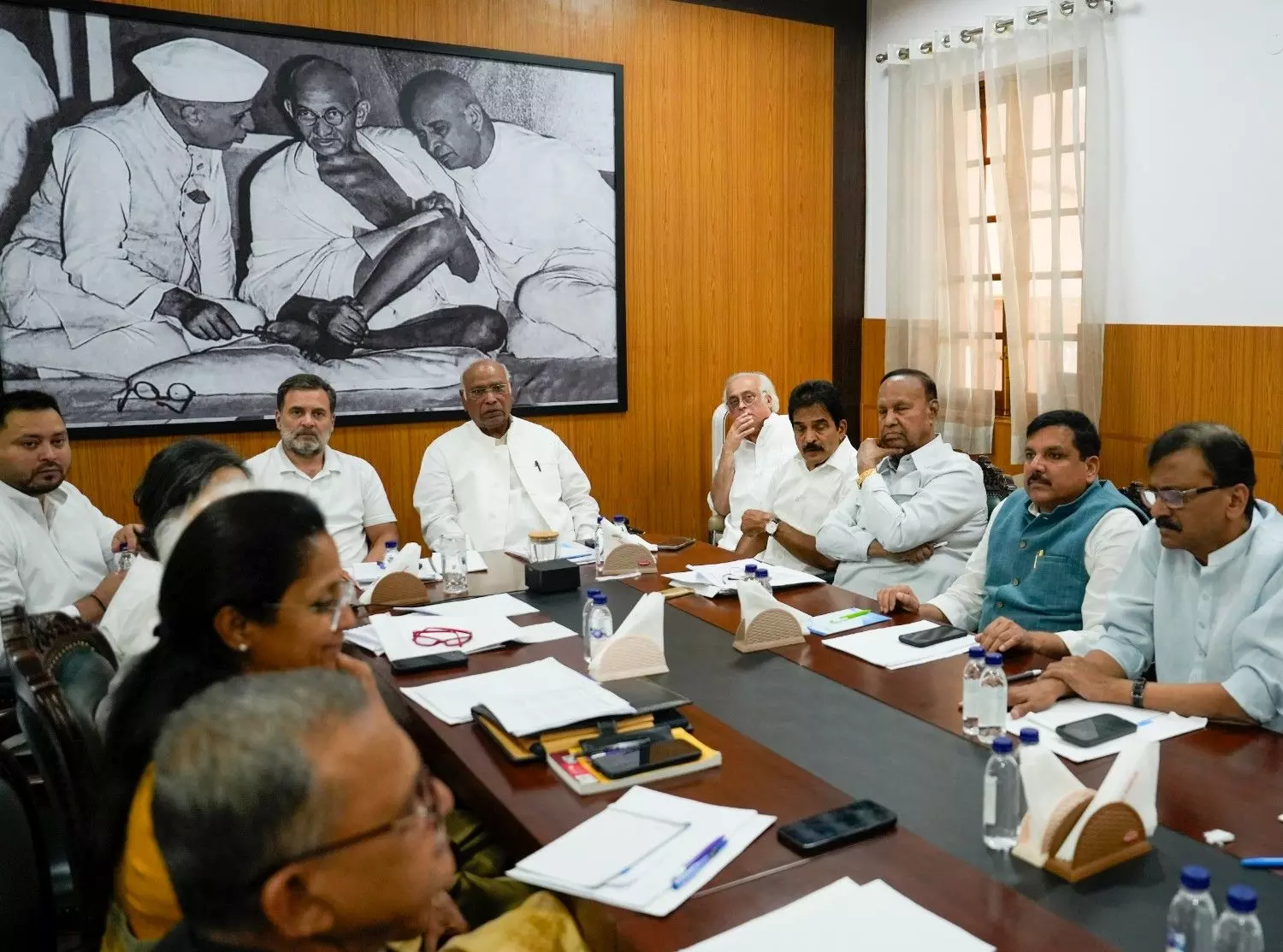
The Opposition, however, hopes to lob the reservation ball back into the Centre’s court. On Wednesday (April 15), at a meeting convened by Congress president and Rajya Sabha’s Leader of Opposition Mallikarjun Kharge, senior Opposition leaders formulated their stand on the three Bills.
Opposition to announce three Bills: Kharge
Kharge announced that while the Opposition continues to fully support women’s reservation, a guarantee woven into the Constitution with the Opposition’s unanimous support for the 2023 Act, it would oppose the three Bills. He alleged that the Centre was trying to “trap and deceive” the Opposition by claiming that the enactment of the three Bills is necessary for operationalising women’s reservation.
Also read: 'Degressive proportionality', 'unscientific exercise', 'punishment to TN' | Delimitation Bill
The Centre’s “real intention” behind pushing the three Bills in haste in an extended session of Parliament, the Congress president said, was to “introduce delimitation by stealth”.
He accused the Centre of “playing tricks on delimitation” and said that through the three Bills, the government was attempting to seize “all powers of the Constitution” and have a delimitation exercise conducted to tilt the country’s electoral pitch decisively in the BJP’s favour.
'BJP eyeing reconstituting constituencies'
At the meeting convened by Kharge, sources said senior Opposition leaders, including Independent MP Kapil Sibal, DMK’s TR Baalu, AAP’s Sanjay Singh, TMC's Sagarika Ghose and the Rashtriya Janata Dal's (RJD) Tejashwi Yadav, asserted that the changes the Bills sought to introduce in the Constitution and institutional framework of delimitation “will help the BJP reconstitute constituencies to its advantage”.
Sibal, Baalu and Congress MP Jairam Ramesh also spoke extensively about the “marginalisation of southern states and states with smaller populations” in Lok Sabha if the Bills are allowed to be passed.
There was also extensive criticism of the manner in which the Centre was seeking to “delink the need for a constitution amendment from the delimitation exercise in the future”. Opposition leaders are also up in arms against the manner in which the “Centre is trying to undermine the constitutional mandate for delimitation to be conducted only after fresh Census by bringing amendments that would vest in the Centre powers to choose not just which Census to rely upon for delimitation but even the power to decide to conduct delimitation, as opposed to the constitutional scheme that allows delimitation only after the completion of a fresh decadal Census,” a leader present at the meeting told The Federal.
Opposition onus is to convince women
The challenge for the Opposition now is to articulate its position in a way that the general public, particularly women, can understand. Opposition leaders believe that they may have found a way to do so by asserting the demand for “immediate implementation of women’s reservation as per the current strength of the Lok Sabha”.
Also read: Women’s reservation a smokescreen for delimitation, warns activist Anjali Bhardwaj
“This puts the ball in the Centre’s court. This is not a new stand for us. Even when the Naari Shakti Vandan Adhiniyam was passed in Parliament, many Opposition leaders had demanded that the reservation should be implemented in the 2024 Lok Sabha election itself, based upon the Lok Sabha’s existing strength of 543 members," CPI(Marxist-Leninist) Liberation MP Raja Ram Singh, who was present at Kharge’s meeting, told The Federal.
"It is for the Centre to explain why it chose not to do so. The Centre had argued at the time that the reservation could only be implemented after the next Census was completed and delimitation of seats was done based on its final published date. We had opposed that argument then, too. So, what has changed for the Centre now that it wants to delink the rollout from the next Census, which is already underway and is, as per the Census Commissioner, expected to be completed within 2027,” he added.
Opposition outfits such as the Samajwadi Party and the RJD are also expected to vociferously raise the demand for introduction within the 33 per cent women’s reservation of a ‘quota within quota’ for OBC women (apart from the existing quota for Scheduled Castes and Scheduled Tribes).
While the Congress also supports this demand, it is unclear if it would take a firm stand on this when the three Bills come up for consideration and passing in the Lok Sabha as the party’s view is to “fully oppose the amendments”.
Also read: Stalin announces black-flag protest in TN on April 16 over delimitation proposal
“We had backed quota within quota in 2023 itself, and our position remains the same, but the current situation is different. The Opposition’s demand is that the three Bills should be completely withdrawn, and that will be our priority. If the Centre agrees to have a discussion on introducing women’s reservation with the current strength of Lok Sabha, then we will naturally demand quota-within-quota for OBC women too, but the Centre obviously does not want that,” a Congress MP told this website.
Opposition could also question Centre on claims-actual gap
The Opposition is also expected to question the Centre on the “huge difference” between the “unofficial claims” that were being made by the government regarding the delimitation exercise over the past few weeks and the “actual text of the Bills being brought now,” said sources.
While the past few weeks had seen heavy speculation that the Bills would increase the strength of the Lok Sabha from the current cap of 550 to 816 MPs while maintaining the proportion that each state currently has in its seat share, the Bills now in the public domain mention neither.
Where is the 50 per cent formula?
Union Home Minister Amit Shah had also assured a section of Opposition leaders that post delimitation, the share of every state’s seats in Lok Sabha would rise by a uniform 50 per cent; a formula that was being touted as the Centre’s way of addressing concerns of southern states who feel a delimitation tethered to population count would drastically reduce their proportionate share in seats in Lok Sabha. The three Bills make no mention of this 50 per cent formula, too.
Also read: Delimitation: Govt proposes to increase Lok Sabha seats to 850
Instead, the Constitution Amendment Bill proposes to increase the strength of the Lok Sabha to 850 MPs (815 from the States and 35 from Union Territories) and leaves it to the Delimitation Commission to decide the parameters for delimiting constituencies while allowing the Centre to choose which Census to base the delimitation exercise on.