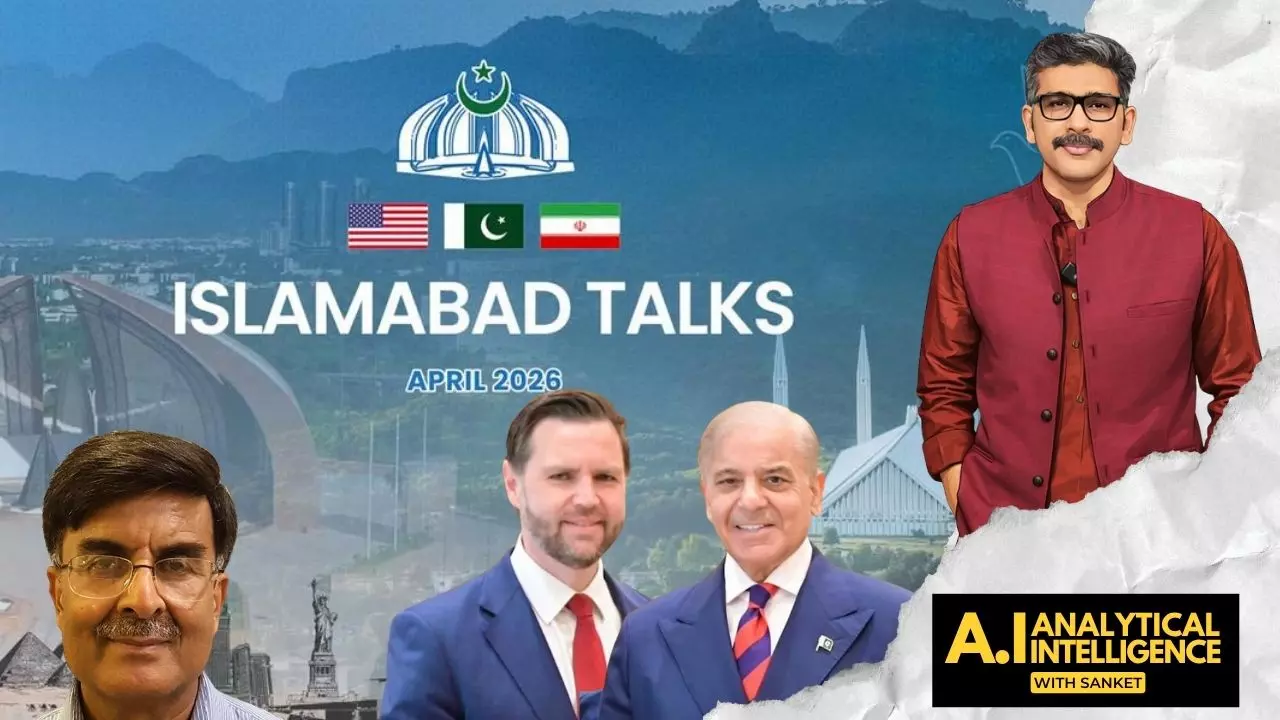
Could Pakistan’s ‘peace broker’ role pose new risks for India? | Ai With Sanket
Former High Commissioner Sharat Sabarwal says Islamabad’s mediator role in US-Iran tensions boosts its relevance but may embolden adventurism toward India

“Whenever Pakistan has had a transactional relationship with the United States, it has tended to become more adventurous towards India,” warns Sharat Sabarwal, former High Commissioner to Pakistan, flagging potential security risks amid Islamabad’s evolving geopolitical role. As Pakistan positions itself as a mediator in the ongoing US–Iran tensions, concerns are rising in India over the implications for regional stability. The Federal spoke to Sabarwal to unpack Islamabad’s role, shifting global alignments, and what this could mean for India.
How do you view Pakistan’s role as a negotiator in this volatile situation?
I think we should be clear about two things: what Pakistan’s role was and why it came about. Pakistan’s role was essentially that of a messenger—carrying messages between the two sides—and a facilitator in establishing communication and organising the meeting in Islamabad.
It was not a decision-maker, nor an influencer in any material sense, except perhaps in trying to influence Iranian decisions through the Chinese. A few days before the meeting, Pakistan's Deputy Prime Minister and Foreign Minister Ishaq Dar visited Beijing, most likely with American approval, to brief the Chinese.
Also read | Congress calls Pakistan’s role in US-Iran ceasefire 'setback' to PM Modi’s foreign policy
Pakistan came into this role due to several factors. One was Donald Trump’s rapport with General Asim Munir, whom he has called his favourite field marshal. This reflects Trump’s effort to co-opt Pakistan into his West Asia strategy.
Pakistan also enjoys a stable relationship with Iran despite past tensions, and maintains a publicly hard line on Israel. Additionally, Pakistan has defence ties with Saudi Arabia and wanted to avoid a situation where Riyadh might seek its military assistance against Iran, which could inflame sectarian tensions domestically.
All these factors combined to give Pakistan this role. Having said that, one must give them some credit for facilitating a high-level meeting, even if it did not produce results.
From India’s perspective, should we be cautious about Pakistan projecting itself as a global peace broker?
Yes, from India’s point of view, the concern is that Pakistan is now in a new transactional relationship with the United States. Over the past year, this has evolved through business offers, including rare earth minerals, and Trump’s strategic use of Pakistan in West Asia.
Pakistan has joined initiatives like the Board of Peace and was even expected to contribute personnel to a potential Gaza peace force. Now, with its role in the Iran context, this relationship is deepening.
Historically, whenever Pakistan has been comfortable in such a relationship with the US, it has tended to become more adventurous towards India. I am not saying this will necessarily happen, but we need to keep a close watch.
Does the world view Pakistan differently from how India perceives it?
Absolutely. Pakistan has gone through cycles of decline and recovery over its 75–76 year history, often linked to its relationship with the United States—during the Cold War, the Afghan jihad, and the war on terror.
Three years ago, Pakistan was in deep crisis—politically unstable, economically near default, and with leadership uncertainty. Today, that situation has improved. General Asim Munir has consolidated control, and Pakistan has secured financial arrangements with the IMF and support from China and Saudi Arabia.
While structural problems remain—civil-military imbalance, terrorism, sectarian issues—Pakistan is currently in a phase of geopolitical recovery.
We in India need to be realistic. The narrative that Pakistan is about to collapse or can be internationally isolated has not held true. Instead, it has regained some geopolitical relevance.
Will peace hold, or is the conflict heading toward further escalation?
There are two parallel trends. While the US and Israel may have started the conflict together, they are not entirely aligned. For Benjamin Netanyahu, continuing the conflict may serve domestic and strategic interests.
For Trump, however, this conflict is becoming problematic. It has already hurt the global economy—stock markets have fallen, oil prices have surged, and inflation is increasing. With US midterm elections approaching, there is pressure to stabilise the situation.
Iran, too, has reasons to de-escalate, given the damage it has suffered and the economic impact of blocking the Strait of Hormuz.
However, the failure of the Islamabad talks suggests that things may move in a negative direction again. Trump’s announcement of a blockade and Iran’s warnings of retaliation could push the situation into a more dangerous phase.
Who appears more desperate to end the conflict—the US or Iran?
In such conflicts, it is difficult to identify a clear winner or loser. But if we look at current pressures, the US appears more eager to end it—given economic damage, lack of allied support, and upcoming elections.
Also read | 'Final and best offer': Vance's ultimatum, Iran's silence spell trouble
For instance, the United Kingdom has indicated it will not join the blockade. This shows the US is relatively isolated.
That said, Iran also has strong reasons to seek a resolution. It has suffered damage to its nuclear and military infrastructure and would not want continued escalation.
So, there is logic on both sides to end the conflict, but the situation is still moving toward another dangerous phase.
Could Pakistan’s renewed geopolitical importance lead to misadventures against India?
Historically, when Pakistan has enjoyed strong backing from the US, it has taken risks. During the Cold War under Ayub Khan, it launched operations like Gibraltar and Grand Slam in 1965, believing it had the upper hand.
Similarly, under Yahya Khan, close ties with the Richard Nixon administration led to miscalculations during the 1971 crisis.
Each time, Pakistan ultimately suffered, but it also caused significant trouble for India.
I am not saying it will happen again, but Pakistan’s military leadership has not always acted rationally. Even a single incident—such as a terror attack—could escalate tensions.
So, while we should not assume the worst, we must remain vigilant, especially during phases when Pakistan feels more confident due to its ties with the US.
The content above has been transcribed from video using a fine-tuned AI model. To ensure accuracy, quality, and editorial integrity, we employ a Human-In-The-Loop (HITL) process. While AI assists in creating the initial draft, our experienced editorial team carefully reviews, edits, and refines the content before publication. At The Federal, we combine the efficiency of AI with the expertise of human editors to deliver reliable and insightful journalism.