Parliament is not a warm-up arena for elections, say experts | Capital Beat
As Winter Session of Parliament begins, analysts question Modi’s ‘drama vs delivery’ remark, say robust debate is central to functioning parliamentary democracy

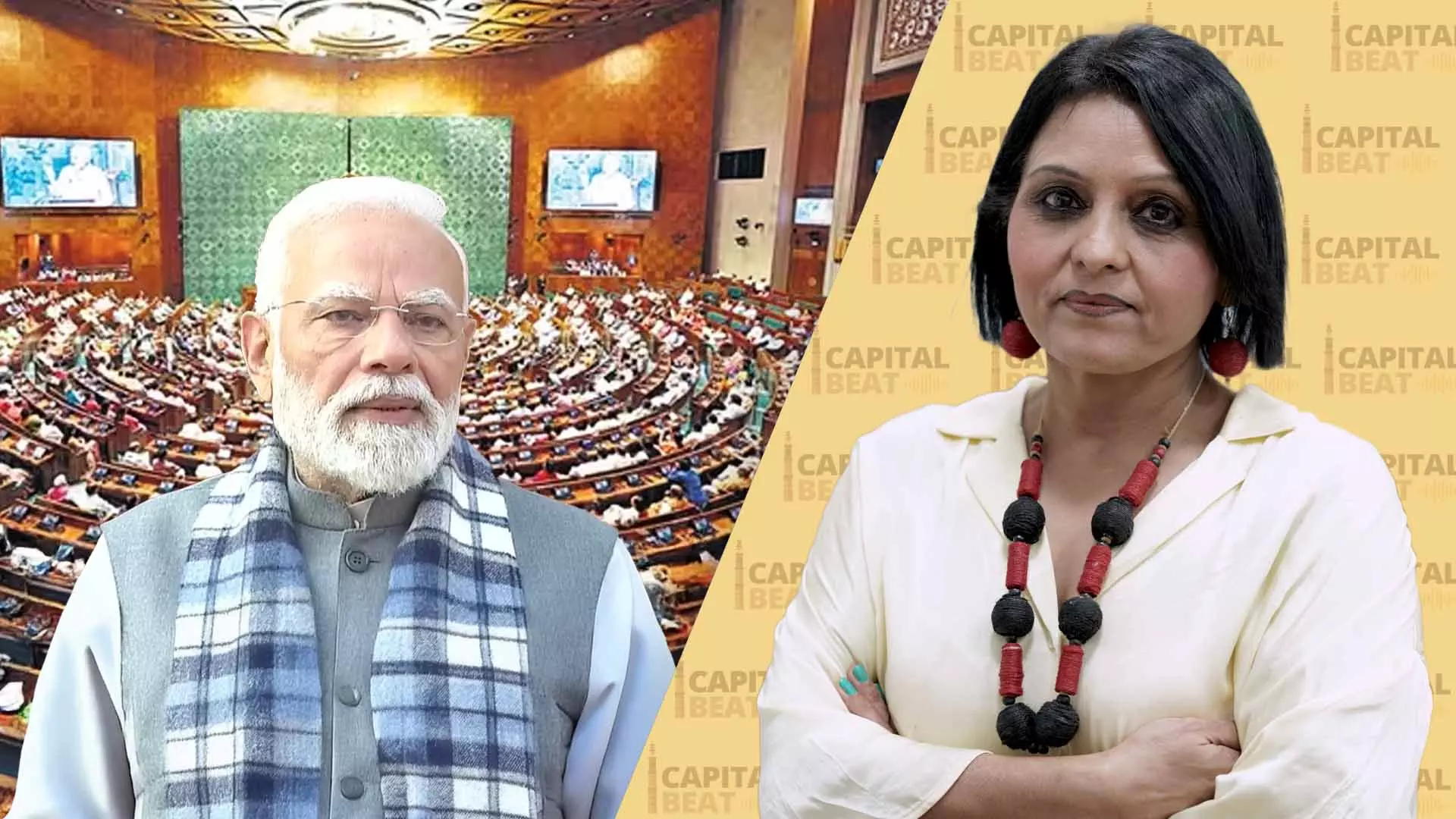
Prime Minister Narendra Modi’s remarks on “drama” versus “delivery” in Parliament and his reference to the Bihar election outcome framed the latest Capital Beat episode, featuring senior journalist TK Rajalakshmi and political analyst Vivek Deshpande. The discussion focused on what Modi's pre-session address signals for the winter session and for opposition demands on issues such as the Special Intensive Revision (SIR) of electoral rolls.
'Drama vs delivery’
Before the winter session opened, Modi addressed reporters outside Parliament and urged that the House function as a space for “delivery, not drama”. He criticised opposition parties for frequently disrupting proceedings and turning Parliament into a “warm-up arena for elections” or a platform to vent frustration after electoral defeats, specifically referring to the recent Bihar Assembly elections.
Modi also cautioned against a repeat of the monsoon session, where the government has maintained that opposition protests over the SIR exercise in Bihar had stalled work. While the opposition has asked for a discussion on the SIR across nine states and three Union Territories, the Prime Minister urged parties to adopt what he described as a responsible approach.
He underlined the slogan “nara nahi, niti chahiye” and remarked that “drama nahi, Parliament mein delivery ki zarurat hai”, indicating that in his view, raising “bekaar ke mudde” inside the House amounted to theatre rather than constructive work.
Opposition leaders hit back
The description of opposition interventions as “drama” drew immediate pushback from several leaders. Congress spokesperson Supriya Shrinate posted on social media that raising urgent public issues in Parliament cannot be labelled drama, and argued that “drama is not allowing democratic discussions about issues that matter to the public like the election situation, SIR and pollution”.
Priyanka Gandhi and KC Venugopal also publicly reacted to the Prime Minister’s remarks, with the opposition camp broadly objecting to the characterisation of their interventions as theatrical. They highlighted their demand for structured debates on electoral rolls, governance and other pressing concerns.
These reactions formed the backdrop to the Capital Beat discussion, which examined whether the government’s framing placed the onus for parliamentary disruption on the opposition alone, or whether the executive also bore responsibility for stalled sessions.
‘Unfortunate choice of words’, says Rajalakshmi
Rajalakshmi described the language used by Modi as problematic. In her view, “it is a very unfortunate choice of words to use to say ‘drama’ and to hint or to insinuate that all that the opposition does is drama bazi on the floor of the House.” She noted that opposition members frequently raise substantive questions on policy and governance.
Rajalakshmi pointed out that the opposition may not always succeed in overturning bills or changing government policy, but the act of placing issues on record in Parliament is part of their institutional role. She listed areas such as SIR, foreign policy, inflation, the state of the economy and national security as subjects on which the public expects scrutiny in the House.
She stressed that these subjects fall within the remit of the Union government and Parliament, noting that “all important portfolios are with the Centre, whether it is finance, home, national security, internal security, foreign affairs,” and that these are not provincial subjects that can be left to state legislatures.
Primary forum for accountability
Rajalakshmi framed Parliament and state assemblies as “people’s houses”, where elected representatives are expected to question the government in the public interest. In her words, “these are the people’s houses, essentially elected by the people, for the people, of the people. So why should the government shy away from such issues?”
She argued that members of Parliament regularly channel questions from citizens who have no direct Q&A forum with the executive. According to her, MPs are “duty bound to raise those questions” when they concern issues of public importance rather than private interest.
On this basis, she rejected the idea that robust questioning in the House should be viewed as disruptive theatre, emphasising that the government ought to be confident in defending its policy choices if it is satisfied with its record.
Potential ‘obstructionist’
Asked whether Modi’s tone suggested that the winter session could be headed towards a washout, Rajalakshmi stated that the approach signalled a more obstructionist stance by the government rather than the opposition. She argued that by refusing to allow debates on key issues, the executive risked blocking parliamentary scrutiny.
She questioned why the government would avoid discussion if it believed its policies to be sound, observing that “unless they are not confident, that is the only impression that one gets.” She added that the Prime Minister’s remarks appeared to trivialise serious concerns by framing them in narrow electoral terms.
Rajalakshmi also underlined that, in her view, the Prime Minister’s position did not “behoove” the office, stating that “there has to be a certain amount of gravity and a certain amount of seriousness when he speaks,” and that the tone adopted on this occasion appeared “extremely lightweight”.
Erosion of parliamentary time
Vivek Deshpande focused on the functioning of Parliament over recent years. He referred to a study by a parliamentary monitoring institution, noting that “this particular year less than 26% of the time was actually used in some productive activity in Parliament, which is very unfortunate.”
Deshpande underlined that citizens send representatives to get legislative work done, but successive sessions have frequently ended in washouts. He argued that in a parliamentary democracy, “the government’s responsibility is greater than that of the opposition” when it comes to ensuring that the House runs and business is completed.
He characterised opposition parties as having a defined institutional role, stating that “opposition will always… their cardinal duty in democracy is that they must oppose,” and that this function should be recognised rather than discouraged.
Passage of bills
Deshpande criticised the manner in which several bills have been passed in recent years. He recalled instances where legislation cleared Parliament “without any discussion at all” despite opposition demands for debate.
In his assessment, the government’s approach has been to “push its agenda and stonewall everything that the opposition wants to do,” which, he argued, places primary responsibility for a “more and more dysfunctional” Parliament on the treasury benches rather than on opposition parties.
He also pointed to the conduct of the Parliamentary Affairs Minister, Kiran Rijiju, remarking that while the minister’s role is to coordinate with the opposition, the posture adopted has often been confrontational instead.
‘Disruptions serve this govt better’
Deshpande linked the pattern of disruptions to the executive’s preferences. He argued that meaningful, cohesive discussions in Parliament expose the government to questions to which it may not have ready answers, and contended that “disruptions serve this government better than any qualitative discussion”.
He suggested that this dynamic enabled the government to take a higher moral ground by accusing the opposition of obstructing proceedings, even when, in his view, the underlying cause lay in the government’s reluctance to engage with criticism.
He concluded that the Prime Minister should reflect on whether the current approach was helping parliamentary democracy, stating that “at least in Parliament, if they allow the opposition to do something and say something, that will serve Indian democracy better.”
Bihar results and ‘warm-up arena’ remark
The Prime Minister’s reference to the Bihar elections was another focal point of the discussion. Modi had remarked that some opposition parties were unable to accept their defeat and that “from the statements I heard yesterday it seems a loss has deeply troubled them”. He argued that defeat should not lead to disruption, just as victory should not lead to arrogance.
Rajalakshmi responded that equating opposition behaviour in Parliament with frustration over electoral losses reduced institutional functioning to “narrow electoral politics”. She pointed to the vote shares in Bihar to underline that a substantial segment of the electorate had supported the INDIA alliance.
She suggested that the persistence of the INDIA bloc despite defeats in several states may be a factor in the ruling camp’s rhetoric, noting that “a significant section of the electorate still has voted for the India alliance,” and that parties in the bloc “still stand for something and not just opportunistic politics.”
Debate over SIR, BLO deaths
The panel also addressed the opposition’s demand for a discussion on the Special Intensive Revision of electoral rolls and reports of Booth Level Officers (BLOs) dying during the exercise in different parts of the country. The opposition has been pressing for a structured debate on both SIR and the conditions faced by BLOs.
Deshpande recalled earlier instances where the government declined to discuss issues that were under consideration by the Supreme Court, and noted that a hearing on SIR is scheduled to run parallel to the winter session. He anticipated that the government might again cite sub judice grounds to avoid a direct debate on the revision exercise.
He suggested that the opposition could frame a discussion around the working conditions and safety of BLOs, and then raise SIR-related questions within that framework. In his view, “the opposition has to act very smartly and push their agenda in a very smart way” to bring scrutiny into the House despite procedural objections.
Floor strategy and strength
Deshpande noted that unlike in some state assemblies, the opposition in the current Lok Sabha has a “very sizeable number” and should use this strength to press for debates. He emphasised the need for greater floor coordination among INDIA bloc parties to ensure that issues such as SIR, pollution, foreign policy and national security come up for discussion.
He argued that the government’s attempts to “make the opposition nervous with its statements” should not distract from substantive planning by opposition parties inside Parliament. In his view, tactical changes in strategy on the floor of the House are required to compel the government to participate in debates.
The episode concluded with a reminder that the winter session is scheduled for about 15 sittings, with the question of whether the government will agree to a discussion on SIR and related issues remaining open.
The content above has been transcribed from video using a fine-tuned AI model. To ensure accuracy, quality, and editorial integrity, we employ a Human-In-The-Loop (HITL) process. While AI assists in creating the initial draft, our experienced editorial team carefully reviews, edits, and refines the content before publication. At The Federal, we combine the efficiency of AI with the expertise of human editors to deliver reliable and insightful journalism.