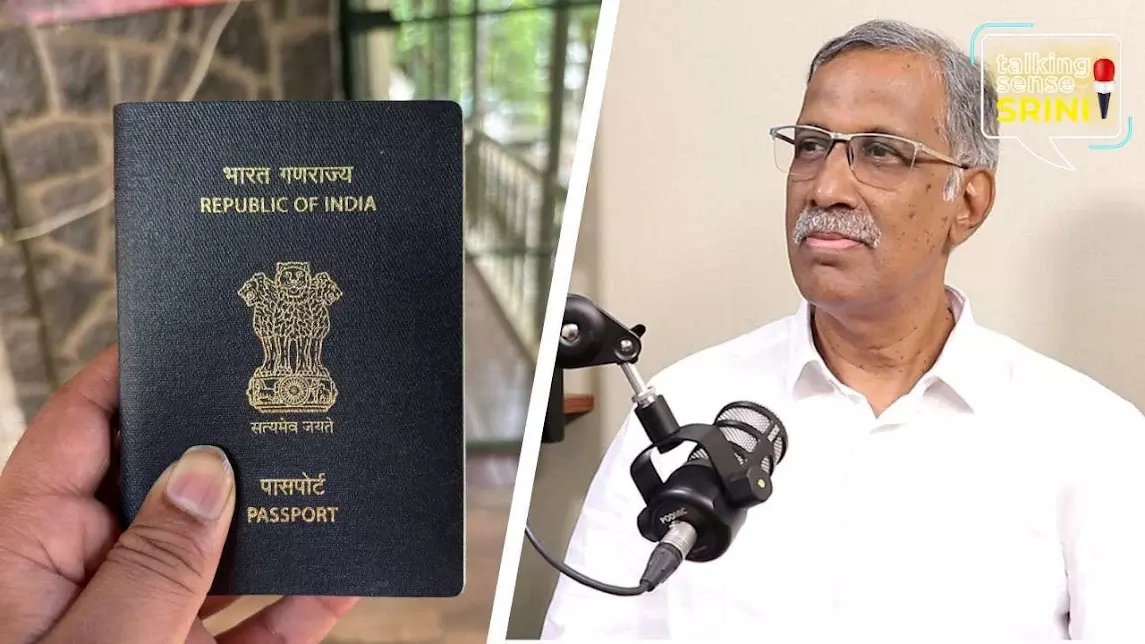
‘MEA statement on passport bizarre, sends out confusing message’
The Federal’s Editor-In-Chief says nationality-citizenship distinction may exist legally, but MEA statement may imply govt is not recognising passport anymore

The Centre's recent clarification that an Indian passport is a travel document and not conclusive proof of citizenship has triggered widespread confusion, with many questioning how a document issued after extensive government verification can suddenly be seen differently.
In the latest episode of Talking Sense With Srini, The Federal's Editor-in-Chief, S Srinivasan, argued that the clarification was both unnecessary and poorly timed.
Confusing message
"To an ordinary citizen, it looks bizarre," Srinivasan said. "People will simply conclude that the government is no longer recognising the passport. It sends out a confusing message."
He explained that the controversy began after a Ministry of External Affairs official, responding to a question linked to the ongoing Special Intensive Revision (SIR) of electoral rolls, stated that a passport establishes identity and facilitates travel but is not, by itself, proof of citizenship.
Also read: Passport, citizenship, and the SIR debate: Why the govt’s stand faces scrutiny
According to Srinivasan, the distinction between nationality and citizenship may exist legally, but it has little practical relevance for the overwhelming majority of Indians. While Section 20 of the Passports Act allows passports to be issued to non-citizens in exceptional cases and in public interest, he noted that such instances are exceedingly rare.
Rigorous application process
"The exception applies to a minuscule fraction of people. For 99.999 per cent of Indians, passports are issued only after rigorous scrutiny," he said.
Srinivasan pointed out that obtaining a passport involves submission of birth and residence documents, educational records, police verification, and a signed declaration affirming allegiance to the Constitution. "Taken together, these processes should ordinarily make the passport a reliable indicator of citizenship," he argued.
Also read: ‘Passport should prove citizenship’: Tharoor calls for legal change
He also referred to Ambassador Vivek Katju's observation that passports were historically denied only in limited circumstances, such as travel restrictions to apartheid-era South Africa and Israel before diplomatic ties were established. With those restrictions no longer applicable, Katju contends that a passport should naturally be regarded as evidence of citizenship.
Timing raises questions
Srinivasan suggested that the timing of the clarification has inevitably fuelled speculation because of its overlap with electoral roll revisions in several states. "Whether this is linked to the SIR exercise or merely an off-the-cuff remark is unclear. But once the clarification was officially reinforced, it became difficult to dismiss it as incidental," he said.
Also read: Citizenship proof burden can’t be on people: Legal expert Faizan Mustafa | AI With Sanket
While the controversy is unlikely to affect Indians travelling overseas, Srinivasan believes it has opened an avoidable debate over citizenship documentation within the country.