








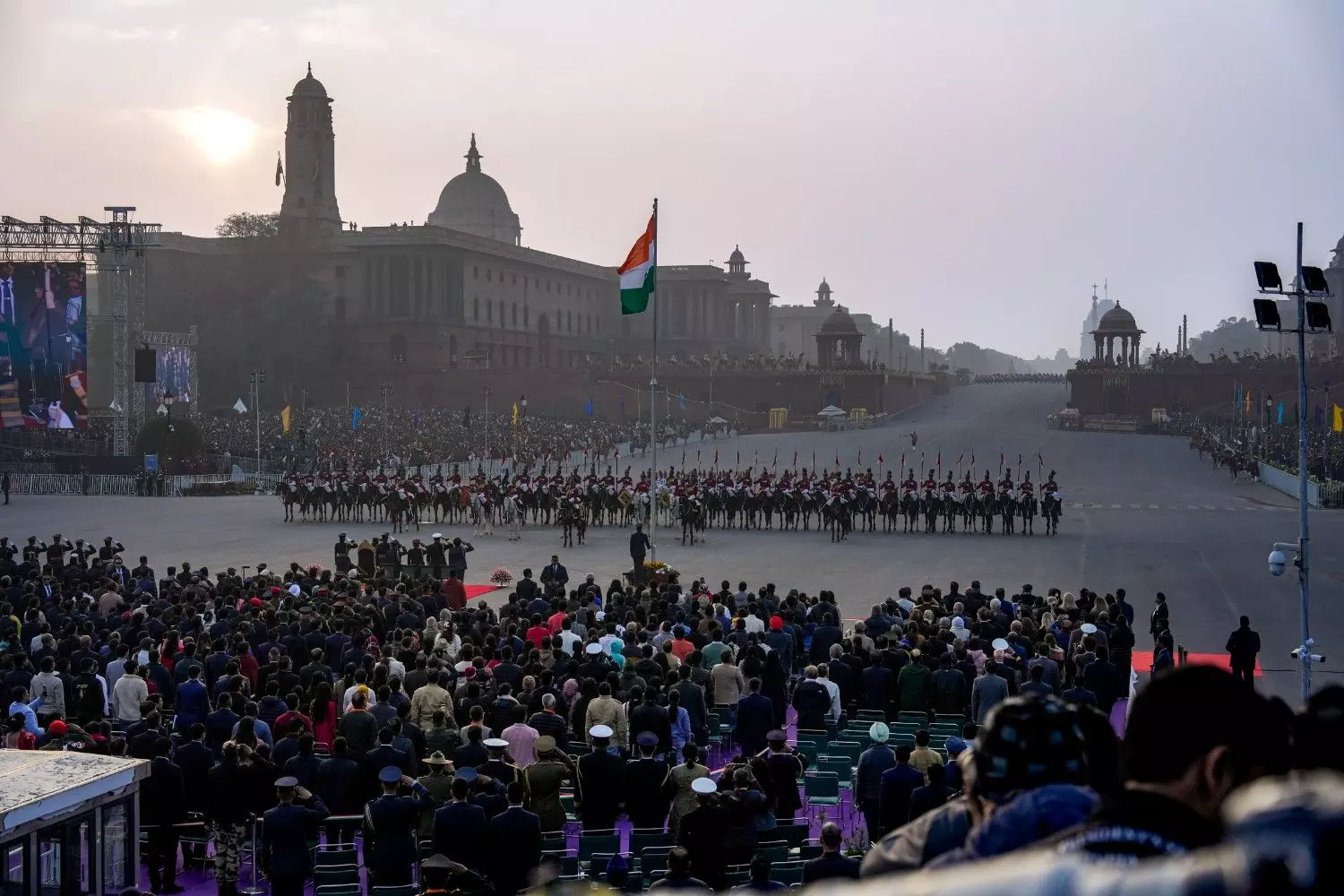
A scene from the Beating Retreat ceremony 2026 at Vijay Chowk in New Delhi on January 29, 2026. Photo: PTI
Beating Retreat 2026 ditches colonial past, takes Swadeshi turn
The event, which marked the end of 77th Republic Day celebrations, saw a completely fresh execution of ideas inspired by 'Indianness'

Every year, India's Beating Retreat ceremony, held three days after the Republic Day celebrations to mark their conclusion, makes evident the pride of a post-colonial State that dumped the relics of the British colonial era nearly eight decades ago.
But not this time.
As the Narendra Modi government continues to stress Indianness and promote the indigenous culture across several forums — changing names of cities and landmarks and allegedly imposing Hindi on all nooks and corners of the country — the Beating Retreat ceremony of 2026 gave enough hint that even a State event is no more immune from the process of 'Indianisation' or rather 'indigenisation'.
The event, held at New Delhi's iconic Vijay Chowk on Thursday (January 29), was witness to special presentations staged by bands of the three branches of the armed forces that included stirring and foot-tapping notes, mesmerising the audience that included both high-profile and common viewers.
The event, which marked the culmination of the country's 77th Republic Day celebrations held on January 26, saw a charged-up patriotic ambience and nothing other than indigenous tunes, especially Hindi, and ideas (displayed through formations, sometimes even through Hindi words such as 'Sindoor') being used to convey the message.
Bands of the various branches of the armed forces performed timeless tunes, which have been identified with the ethos of the Indian nationhood from time to time, such as 'Kadam Kadam Badhaye Ja', 'Vijay Bharat', ‘Aye Watan, Aye Watan’. 'Saare Jaha se Achcha' and several others, filling up the air with deeply nationalistic vibes.
The event also paid tributes to the National Song, “Vande Mataram”, which completed 150 years recently.
Hindi formations
The performing bands also came up with special formations during the event, most of which again represented the uniqueness of the Indian State and its designs, particularly Hindi. The Indian Air Force contingent band, for instance, came up with a special Gaganyaan and Sindoor formations to pay tributes to India's varied success, be it in the sphere of space or military missions against enemy countries.
The Hindi word/figure-formation presentations included, besides "Sindoor", "Vande", "Mataram", "150" to denote the centenary and half of the national song, among others.
Members of the Pipes and Drums Band also executed the Gaganyaan formation to showcase India's space-related achievements. They also formed ‘Amar Jawan’ to pay tribute to the bravery and sacrifice made by Indian Army jawans.
The IAF band also staged a MiG-21 formation, honouring the iconic fighter aircraft it had used over the decades and retired last year.
Also read: On 77th Republic Day, kids eat off torn notebook pages at MP school
The ceremony was presided over by President Droupadi Murmu, who reached the venue in a traditional buggy to the sound of bugles, a scene common with the Beating Retreat ceremony. Her ceremonial carriage was escorted by the President's Bodyguard, as per the tradition.
The Beating Retreat ceremony
Beating Retreat is a ceremony that marks the culmination of Republic Day festivities in India. It is held on the evening of January 29, three days after R-Day, at New Delhi's Vijay Chowk. The ceremony features musical performances by the bands of the Indian Army, Navy, Air Force, Delhi Police, and the Central Armed Police Force.
The ceremony is presided over by the President of India, who is the supreme commander of the armed forces. The ceremony was first held in 1950s, during a state visit by former British Queen Elizabeth and Prince Philip. Since then, it has become an annual event.
Music performance
The evening, illuminated by lights and colours, saw massed bands presenting march with the iconic 'Kadam Kadam Badhaye Ja’. Melodious renditions from the Pipes and Drums band followed, including ‘Atulya Bharat’, ‘Veer Sainik’, ‘Mili Jhuli’, ‘Nritya Sarita’, ‘Marooni’ and ‘Jhelum’. Bands from the Central Armed Police Forces will present compositions such as ‘Vijay Bharat’, and 'Veer Seepahi’, among others.
The Indian Air Force band also enthralled the audience with tunes such as ‘Brave Warrior’, ‘Twilight’, and others while the Indian Navy band performed ‘Namaste’, ‘Sagar Pawan’, ‘Matribhumi’, ‘Tejasvi’ and ‘Jai Bharati’.
The Indian Army band also chipped in with powerful compositions including ‘Vijayee Bharat’, ‘Aye Watan, Aye Watan’, ‘Anand Math’, and others.
Massed bands played ‘Bharat Ke Shaan’, ‘Vande Mataram’ and ‘Drummers Call’, before the ceremony drew to a close with the evergreen patriotic tune ‘Sare Jahan Se Acha’, played by the Buglers.
One of the special features of this year's event was the seating enclosures at Vijay Chowk were named after Indian musical instruments, such as Bansuri, Damaru, Ektara, Esraj, Mridangam, Nagada, Veena, among others, another indication of turning the Beating Retreat into an indigenised event.
Top leaders in attendance
Vice President C P Radhakrishnan, Prime Minister Narendra Modi, Defence Minister Rajnath Singh, Chief of Defence Staff General Anil Chauhan, and chief of the three service chiefs, were also present among other dignitaries who graced the occasion.
Also read: Congress fumes over ‘back-row seat insult’ to Kharge, Rahul at R-Day parade
Big screens were installed at the venue, beaming the event’s live images. Several people, including foreigners, remained witnesses to the colourful event and offered heartfelt applause.
Also read: Trump greets India on Republic Day amid US tariffs and trade strain
Before the ceremony, Modi shared a message in which he described the occasion as one that celebrates India’s enduring defence traditions. He said the Beating Retreat represents the strength and continuity of India’s military heritage and spoke about the valour of the armed forces, hailing them as central to the country’s security and sovereignty.
(With agency inputs)