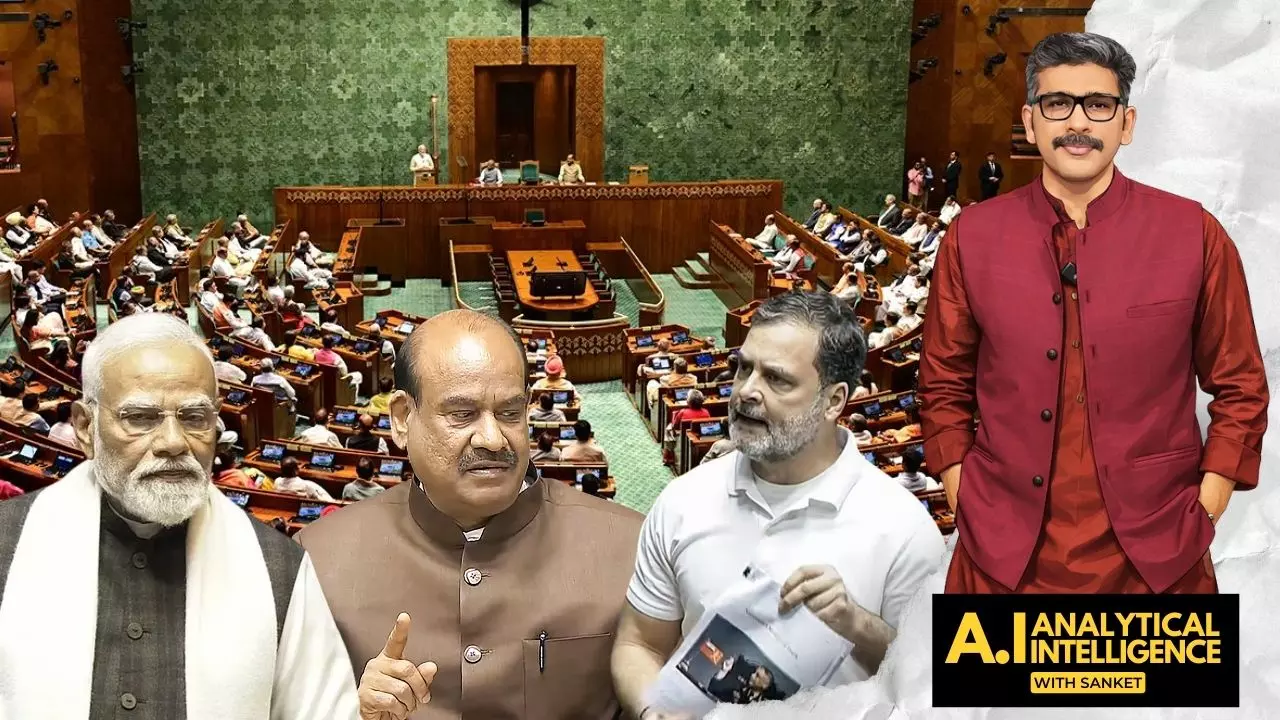
Modi in Lok Sabha
AI with Sanket | ‘Threat’ to Modi in Lok Sabha a security breach or evasion excuse?
PM Modi's no-show in Lok Sabha raises questions: Security concern or political strategy? What did the Speaker's statement reveal?

A claim by the Lok Sabha Speaker Om Birla that Prime Minister Modi faced a security threat inside the House - leading to his decision to skip replying to the Motion of Thanks - has opened up a serious constitutional debate.
“If the Prime Minister is not safe in the House of the People, where exactly is he safe?” asked Neerja Chowdhury, capturing the unease triggered by the Speaker’s statement.
The Federal spoke to senior journalists Neerja Chowdhury and Aditi Phadnis to assess whether this episode marks a dangerous shift in parliamentary norms.
The controversy arose after the Speaker said intelligence inputs suggested a threat from the opposition, prompting the Prime Minister not to speak in the Lok Sabha. The Motion of Thanks was passed without the customary reply, a departure from parliamentary tradition that immediately raised questions about accountability and precedent.
An unprecedented claim
The suggestion that the Prime Minister could be unsafe within Parliament struck at the core of democratic functioning. Chowdhury underlined that ensuring the Prime Minister’s security is the government’s responsibility. “To say the government cannot protect its own Prime Minister inside Parliament is a startling admission,” she said.
Also read: Speaker Om Birla says PM Modi was advised to skip House over ‘unexpected act’ fears
The Prime Minister’s reply to the President’s Address is not ceremonial but substantive, outlining the government’s priorities and responding to criticism. Its absence from the Lok Sabha, Chowdhury noted, weakens a key moment of executive accountability to the directly elected House.
Demand for transparency
A central concern was the lack of clarity about the alleged threat. Chowdhury argued that intelligence claims cannot remain vague. “If there was intelligence, the country has a right to know its nature,” she said, warning that opacity fuels suspicion rather than reassurance.
Aditi Phadnis was scathing about claims aired by ruling party figures that women MPs might physically attack the Prime Minister. “The idea that MPs would ‘bite’ the Prime Minister is completely absurd,” she said, adding that such statements trivialised Parliament while deflecting from the real issue.
Avoidance or necessity?
Both journalists questioned whether the security explanation functioned as a pretext to avoid scrutiny. Phadnis noted that the Prime Minister’s reply to the Motion of Thanks often addresses contentious issues raised during the debate. “Using a threat claim to avoid a head-on parliamentary response is not a sustainable strategy,” she said.
Also read: Rahul Gandhi calls Lok Sabha speech block a blot on democracy in letter to Speaker
She also pointed out that Parliament has witnessed far more turbulent moments in the past. Even during high-voltage debates, including those involving major legislative changes, prime ministers continued to face the House.
Parliament’s declining norms
Beyond the immediate episode, the discussion turned to the erosion of parliamentary culture. Chowdhury observed that the breakdown runs deeper than disruptions. “What worries me is the collapse of parliamentary language itself,” she said, noting that personal bitterness has replaced ideological disagreement.
She recalled earlier eras when disruptions were eventually resolved through negotiation and mutual restraint. While Parliament has always reflected political tensions, she said, the present atmosphere is marked by a lack of willingness to engage.
The Speaker’s role
The Speaker’s conduct emerged as a critical institutional question. Phadnis pointed out that there is no clear mechanism to compel the Speaker to disclose or justify intelligence-based decisions. “Short of impeachment, which is unrealistic, there is no way to force an explanation,” she said.
Also read: Why Rahul citing Naravane’s memoir sparked Parliament showdown | Capital Beat
The Speaker’s statement that he advised the Prime Minister not to attend complicated matters further. Chowdhury questioned whether such responsibility could legitimately rest with the Chair. “That is not a burden the Speaker should be carrying,” she said.
Security versus accountability
Both panellists stressed that security arrangements exist to counter external threats, not to insulate leaders from parliamentary scrutiny. Phadnis summed it up pointedly: “Security can protect the Prime Minister from militants, not from questions.”
Allowing security claims to override parliamentary convention, she warned, risks normalising executive avoidance of accountability — a shift with long-term implications for democratic functioning.
The way forward
Despite their critique, both journalists emphasised the need to de-escalate. Chowdhury suggested institutional dialogue as the only viable path forward. “Trust has completely broken down, and without rebuilding it, Parliament cannot function,” she said.
Drawing on history, she argued that past crises were resolved when political leaders chose engagement over escalation. Without such an effort now, the episode risks becoming a precedent that further weakens Parliament’s role as the central arena of democratic accountability.
(The content above has been transcribed from video using a fine-tuned AI model. To ensure accuracy, quality, and editorial integrity, we employ a Human-In-The-Loop (HITL) process. While AI assists in creating the initial draft, our experienced editorial team carefully reviews, edits, and refines the content before publication. At The Federal, we combine the efficiency of AI with the expertise of human editors to deliver reliable and insightful journalism.)