








Is Quad gradually slipping into irrelevance? | Worldly-Wise
As India hosted Quad foreign ministers’ talks, global tensions and shifting US priorities raise fresh questions over the alliance’s future

The recent meeting of Quad foreign ministers in New Delhi, attended by US Secretary of State Marco Rubio, once again brought focus back on the grouping involving India, the US, Japan, and Australia.
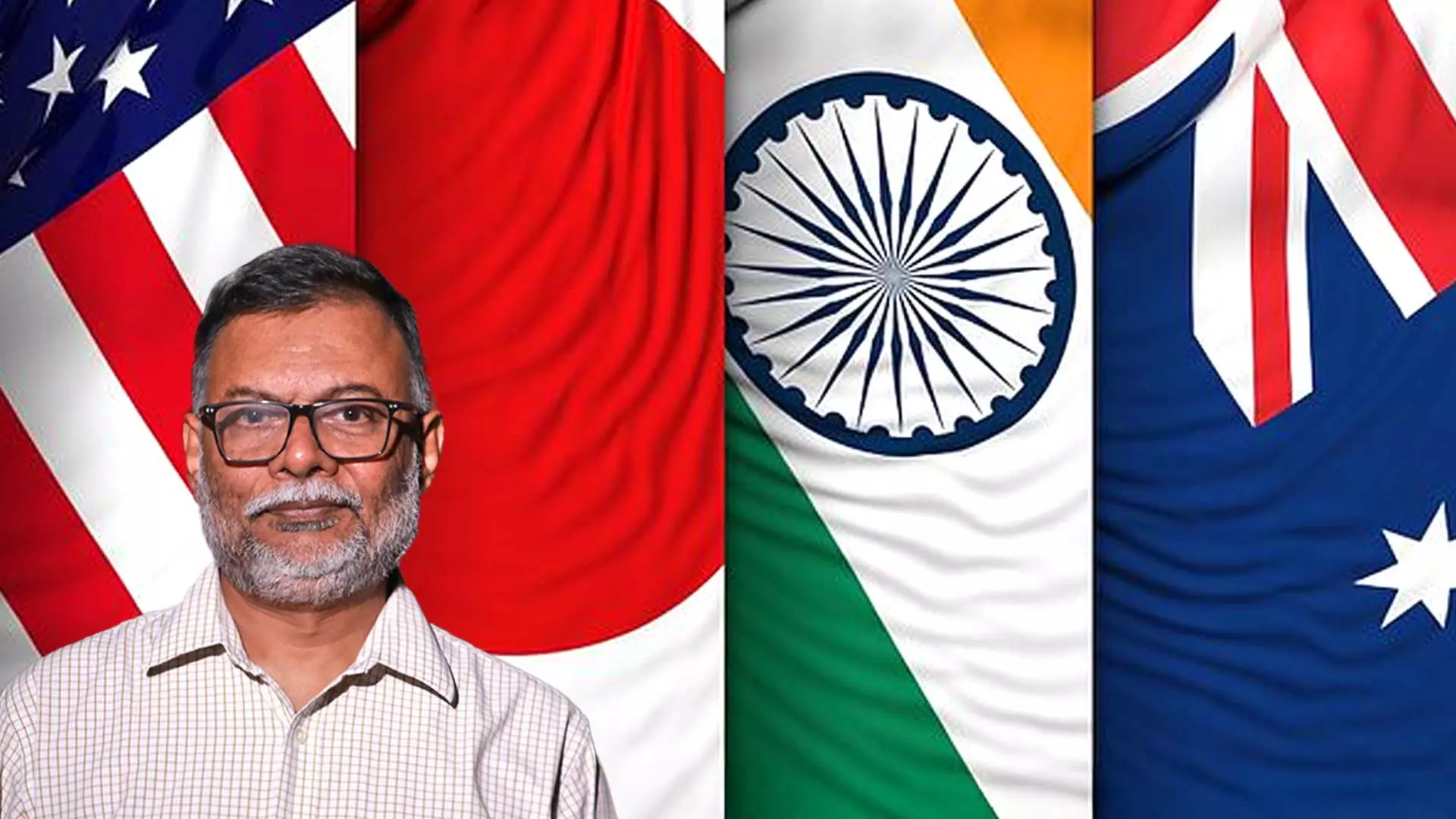
The Federal spoke to Consulting Editor and geopolitical analyst KS Dakshina Murthy in the latest episode of Worldly-Wise about whether the Quad still matters, India’s role in it, and how China and shifting US priorities are reshaping the alliance.
Also read: Quad expands Indo-Pacific cooperation with maritime surveillance and port initiatives
Is the Quad still relevant today?
On paper, definitely the Quad remains relevant. At the same time, practically speaking, the Quad is going through something close to a crisis over its own existence and purpose.
If you look at the history of the Quad, it has always had a troubled journey. It began in 2007 due to Japan’s initiative. But within a year, then Australian Prime Minister Kevin Rudd had doubts about the grouping because he felt antagonising China would hurt Australia’s interests. China was Australia’s biggest trading partner and Canberra did not want to damage that relationship despite being close to the US.
As a result, the Quad entered a lull and for some time, it looked like it may not survive. Later, Julia Gillard took over as Australia’s prime minister and ties with the US were revived again. During Barack Obama’s presidency, there was renewed interest in the Quad and several military exercises happened between the member countries. This eventually led to the Malabar naval exercises involving India.
Over time, the Quad started resembling a strategic security arrangement. China repeatedly argued that this was always the grouping’s real intention.
Then, during Donald Trump’s first term in 2017, the Quad gained fresh momentum because Trump wanted to counter China’s growing influence in the Indo-Pacific. The first leaders’ summit happened in 2021 under Joe Biden and from 2021 to 2024 there were several regular summits involving the heads of government.
A summit was supposed to happen in India in 2025 after Trump returned to power, but it did not happen because many global and bilateral issues emerged, including tensions between India and the US over tariffs.
What we are seeing now is a kind of slowdown. China has become so powerful that even Trump appears to be softening his stance. China blocked exports of rare earth materials to the US, Washington panicked, and eventually backed off from imposing reciprocal tariffs. China is also playing a larger role globally, including in discussions around the Iran conflict.
So the question is whether the Quad is really making an impact anymore. At the moment, it does not seem that way.
Also read: The duplicity behind Trump's push to disarm Iran
Can India balance ties with the US, Russia and China while staying in the Quad?
That is really the core issue for India.
For India, the Quad has always been important, more in a symbolic sense. After the Galwan clash in 2020, tensions between India and China increased even though economic relations between the two countries remained strong.
India also saw how China openly supported Pakistan with defence equipment during recent military tensions. So India understands that China may maintain ties with India, but it is strategically closer to Pakistan.
At the same time, India cannot fully antagonise China because China is a much larger power economically and strategically.
If there is a serious border crisis between India and China, the Quad cannot practically intervene in a meaningful way. Symbolically, India is part of a grouping where four countries stand together, but realistically, the Quad cannot directly help India in such a conflict.
Still, for India, the grouping offers psychological and diplomatic value because there remains a feeling that these countries could support India in a larger strategic crisis.
From India’s perspective, what does the Quad still offer?
That is exactly the important question today.
India needs stronger ties with countries like Australia, Japan and the US. So, the Quad matters not only as a platform to counter China, but also as a broader partnership with countries that can benefit India strategically and economically.
For example, Australia had once hesitated to export uranium to India. But closer ties through the Quad framework make such cooperation easier.
Similarly, the issue of rare earth minerals has become very important globally. China dominates the sector, but India also possesses sizeable rare earth reserves. India is now part of broader discussions involving countries with such resources.
While these initiatives may help the US in reducing dependence on China, they can also benefit India because New Delhi can use these partnerships to negotiate for technology, investment and strategic cooperation.
India also has much to gain from closer relations with Japan. So even if the Quad is weakening as a hard security grouping, it still offers India major diplomatic and economic advantages.
Is the Quad becoming more economic than military?
That is the interesting shift taking place within the Quad.
The grouping has potential to expand beyond the current four members. During the Covid period, some Southeast Asian countries joined discussions informally and this became known as Quad Plus.
The larger idea has always been to gradually create a wider regional arrangement involving more countries around China. Japan has promoted this concept in the past.
Even if the Quad is no longer visibly functioning as a military grouping, cooperation in areas like technology, energy, trade, maritime awareness and infrastructure still matters. Such cooperation can reduce dependence on China and create alternative partnerships.
China may still interpret these developments strategically, but the Quad is now trying to avoid directly appearing like an anti-China military alliance.
At present, there are no major military exercises or aggressive security moves linked to the Quad. Instead, the grouping is evolving into a looser platform for strategic and economic cooperation.
How important is the US for the Quad’s survival?
The US has always played the central role in the Quad.
The grouping became active because Washington believed it aligned with American strategic interests in the Indo-Pacific. Both Barack Obama and Joe Biden strongly supported it because they wanted to challenge China’s influence in the Pacific and South China Sea regions.
But things have changed under Trump’s second term.
Trump is not as aggressive towards Russia or China as many previous US presidents. His recent meeting with Xi Jinping in Beijing showed a much softer approach. Trump was extremely polite and careful not to provoke China publicly.
That shift matters because the Quad’s future depends heavily on how committed the US remains.
If Washington loses interest, the Quad may not collapse formally, but it could slowly become inactive and ineffective. It may simply freeze without achieving its original goals.
For the Quad to remain successful, the US has to actively lead it. Otherwise, countries like Japan and Australia may eventually stop seeing strong strategic value in the grouping.
The future of the Quad may therefore depend not only on China’s rise, but also on whether the US continues to see the grouping as important.
(The content above has been transcribed from video using a fine-tuned AI model. To ensure accuracy, quality, and editorial integrity, we employ a Human-In-The-Loop (HITL) process. While AI assists in creating the initial draft, our experienced editorial team carefully reviews, edits, and refines the content before publication. At The Federal, we combine the efficiency of AI with the expertise of human editors to deliver reliable and insightful journalism.)


